element14 Community
element14 Community
    Register Log In
  • Site
  • Search
  • Log In Register
  • Community Hub
    Community Hub
    • What's New on element14
    • Feedback and Support
    • Benefits of Membership
    • Personal Blogs
    • Members Area
    • Achievement Levels
  • Learn
    Learn
    • Ask an Expert
    • eBooks
    • element14 presents
    • Learning Center
    • Tech Spotlight
    • STEM Academy
    • Webinars, Training and Events
    • Learning Groups
  • Technologies
    Technologies
    • 3D Printing
    • FPGA
    • Industrial Automation
    • Internet of Things
    • Power & Energy
    • Sensors
    • Technology Groups
  • Challenges & Projects
    Challenges & Projects
    • Design Challenges
    • element14 presents Projects
    • Project14
    • Arduino Projects
    • Raspberry Pi Projects
    • Project Groups
  • Products
    Products
    • Arduino
    • Avnet & Tria Boards Community
    • Dev Tools
    • Manufacturers
    • Multicomp Pro
    • Product Groups
    • Raspberry Pi
    • RoadTests & Reviews
  • About Us
  • Store
    Store
    • Visit Your Store
    • Choose another store...
      • Europe
      •  Austria (German)
      •  Belgium (Dutch, French)
      •  Bulgaria (Bulgarian)
      •  Czech Republic (Czech)
      •  Denmark (Danish)
      •  Estonia (Estonian)
      •  Finland (Finnish)
      •  France (French)
      •  Germany (German)
      •  Hungary (Hungarian)
      •  Ireland
      •  Israel
      •  Italy (Italian)
      •  Latvia (Latvian)
      •  
      •  Lithuania (Lithuanian)
      •  Netherlands (Dutch)
      •  Norway (Norwegian)
      •  Poland (Polish)
      •  Portugal (Portuguese)
      •  Romania (Romanian)
      •  Russia (Russian)
      •  Slovakia (Slovak)
      •  Slovenia (Slovenian)
      •  Spain (Spanish)
      •  Sweden (Swedish)
      •  Switzerland(German, French)
      •  Turkey (Turkish)
      •  United Kingdom
      • Asia Pacific
      •  Australia
      •  China
      •  Hong Kong
      •  India
      •  Korea (Korean)
      •  Malaysia
      •  New Zealand
      •  Philippines
      •  Singapore
      •  Taiwan
      •  Thailand (Thai)
      • Americas
      •  Brazil (Portuguese)
      •  Canada
      •  Mexico (Spanish)
      •  United States
      Can't find the country/region you're looking for? Visit our export site or find a local distributor.
  • Translate
  • Profile
  • Settings
Personal Blogs
  • Community Hub
  • More
Personal Blogs
Legacy Personal Blogs CurSns3 – Current Shunt Test. Big errors are posible!
  • Blog
  • Documents
  • Mentions
  • Sub-Groups
  • Tags
  • More
  • Cancel
  • New
  • Share
  • More
  • Cancel
Group Actions
  • Group RSS
  • More
  • Cancel
Engagement
  • Author Author: peterjcs23
  • Date Created: 2 Mar 2015 12:49 PM Date Created
  • Views 820 views
  • Likes 5 likes
  • Comments 4 comments
  • current
  • circuit
  • 2-wire
  • kelvin
  • shunt
  • 4-wire
  • analog
  • sensor
Related
Recommended

CurSns3 – Current Shunt Test. Big errors are posible!

peterjcs23
peterjcs23
2 Mar 2015

CurSns3 – High-Side Current Shunt Test.

02 Mar 2015


This section, CurSns3, will test a High-Side Current Shunt to demonstrate:

  • High common mode voltage
  • Big error (x100) using 2-wire connection
  • Why you should use 4-wire connection whenever possible
  • The advantages of isolation amplifiers


Current sensor resistors are used to convert current to an easily measured voltage that is proportional to current as discussed in the blog:


Current Sense Resistors.


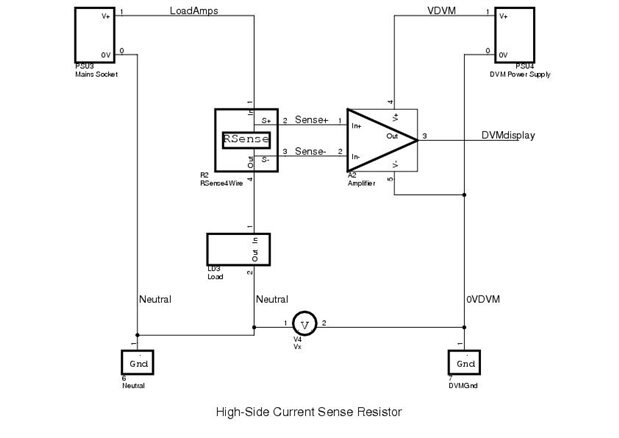
High-Side Current Shunt Test.


image


Figure 1. High-Side Current Sensing Test Circuit.


It is not very safe to use an open shunt on the bench, you must observe safe operation in the area of such tests.


For the test, PSU3 is a mains power socket operating at 240Vac 50Hz, RSense is a Murata 20A 50mV current shunt, Load LD3 is an oil filled radiator that takes about 5A on full power and the load circuit Gnd is mains Neutral. The Amplifier A2 is part of a DVM, which is a bench type, powered from the same mains strip as the load. The DVM must have an internal power supply and there is galvanic isolation between the black input socket of the DVM and Neutral. The current shunt has a 4-wire configuration and, for the first test, the DVM is connected directly to the sense terminals.

To measure the common mode voltage at the input to the DVM we use a second handheld meter, battery powered; we do not have access to 0VDVM so the measurement will be made to the black input test clip at IN- of the bench DVM.


imageimage


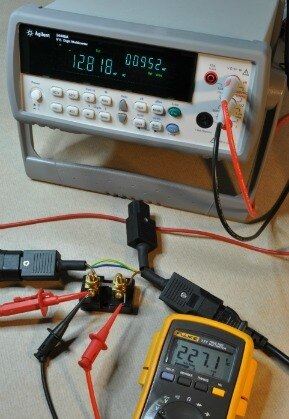
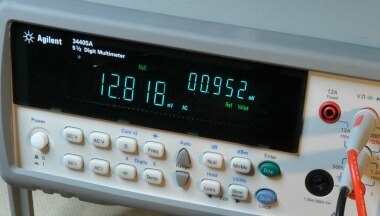
Figure 2. High-Side Measurement.

The results show that the bench DVM reads 12.818mV AC, which corresponds to a current of:

20A/50mV x 12.818mV = 5.13Aac.

The common mode voltage is 227.1Vac. (These ac results are of course rms).


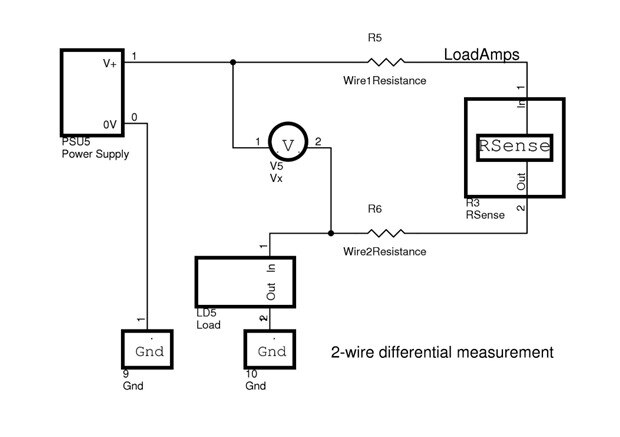
Typical 2-wire Connection.
 

image


Figure 3. A 2-wire High-Side Connection.

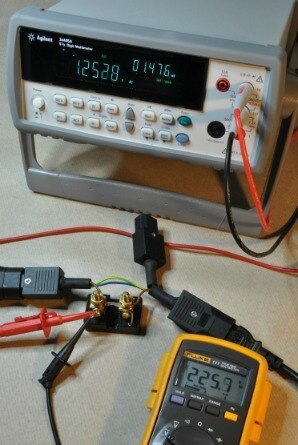
In our test, the red measurement clip was moved from the shunt sense terminal to the mains source on the socket strip. So we have added a potentially large value of Wire1Resistance to the shunt resistance RSense. The circuit passed through 3 metres of cable and 3 connectors that add contact resistance in series with the shunt.
 

  imageimage


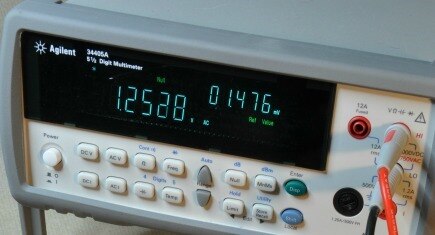
Figure 4. 2-wire measurement.

The current is still around 5A but the measurement is now 1.2528Vac, which corresponds to a current of:

20A/50mV x 1252.8mV = 501A … this a hundred times error!

The resistance RSense of the Murata shunt is 50mV/20A = 2.5mR.

But the resistance including Wire1Resistance is 1.2528/5.13A = 244mR. (we know 5.13A is flowing)

This is quite an extreme example but it does show the danger of using 2-wire measurements with a current sense resistor. If for some reason you have to use 2-wire measurement because you cannot afford to run the extra wires then you need to make the value of RSense >> than the Wire1Resistance (or Wire2Resistance if it is also significant.) For example, we could us a 2.5R resistor for RSense, then the wiring error is only 10% and we might accept that. There are other trade-offs, there will be power dissipation of 52X2.5 = 62.5W so we need to choose a component for RSense rated for say 100W on a heat-sink. Also there will be a volts drop of 12.5Vac at the load.


Common-mode voltage and isolation.


One final observation about common-mode voltage; at 227Vac, peak 321V it requires a special amplifier to withstand that at its inputs. You may search around and find the INA149 can withstand +/-275V on its inputs. That type of amplifier can be used if the input is limited to 275Vpeak. Alternatively an isolation amplifier allows the input stage to float to the voltage referenced on the IN- pin while the output operates at the supply 0V, which may be earthed. For example ACPL-C790 can withstand 1.2kV between inputs and outputs. The bench DVM almost certainly uses an isolation amplifier between the input and the mains supply. The hand-held DVM is battery operated and can float at the IN- potential of +/- 321V; the user is protected by the plastic case and the safety style sockets and test probes.


High-Side measurement requires consideration of the common-mode voltage, isolation and a carefully crafted solution – more on this later.


This blog will be available at: electronics know-how blog


Here are a few useful links to components at Farnell.

http://uk.farnell.com/avago-technologies/acpl-c790-000e/ic-amp-isolation-8soic/dp/1854250?ost=1854250

http://uk.farnell.com/texas-instruments/ina149aid/amp-diff-500khz-cmrr-275v-8soic/dp/2082428?ost=ina149&categoryId=700000004305

http://uk.farnell.com/murata-power-solutions/3020-01098-0/shunt-50mv-20a/dp/1339338

  • Sign in to reply

Top Comments

  • michaelkellett
    michaelkellett over 10 years ago +1
    I expect you know this but there is (usually) very little point in measuring AC mains current with a high side current sense resistor - much better (safer, cheaper) using a current transducer or a current…
  • jw0752
    jw0752 over 10 years ago +1
    Hi Peter, Thanks for the informative post. John
  • peterjcs23
    peterjcs23 over 10 years ago in reply to michaelkellett

    If you want a precision current measurement over a wide range in the high side or in a motor phase then a shunt and precision amp is the answer. Look inside a DVM or Power Analyser and you'll find a shunt. I used them in a test stand for aerospace motor drives as we needed precision over 4 switchable ranges of current.

    • Cancel
    • Vote Up 0 Vote Down
    • Sign in to reply
    • More
    • Cancel
  • peterjcs23
    peterjcs23 over 10 years ago in reply to jw0752

    Hi John, glad you liked it...Peter

    • Cancel
    • Vote Up 0 Vote Down
    • Sign in to reply
    • More
    • Cancel
  • jw0752
    jw0752 over 10 years ago

    Hi Peter,

    Thanks for the informative post.

    John

    • Cancel
    • Vote Up +1 Vote Down
    • Sign in to reply
    • More
    • Cancel
  • michaelkellett
    michaelkellett over 10 years ago

    I expect you know this but there is (usually) very little point in measuring AC mains current with a high side current sense resistor - much better (safer, cheaper) using  a current transducer or a current transformer.

    There are many DC cases when measuring high side current is necessary and at lower voltages  a series sense resistor and either a specialised high side current measuring chip or op amp with the required common mode range can be a good choice.


    MK

    • Cancel
    • Vote Up +1 Vote Down
    • Sign in to reply
    • More
    • Cancel
element14 Community

element14 is the first online community specifically for engineers. Connect with your peers and get expert answers to your questions.

  • Members
  • Learn
  • Technologies
  • Challenges & Projects
  • Products
  • Store
  • About Us
  • Feedback & Support
  • FAQs
  • Terms of Use
  • Privacy Policy
  • Legal and Copyright Notices
  • Sitemap
  • Cookies

An Avnet Company © 2025 Premier Farnell Limited. All Rights Reserved.

Premier Farnell Ltd, registered in England and Wales (no 00876412), registered office: Farnell House, Forge Lane, Leeds LS12 2NE.

ICP 备案号 10220084.

Follow element14

  • X
  • Facebook
  • linkedin
  • YouTube