element14 Community
element14 Community
    Register Log In
  • Site
  • Search
  • Log In Register
  • Community Hub
    Community Hub
    • What's New on element14
    • Feedback and Support
    • Benefits of Membership
    • Personal Blogs
    • Members Area
    • Achievement Levels
  • Learn
    Learn
    • Ask an Expert
    • eBooks
    • element14 presents
    • Learning Center
    • Tech Spotlight
    • STEM Academy
    • Webinars, Training and Events
    • Learning Groups
  • Technologies
    Technologies
    • 3D Printing
    • FPGA
    • Industrial Automation
    • Internet of Things
    • Power & Energy
    • Sensors
    • Technology Groups
  • Challenges & Projects
    Challenges & Projects
    • Design Challenges
    • element14 presents Projects
    • Project14
    • Arduino Projects
    • Raspberry Pi Projects
    • Project Groups
  • Products
    Products
    • Arduino
    • Avnet & Tria Boards Community
    • Dev Tools
    • Manufacturers
    • Multicomp Pro
    • Product Groups
    • Raspberry Pi
    • RoadTests & Reviews
  • About Us
    About the element14 Community
  • Store
    Store
    • Visit Your Store
    • Choose another store...
      • Europe
      •  Austria (German)
      •  Belgium (Dutch, French)
      •  Bulgaria (Bulgarian)
      •  Czech Republic (Czech)
      •  Denmark (Danish)
      •  Estonia (Estonian)
      •  Finland (Finnish)
      •  France (French)
      •  Germany (German)
      •  Hungary (Hungarian)
      •  Ireland
      •  Israel
      •  Italy (Italian)
      •  Latvia (Latvian)
      •  
      •  Lithuania (Lithuanian)
      •  Netherlands (Dutch)
      •  Norway (Norwegian)
      •  Poland (Polish)
      •  Portugal (Portuguese)
      •  Romania (Romanian)
      •  Russia (Russian)
      •  Slovakia (Slovak)
      •  Slovenia (Slovenian)
      •  Spain (Spanish)
      •  Sweden (Swedish)
      •  Switzerland(German, French)
      •  Turkey (Turkish)
      •  United Kingdom
      • Asia Pacific
      •  Australia
      •  China
      •  Hong Kong
      •  India
      •  Japan
      •  Korea (Korean)
      •  Malaysia
      •  New Zealand
      •  Philippines
      •  Singapore
      •  Taiwan
      •  Thailand (Thai)
      •  Vietnam
      • Americas
      •  Brazil (Portuguese)
      •  Canada
      •  Mexico (Spanish)
      •  United States
      Can't find the country/region you're looking for? Visit our export site or find a local distributor.
  • Translate
  • Profile
  • Settings
Personal Blogs
  • Community Hub
  • More
Personal Blogs
Legacy Personal Blogs Electronics in depth : Diodes
  • Blog
  • Documents
  • Mentions
  • Sub-Groups
  • Tags
  • More
  • Cancel
  • New
  • Share
  • More
  • Cancel
Group Actions
  • Group RSS
  • More
  • Cancel
Engagement
  • Author Author: matija.martinec
  • Date Created: 26 Dec 2014 10:36 PM Date Created
  • Views 1078 views
  • Likes 3 likes
  • Comments 4 comments
  • diode
  • p-type
  • n-type
  • pn-junction
  • diodes
  • electronics
  • basics
Related
Recommended

Electronics in depth : Diodes

matija.martinec
matija.martinec
26 Dec 2014

Diodes, you may not know it, but you use them every day. They can be found as full or half wave rectifiers to make AC current into DC for a ton of electronics.  (e.g. cellphone chargers, DC motors in mixers etc.)


For us to understand what diodes really are and how to use them we need to start from the very rock bottom of electronics which is, you guessed it (probably not if you are new to this) chemistry. But do not worry it is not that hard or complicated, we only have to go over basic types of semiconductor elements. That being said let's begin :


    Semiconductor - is a type of material that has both electrical conductivity of a conductor (e.g. copper) and a insulator(e.g. rubber)


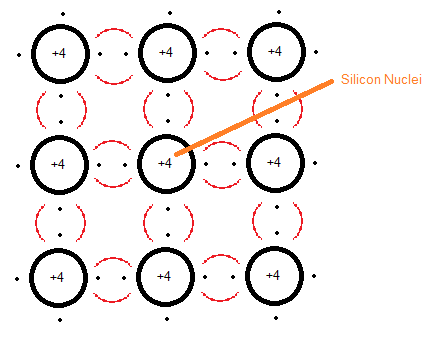
    In these examples we are going to use Silicon ( Si ), and in order to determine P and N type of silicone we need to look at its crystal structure of a pure/intrinsic silicon

          - At intrinsic silicon we can see that each silicon atom has 4 valence electrons (electrons on the most outer shell) which are connected via covalent bond with their neighboured atom
image


    Adding impurities (other elements) we can alter the type  :

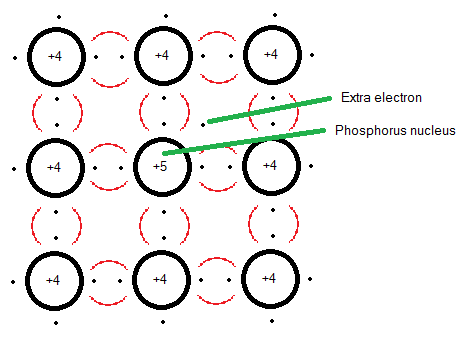
    • N - Type - We get N-Type silicon when we add Phosphorus, because it has 5 valence electrons which makes 1 of them an extra electron. Because of that extra electron electricity can be conducted trough the crystalline structure via electrons as they move throughout the structure. We say that major carriers of electricity are electrons.The N-type name came to be because electrons represent negative charge. (N stands for negative)
image

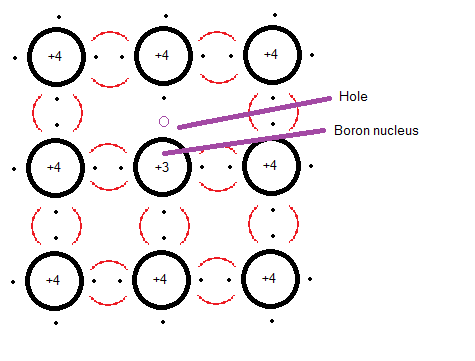
    • P - Type - We get P-Type silicon when we add Boron, because it has 3 valence electrons which makes a hole which breaks one of the covalent bonds . Because of that hole electricity can be conducted trough the crystalline structure via holes as electrons from neighboured atoms replace the hole and make a hole in an that atom. We say that major carriers of electricity are holes.The P-type name came to be because holes represent positive charge. (P stands for positive)
image

Now that we know this we can start talking about diodes.

Diodes essentially are  two-terminal components with a P-N junction. Now you can see why we needed to learn this. Essentially that P-N junction makes two fields; one with minimal resistance(ideally zero) and one with high resistance(ideally infinite).


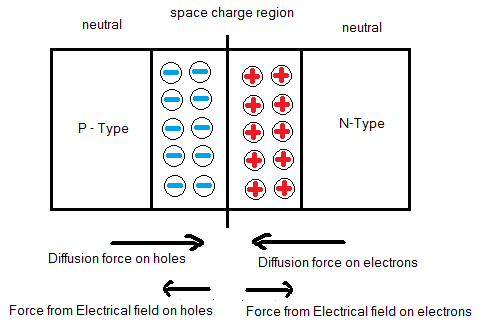
Now we are going to take a look at how this P-N junction is made :
image

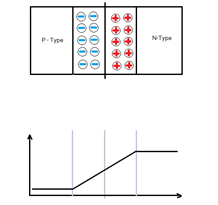
    In this picture you can see that there is a metallurgical limit, which means that P and N type are not mixing, but why is that?

          Well, negative charge and positive charge will start to mix and equal out (concentration of boron and phosphorus isn't equal), as they are doing that they are crossing the          metallurgical limit. The consequence of that is forming of space charge region. Space charge region around the metallurgical limit is called the P-N Barrier, because it is not          allowing major carriers of electricity to pass trough it.


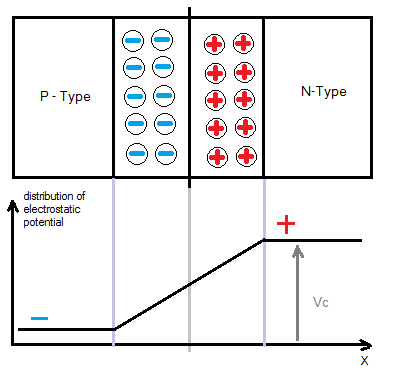
          In order to pass trough the P-N barrier major carriers of electricity need to overcome the contact potential (lets call it Vc) of the barrier.
          image

              This contact potential is actually the voltage you need to get to the diode so it can conduct electricity.

Now we can talk about polarization of diodes. We have 3 base polarizations :

    • No voltage

image

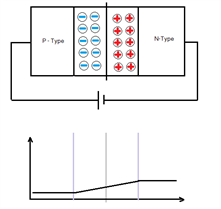
    • Normal polarization - positive end of a battery is connected to the P type and the negative side is connected to the N type
image

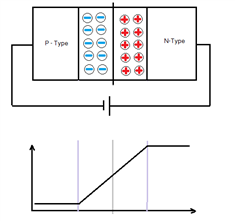
    • Reverse polarization - positive end of a battery is connected to the N type and the negative side is connected to the P type
image

This essentially shows that if you connect the diode in wrong order you will get a some kind of a wall that doesn't let electricity to flow trough.

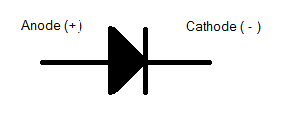
A symbol for a diode is this :
image

Positive end of a diode (P-type in P-N junction) is called an Anode and a negative end of a diode (N-type in P-N junction) is called an Cathode

So if you connect positive end of a battery/power to the anode and a negative/ground to the cathode electricity will flow trough it just like trough a normal conductor (with an additional voltage drop), but if we reverse polarize it so that the anode is connected to the ground and the cathode to the positive end, electricity would not flow trough because the contact potential would be enormous (much bigger than the voltage). In datasheets that is called maximum reverse voltage commonly called VR.


So that is all we need to know about diodes in terms of how are they made and how do they work, if you liked this post like it and come back every week or two where i will be posting a lot more posts like these.


Let me know in the comments if you liked it, if not why, and next i would like to do Rectifiers (sequel to diodes) or a post about transistors.


Until then bye,

      Matija Martinec

  • Sign in to reply

Top Comments

  • D_Hersey
    D_Hersey over 11 years ago +1
    How do you model a shottky diode? What about the photons?
  • jw0752
    jw0752 over 11 years ago +1
    Hi Matija, Thanks for the nice post about diodes. I thought it was very well done and I enjoyed reading it. John
  • matija.martinec
    matija.martinec over 11 years ago in reply to jw0752

    Thank you a lot John, positive feedback is always nice image. I didn't know how people would like it since it is my first post.

    Matija

    • Cancel
    • Vote Up 0 Vote Down
    • Sign in to reply
    • More
    • Cancel
  • jw0752
    jw0752 over 11 years ago

    Hi Matija,  Thanks for the nice post about diodes. I thought it was very well done and I enjoyed reading it.

    John

    • Cancel
    • Vote Up +1 Vote Down
    • Sign in to reply
    • More
    • Cancel
  • matija.martinec
    matija.martinec over 11 years ago in reply to D_Hersey

    This is just the bare bones of the diode, I did not tackle the types of diodes only their principal of work, but thank you for this comment I will consider doing another post if you want about all types of diodes and more in depth stuff.


    Matija Martinec

    • Cancel
    • Vote Up 0 Vote Down
    • Sign in to reply
    • More
    • Cancel
  • D_Hersey
    D_Hersey over 11 years ago

    How do you model a shottky diode?  What about the photons?

    • Cancel
    • Vote Up +1 Vote Down
    • Sign in to reply
    • More
    • Cancel
element14 Community

element14 is the first online community specifically for engineers. Connect with your peers and get expert answers to your questions.

  • Members
  • Learn
  • Technologies
  • Challenges & Projects
  • Products
  • Store
  • About Us
  • Feedback & Support
  • FAQs
  • Terms of Use
  • Privacy Policy
  • Legal and Copyright Notices
  • Sitemap
  • Cookies

An Avnet Company © 2026 Premier Farnell Limited. All Rights Reserved.

Premier Farnell Ltd, registered in England and Wales (no 00876412), registered office: Farnell House, Forge Lane, Leeds LS12 2NE.

ICP 备案号 10220084.

Follow element14

  • X
  • Facebook
  • linkedin
  • YouTube