


This is a continuation of trying to solve the inaccurate insulation resistance measurements observed on the Keysight U1461AU1461A whilst testing a generator rotor winding Following on from the tests carried out in the two previous blogs Keysight made some hardware modifications to a unit and sent it over to carry out tests alongside my original unit
Blog #1 - Original fault observations
Blog #2 - Second set of tests using current output mode
The modified unit supplied by Keysight was tested against both the original unit and the Megger MIT420/2MIT420/2 Initially DAR tests were carried out at various voltages and then some PI tests were carried out at 250V and 500V
The modifications carried out by Keysight were purely hardware in nature, with a low pass filter being added into the measurement circuit. I checked the firmware version of the meter they supplied and it was exactly the same as the firmware only original meter.
The first test was carried out with the Megger and this showed insulation resistance values down to 100MOhm, which was a further degradation from when the second set of tests were carried out. This was tracked down to the cardboard gasket material I placed to keep the rotor winding straps from touching the rotating diode pack or parts of the forging. It would appear that over time, moisture has worked its way into the cardboard and made it reduced its insulation properties. Once the cardboard was removed, the insulation resistance of the rotor increased up to 1GOhm and above.
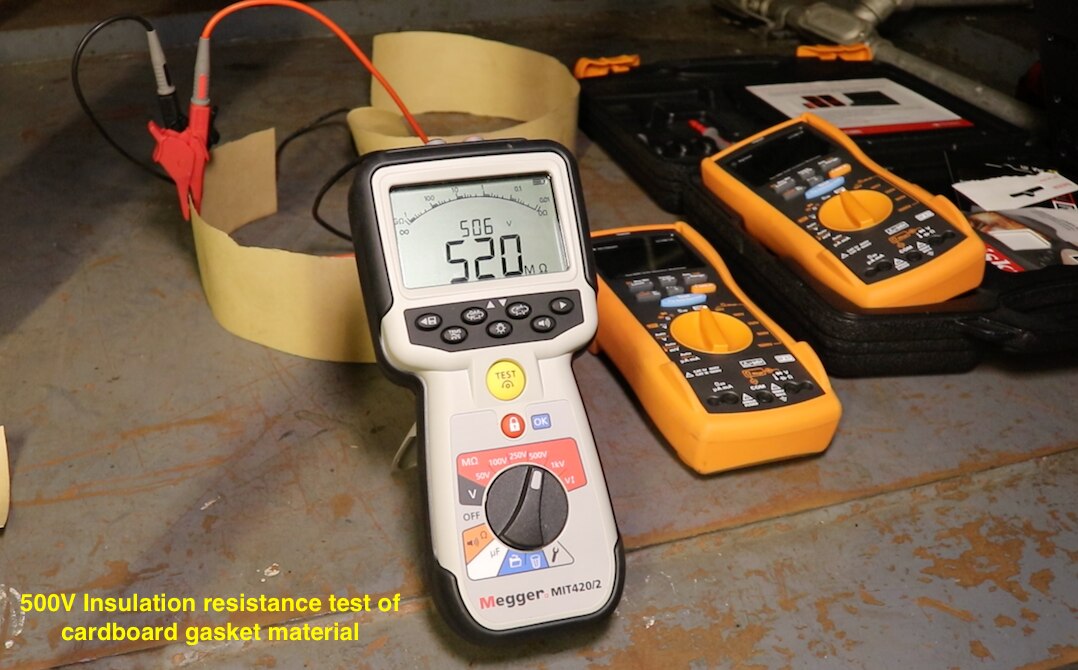
The test above shows a resistance of 520MOhm across one test point of the gasket material. The problem is that the material touches the forging and winding straps in multiple places, effectively giving multiple 520MOhm resistances in parallel, that ultimately lead to the perceived low readings of the winding.
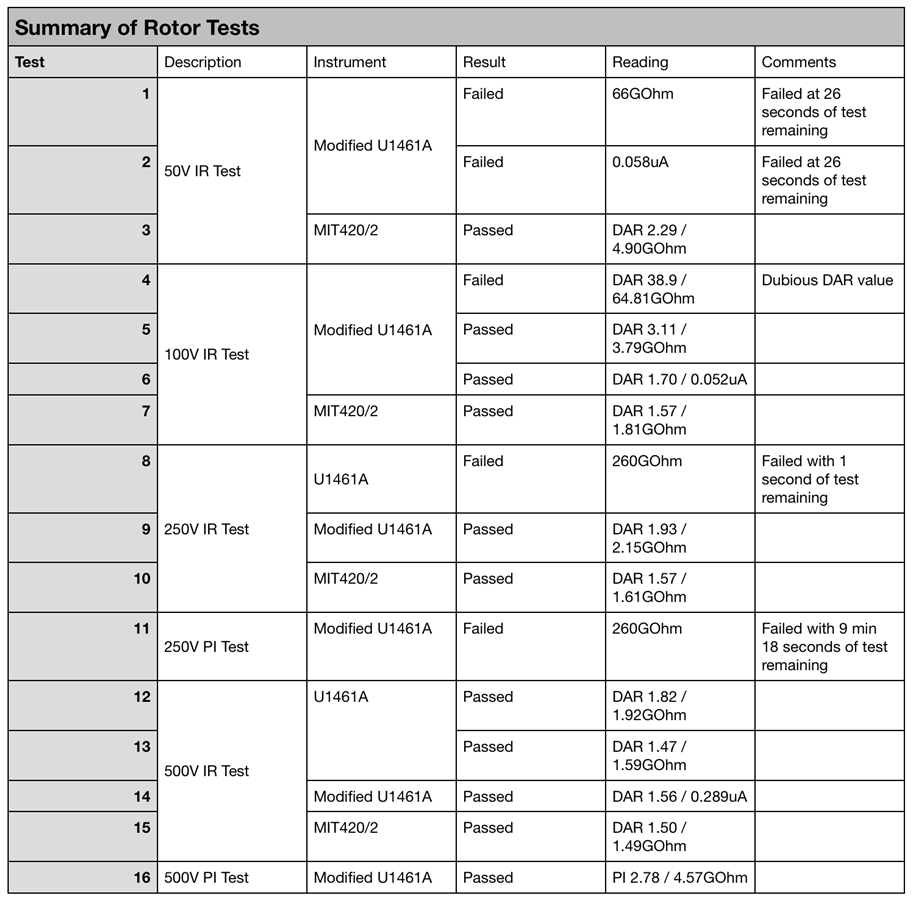
Overall 16 tests were carried out four with the Megger unit two with the original U1461AU1461A unit and six with the modified U1461AU1461A unit As before the Megger unit performed flawlessly and gave consistent readings across of all of its tests
At 50V test voltage, the modified unit would not function on any of the tests and failed with an error message. The Megger unit however, successfully recorded a DAR value at this voltage.
At 100V, erratic readings were again observed. The initial test produced a DAR value of 38, in reality a DAR value should never be above 2.5, but the calculation is based upon the values recorded by the instrument at 1 minute and 30 seconds. At the end of the first test the reading jumped up to 64GOhm to give the false DAR values. During two subsequent tests, the final IR values were more reasonable and better DAR values were calculated. This is a marked improvement from the original unit, but obviously not a full resolution. The video below, shows the start of the testing and the issue with the gasket material along with the 100V DAR test. The DAR test section is split to show the Megger insulation tester operating alongside the modified Keysight unit, the more stable behaviour of the Megger is clearly evident.
The original U1461AU1461A produced acceptable results for 500V tests but not for 250V The modified unit performed better than the original as it gave consistent results at 250V The video below is of the 250V DAR tests using the modified unit and in the inset is the original unit carrying out the same test on the same day You can see much more erratic behaviour on the original meter indicating that the modification carried out by Keysight has improved the stability of the unit
With the modified Keysight unit showing more consistency, it was decided to try some 10 minute PI tests. At 500V, the modified unit gave a successful PI reading of 2.78 which is comparable to previous PI tests carried out on the rotor. At 250V though, the unit failed with an error after around 40 seconds.
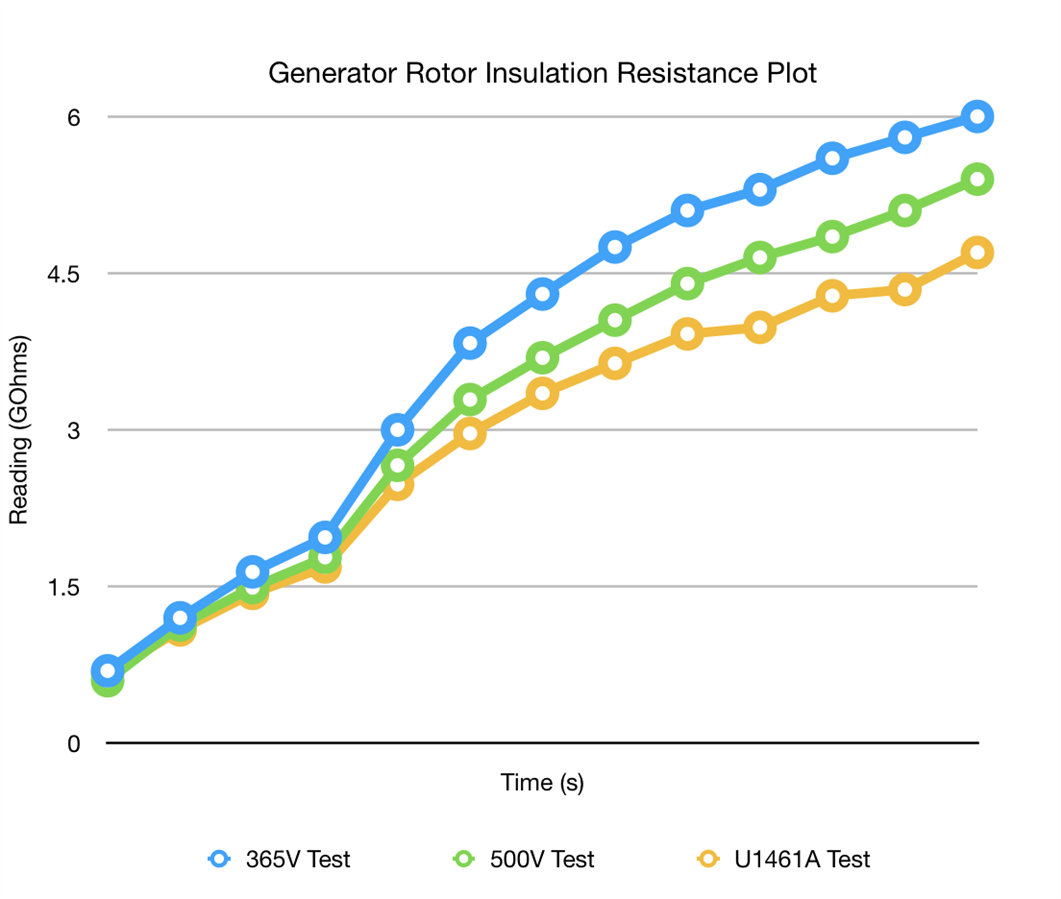
The plot shows the successful PI test at 500V compared to a PI test using the Megger unit at 365V and 500V.
I am not sure how or if any further testing will be done to try and resolve the issue Over the next few weeks I may try and get hold of some other insulation testers to see if the fault is peculiar to Keysight instruments or if other manufacturer's instruments suffer from the same issue One instrument that may be good to get hold of would be a U1452AU1452A which is the insulation tester from Keysight without the multimeter functions added If this tests good then it may provide some further insight into what may be the cause of the erratic behaviour
Keysight have been very helpful in trying to resolve the issue I am having and I would like to take this opportunity in thanking for their support and efforts.
Top Comments
-

genebren
-
Cancel
-
Vote Up
+1
Vote Down
-
-
Sign in to reply
-
More
-
Cancel
-

three-phase
in reply to genebren
-
Cancel
-
Vote Up
0
Vote Down
-
-
Sign in to reply
-
More
-
Cancel
Comment-

three-phase
in reply to genebren
-
Cancel
-
Vote Up
0
Vote Down
-
-
Sign in to reply
-
More
-
Cancel
Children