element14 Community
element14 Community
    Register Log In
  • Site
  • Search
  • Log In Register
  • Community Hub
    Community Hub
    • What's New on element14
    • Feedback and Support
    • Benefits of Membership
    • Personal Blogs
    • Members Area
    • Achievement Levels
  • Learn
    Learn
    • Ask an Expert
    • eBooks
    • element14 presents
    • Learning Center
    • Tech Spotlight
    • STEM Academy
    • Webinars, Training and Events
    • Learning Groups
  • Technologies
    Technologies
    • 3D Printing
    • FPGA
    • Industrial Automation
    • Internet of Things
    • Power & Energy
    • Sensors
    • Technology Groups
  • Challenges & Projects
    Challenges & Projects
    • Design Challenges
    • element14 presents Projects
    • Project14
    • Arduino Projects
    • Raspberry Pi Projects
    • Project Groups
  • Products
    Products
    • Arduino
    • Avnet & Tria Boards Community
    • Dev Tools
    • Manufacturers
    • Multicomp Pro
    • Product Groups
    • Raspberry Pi
    • RoadTests & Reviews
  • About Us
    About the element14 Community
  • Store
    Store
    • Visit Your Store
    • Choose another store...
      • Europe
      •  Austria (German)
      •  Belgium (Dutch, French)
      •  Bulgaria (Bulgarian)
      •  Czech Republic (Czech)
      •  Denmark (Danish)
      •  Estonia (Estonian)
      •  Finland (Finnish)
      •  France (French)
      •  Germany (German)
      •  Hungary (Hungarian)
      •  Ireland
      •  Israel
      •  Italy (Italian)
      •  Latvia (Latvian)
      •  
      •  Lithuania (Lithuanian)
      •  Netherlands (Dutch)
      •  Norway (Norwegian)
      •  Poland (Polish)
      •  Portugal (Portuguese)
      •  Romania (Romanian)
      •  Russia (Russian)
      •  Slovakia (Slovak)
      •  Slovenia (Slovenian)
      •  Spain (Spanish)
      •  Sweden (Swedish)
      •  Switzerland(German, French)
      •  Turkey (Turkish)
      •  United Kingdom
      • Asia Pacific
      •  Australia
      •  China
      •  Hong Kong
      •  India
      •  Japan
      •  Korea (Korean)
      •  Malaysia
      •  New Zealand
      •  Philippines
      •  Singapore
      •  Taiwan
      •  Thailand (Thai)
      •  Vietnam
      • Americas
      •  Brazil (Portuguese)
      •  Canada
      •  Mexico (Spanish)
      •  United States
      Can't find the country/region you're looking for? Visit our export site or find a local distributor.
  • Translate
  • Profile
  • Settings
Personal Blogs
  • Community Hub
  • More
Personal Blogs
Legacy Personal Blogs Let's try this again
  • Blog
  • Documents
  • Mentions
  • Sub-Groups
  • Tags
  • More
  • Cancel
  • New
  • Share
  • More
  • Cancel
Group Actions
  • Group RSS
  • More
  • Cancel
Engagement
  • Author Author: sasquatch84
  • Date Created: 31 Aug 2017 4:57 AM Date Created
  • Views 1158 views
  • Likes 3 likes
  • Comments 7 comments
Related
Recommended

Let's try this again

sasquatch84
sasquatch84
31 Aug 2017

image

Ok, so I grabbed another Nano and got it all wired up like the last one.  I soldered a diode directly onto the solenoid valve contacts.  Maybe I should have just put it on the circuit board?  Anyone think I should?  Let me know. 

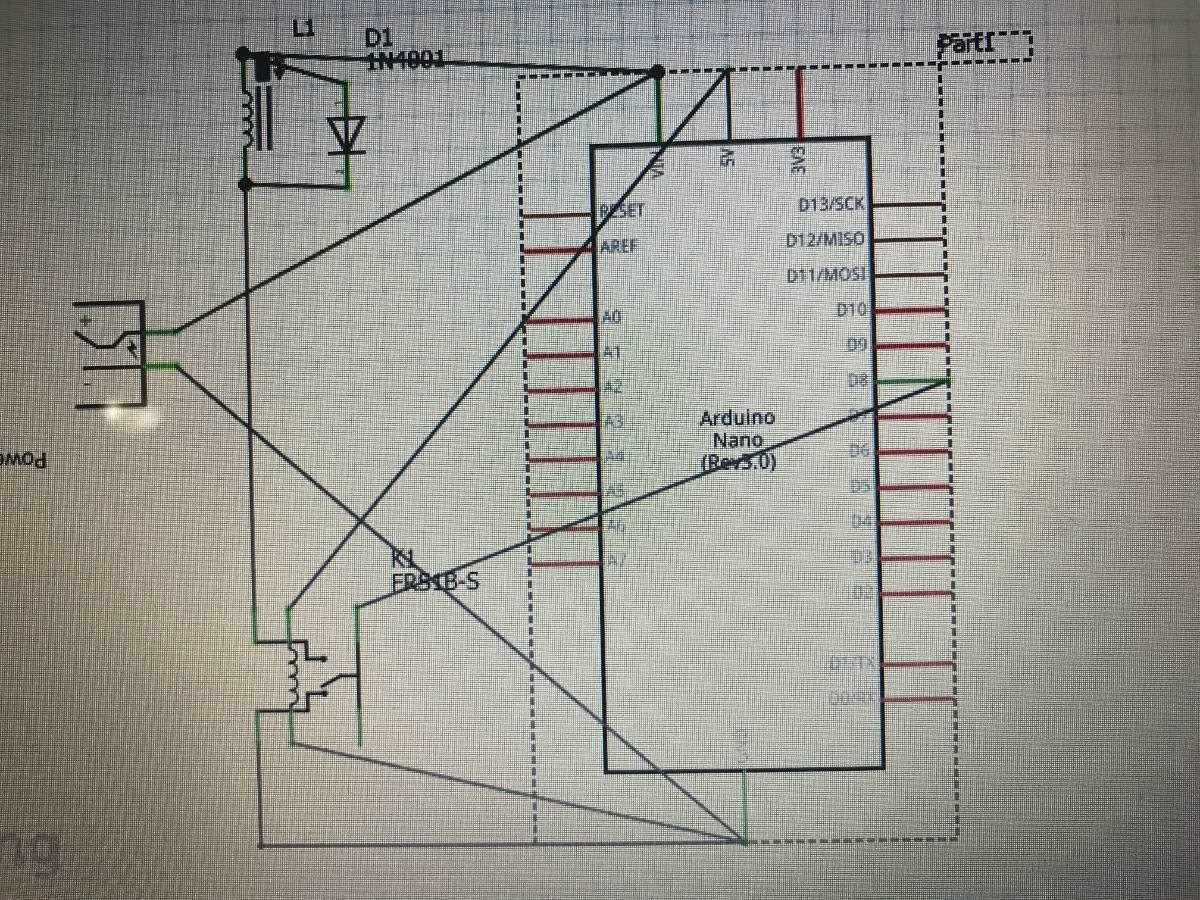
Also, I tried my hand at making a schematic.  Let me know if this makes sense.
image

I'm not plugging anything in until I get at least a little feedback on here. (gulp!)

  • Sign in to reply

Top Comments

  • jw0752
    jw0752 over 8 years ago +3
    Continuing: The diode soldered to the solenoid is actually a good idea as it deals with the counter EMF right where is occurs. Here is an example of part of your schematic. My schematic assumes that the…
  • beacon_dave
    beacon_dave over 8 years ago in reply to jw0752 +3
    Perhaps one downside to soldering the diode directly to the solenoid though is that if someone (especially a third party) has to replace the valve at a later point in time, then they may not realise that…
  • jw0752
    jw0752 over 8 years ago in reply to sasquatch84 +3
    Thank you to gecoz for stepping in with some great advice. I am 2 hours later that Clinton and I got tired and went to bed before we could finish last night. If you really don't like heat get one of these…
Parents
  • jw0752
    jw0752 over 8 years ago

    Continuing: The diode soldered to the solenoid is actually a good idea as it deals with the counter EMF right where is occurs. Here is an example of part of your schematic. My schematic assumes that the output of the Arduino can handle the current demands of the relay (it probably can't) and that the Arduino will output a HIGH to energize the relay. I remember that you have a relay board which probably will take care of drawing a very small current from the Arduino and use the main power to the relay board to actually energize the relay coil. I have also shown a diode for the relay coil but the relay board that you have is a commercial product and they would have built in diodes to protect their own design so you probably do not need to worry about this. You can use the diode on the solenoid as it is soldered just switch the polarity of your hookup wires so that the plus wire goes to the banded end of the diode. To enlarge my schematic or any picture in these postings just click on it.


    image


    John

    • Cancel
    • Vote Up +3 Vote Down
    • Sign in to reply
    • More
    • Cancel
  • sasquatch84
    sasquatch84 over 8 years ago in reply to jw0752

    Awesome!  Yeah, I wasn't sure which way was which when making the schematic, but in reality I knew the striped side of the diode was supposed to go in the positive side to make it reversed like you said to.  I looked into all that stuff today and I really learned a lot.  Thanks for all the help so far.

    I never tried the solenoid valve yet, but when I plugged in the arduino to my computer it was really heating up A LOT so I decided to go with one of my very first ideas and put in a 7805 circuit to run the vcc for the relay and attach it to the 5v pin on the Nano.  I just hate heat. 

    Does this seem right or should I just use the 7805 to power the relay and then just use the regular 12volt for the Nano?

    Also, I have the negative side for the Solenoid valve running through the relay, not the positive side.  Does this matter at all?

    • Cancel
    • Vote Up 0 Vote Down
    • Sign in to reply
    • More
    • Cancel
  • gecoz
    gecoz over 8 years ago in reply to sasquatch84

    Hi Clinton,

    Arduino over-heating is due to the power dissipated by the internal voltage regulator. Some of the heat comes from stepping down from 12v to 5v and the rest from excessive current requested by the Arduino board itself and for driving its output pins (powering the relay from the 5V pin, for instance). In addition, if you have appreciable ripple on your 12V power supply, the excess voltage would put even more strain on the Arduino internal regulator. Considering you have quite an inductive load attached to this supply (your solenoid and the relay), even with the flyback diodes, I would too decouple Arduino from the 12V line. Your choice of using a 7805 to step down the 12V line and power both the Arduino 5V pin and the relay is fine, as the 7805 can provide enough current to satisfy the needs of both. But if you got another spare 7805 lying around, and want to be a little overzealous in eliminating risk (like I am image), you could go a step further and use it to power the relay using a separate line coming from the 12V supply rather than using the 5V pin of the Nano. For the solenoid connection to the relay, it doesn't really matter as they are connected in series (just make sure the rest of the connections follow the choice you made).

    • Cancel
    • Vote Up +2 Vote Down
    • Sign in to reply
    • More
    • Cancel
Comment
  • gecoz
    gecoz over 8 years ago in reply to sasquatch84

    Hi Clinton,

    Arduino over-heating is due to the power dissipated by the internal voltage regulator. Some of the heat comes from stepping down from 12v to 5v and the rest from excessive current requested by the Arduino board itself and for driving its output pins (powering the relay from the 5V pin, for instance). In addition, if you have appreciable ripple on your 12V power supply, the excess voltage would put even more strain on the Arduino internal regulator. Considering you have quite an inductive load attached to this supply (your solenoid and the relay), even with the flyback diodes, I would too decouple Arduino from the 12V line. Your choice of using a 7805 to step down the 12V line and power both the Arduino 5V pin and the relay is fine, as the 7805 can provide enough current to satisfy the needs of both. But if you got another spare 7805 lying around, and want to be a little overzealous in eliminating risk (like I am image), you could go a step further and use it to power the relay using a separate line coming from the 12V supply rather than using the 5V pin of the Nano. For the solenoid connection to the relay, it doesn't really matter as they are connected in series (just make sure the rest of the connections follow the choice you made).

    • Cancel
    • Vote Up +2 Vote Down
    • Sign in to reply
    • More
    • Cancel
Children
No Data
element14 Community

element14 is the first online community specifically for engineers. Connect with your peers and get expert answers to your questions.

  • Members
  • Learn
  • Technologies
  • Challenges & Projects
  • Products
  • Store
  • About Us
  • Feedback & Support
  • FAQs
  • Terms of Use
  • Privacy Policy
  • Legal and Copyright Notices
  • Sitemap
  • Cookies

An Avnet Company © 2026 Premier Farnell Limited. All Rights Reserved.

Premier Farnell Ltd, registered in England and Wales (no 00876412), registered office: Farnell House, Forge Lane, Leeds LS12 2NE.

ICP 备案号 10220084.

Follow element14

  • X
  • Facebook
  • linkedin
  • YouTube