


Before getting into the project build, I thought it would be useful to show how a secondary injection test set (SCITS) is put to use, to give a better idea of the timing requirements.
The SCITS utilised is a single phase Megger SMRT1 unit and the relay tested is a basic electromechanical relay from Alstom for providing restricted earth fault protection to a transformer secondary winding. The relay consists of a single phase current input and two normally open trip contacts that connect into the switchgear via rear terminals. The current input is fed into a tapping transformer to allow the pickup level to be changed via the plug setting at the front of the relay. A low pass filter is then built into the relay to protect against false trips from harmonics, before the current if finally fed to the relay coil. For trip indication, the relay is fitted with a drop down flag.
When connected into the panel, the current input is fed via a burden resistor, 47 Ohms for this relay, this changes the sensitivity of the relay and forms part of the detection circuit. These burden resistors can create problems when testing the relays, but for the purposes of this demonstration the relay is being tested out of the panel without the resistor.

To test this relay, current must be injected through the rear terminals until the relay operates. This will be ramped up at a steady rate to ensure that the relay has time to operate before the next current step is applied. This particular relay has a current pickup of 0.5 to 2A and for the purposes of this test, it will be set to 0.75A.
Following on from these tests, the operating time of the relay is tested by applying multiples of the pickup current to the relay. The multiples used are at the discretion of the test engineer and sometimes the limitation of the test apparatus. For this test I will use 2x, 3x, 5x and 10x the pickup of 0.75A.

The manufacturer of the relay will provide specifications for the operation of the relay. Pickup currents are usually given as a +/- tolerance, for this particular relay it is -0% to +10%. Tripping times are usually given on a curve at multiples of current. Some software packages can trace these curves and regenerate them within the package to allow for automatic test point selection. However, I do not have that facility with the Megger package, so I read them off and enter them manually into the settings in the test form.
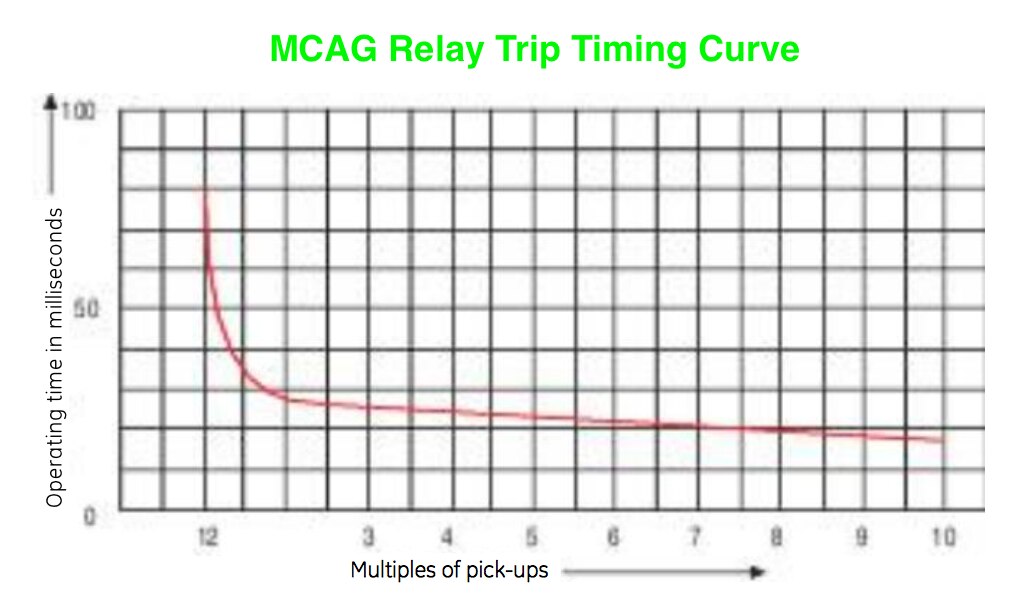
From the curve above, I can read off that at 5x the pickup, the trip time should be around 23ms and at 10x the pickup it should be around 18ms. This calls for accurate test apparatus as deviation of the test current injected will have an equal effect on the result as a poor timing function would.
For this type of relay, the wiring is the same for both the pickup current test and the timing tests, but a different aspect of the software is utilised.


For the pickup current a ramp test is utilised where the start and stop points of the ramp are entered along with a step increase value and step interval time. For this particular relay, the pickup setting plug is set to 0.75A and the manufacturer specifies a tolerance of 0% to +10%. Therefore the ramp was set by the software automatically to start at 0.575A to 0.925A based on the data entered for the relay.
As there is no model for this particular relay within the software package, the timing points are chosen manually within the timing test window. The software will then plot these points onto the graph along with the minimum and maximum times expected. The video below lasts 1 minute 30 seconds and briefly covers the pickup and timing tests.
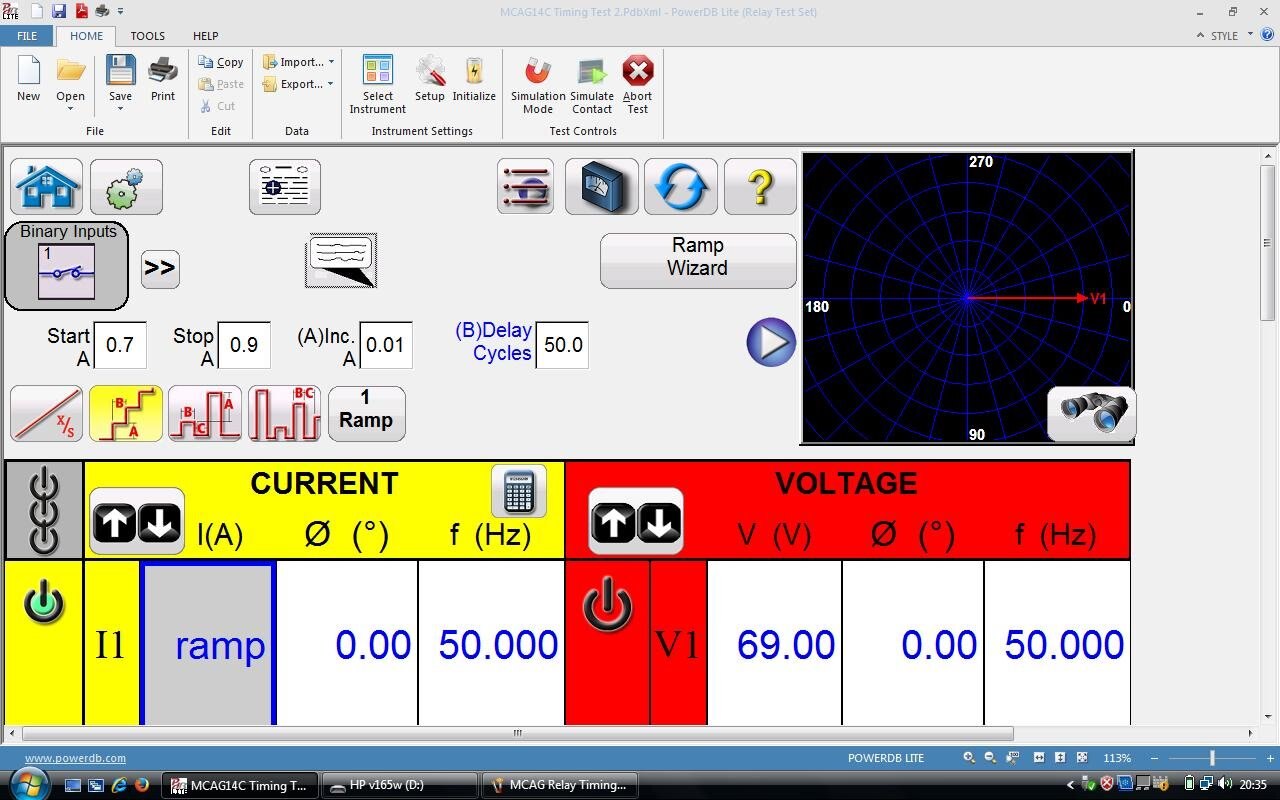
The screen shot below is of the manual set up for the pickup current test. I have selected a step ramp test, set to start at 0.7A and stop at 0.9A with a 0.01A step increase every second (50 cycles). This test would then be initiated by the 'play' button and would run until the relay trips and stops the test or the stop current is reached, whichever comes first.
Below is the test and results screen for the timing tests. The timing points are entered as multiples of pickup current. As this test is manual, the minimum and maximum permissible times are entered into the columns during the set up. The software then selects the current to inject, identified in the second column, and records the time after each test in the final column. You can see that the resolution on the timing results is 1ms.

The results will be saved to a report module built into the software that can be printed out to provide a record of the inspection and test of the relay.
This is a basic overview of the operation of the test set using a basic electro-mechanical relay. If people are interested in seeing more operation of the test set and how it is set up then let me know in the comments and I will test some more relays after I have finished the build of the timing box.
Top Comments