


Sports of yester year were dominated by the hard men and women who lived by the motto, “No pain, No gain”. The athlete of today has technologically evolved into something all together different. That is not to say that being an elite athlete does not come with its share of pain. Rather, it is the fact that pain vs. gain is now measured, managed, and strictly controlled thanks to electronic sensors and computer devices. 
Twenty years ago a cyclist trained based on perceived effort and based on how one felt, to determine training protocols. Then, electronic advancements gave us the personal heart rate monitor allowing one to see and record how fast their heart was working as it responded to a performed action or exertion of energy. The introduction of the heart rate monitor turned the world of training and racing on its head. Suddenly, thanks to technology we had the ability to measure not only one’s pain (exertion) but we could also measure the gains that were being obtained through periods of training. This small device revolutionized training approaches and ultimately changed the physiological and mental make up of today’s top riders.

Most recently, the cycling industry was introduced to the power meter. Utilizing an array of sensors, it is now possible to view and record the actual work being done to the pedals at any moment. Consequently, I can now know exactly how I distribute power over a given time period, allowing my abilities to be evaluated and modified through training much like a design engineer tests and tweaks engine components of a new sports car.

As a cyclist my training is developed, evaluated and modified based on the information collected by my bikes on board computer. My computer system, known as a PowerTap (shown right), collects data for mileage traveled, max/avg/current speed, kilo joules (energy burned), pedal rpms, max/avg/current heart rate, and (most importantly to me) max/avg/current watts or power. This data can then be transferred to a computer where graphs and tables are generated, exploring each moment of my scheduled workout and providing a critical evaluation of the pains and gains achieved.
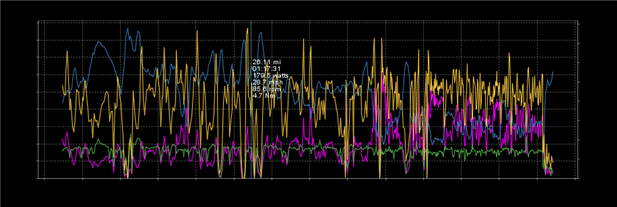
1 Typical Training Data Graphical Representation
Technology and cycling does not end there:
- Personal coaches can be 1000’s of miles away from their athletes and still evaluate training data daily thanks to computers and the internet.
- A bikes geometry and overall setup can now be evaluated by high speed cameras and laser beams providing data that will allow a riders position to be reconstructed by computer models that evaluate biomechanical deficiencies and/or diagnose injuries.
- Even shifting gears, which until the last year was accomplished by manually rotating a lever that then pulled cable, can now be accomplished by electronic signals sent to electronic derailleurs by the tap of a finger.
No pain, no gain, is alive and well in the world of sports. Just ask me some time as I am doubled over staring at the bottom of a trash can after a sprint work out. I will tell you that my suffering is a result of my coach’s knowledge of my strengths and weaknesses as an athlete. He knows which pain will lead to the greatest gains, and unfortunately he now knows just how much pain I can tolerate…thanks technology.
