element14 Community
element14 Community
    Register Log In
  • Site
  • Search
  • Log In Register
  • Community Hub
    Community Hub
    • What's New on element14
    • Feedback and Support
    • Benefits of Membership
    • Personal Blogs
    • Members Area
    • Achievement Levels
  • Learn
    Learn
    • Ask an Expert
    • eBooks
    • element14 presents
    • Learning Center
    • Tech Spotlight
    • STEM Academy
    • Webinars, Training and Events
    • Learning Groups
  • Technologies
    Technologies
    • 3D Printing
    • FPGA
    • Industrial Automation
    • Internet of Things
    • Power & Energy
    • Sensors
    • Technology Groups
  • Challenges & Projects
    Challenges & Projects
    • Design Challenges
    • element14 presents Projects
    • Project14
    • Arduino Projects
    • Raspberry Pi Projects
    • Project Groups
  • Products
    Products
    • Arduino
    • Avnet & Tria Boards Community
    • Dev Tools
    • Manufacturers
    • Multicomp Pro
    • Product Groups
    • Raspberry Pi
    • RoadTests & Reviews
  • About Us
    About the element14 Community
  • Store
    Store
    • Visit Your Store
    • Choose another store...
      • Europe
      •  Austria (German)
      •  Belgium (Dutch, French)
      •  Bulgaria (Bulgarian)
      •  Czech Republic (Czech)
      •  Denmark (Danish)
      •  Estonia (Estonian)
      •  Finland (Finnish)
      •  France (French)
      •  Germany (German)
      •  Hungary (Hungarian)
      •  Ireland
      •  Israel
      •  Italy (Italian)
      •  Latvia (Latvian)
      •  
      •  Lithuania (Lithuanian)
      •  Netherlands (Dutch)
      •  Norway (Norwegian)
      •  Poland (Polish)
      •  Portugal (Portuguese)
      •  Romania (Romanian)
      •  Russia (Russian)
      •  Slovakia (Slovak)
      •  Slovenia (Slovenian)
      •  Spain (Spanish)
      •  Sweden (Swedish)
      •  Switzerland(German, French)
      •  Turkey (Turkish)
      •  United Kingdom
      • Asia Pacific
      •  Australia
      •  China
      •  Hong Kong
      •  India
      •  Japan
      •  Korea (Korean)
      •  Malaysia
      •  New Zealand
      •  Philippines
      •  Singapore
      •  Taiwan
      •  Thailand (Thai)
      •  Vietnam
      • Americas
      •  Brazil (Portuguese)
      •  Canada
      •  Mexico (Spanish)
      •  United States
      Can't find the country/region you're looking for? Visit our export site or find a local distributor.
  • Translate
  • Profile
  • Settings
Personal Blogs
  • Community Hub
  • More
Personal Blogs
Legacy Personal Blogs The Gold of the Fool and the Whiskers of the Cat
  • Blog
  • Documents
  • Mentions
  • Sub-Groups
  • Tags
  • More
  • Cancel
  • New
  • Share
  • More
  • Cancel
Group Actions
  • Group RSS
  • More
  • Cancel
Engagement
  • Author Author: jc2048
  • Date Created: 13 Jun 2017 1:53 PM Date Created
  • Views 2564 views
  • Likes 12 likes
  • Comments 17 comments
Related
Recommended

The Gold of the Fool and the Whiskers of the Cat

jc2048
jc2048
13 Jun 2017

Back in February, I visited one of the small museums that exist in the town where I

live. It's a natural history museum and is based in an old church. It's a lovely

place to visit, with lots of curious things to look at. In the shop, on the way out,

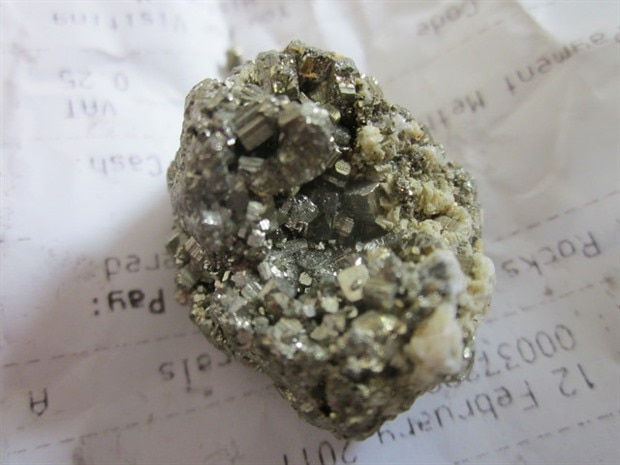
there was a basket with small chunks of rocks and minerals for sale and I bought a

small piece of 'fool's gold' (iron pyrites); I figured that an old fool like me

deserved a piece of gold to treasure.
 

image


What I didn't know back then and have only just discovered is that iron pyrites is

a semiconductor (thank you, Wikipedia!) and in the old days was sometimes used as

the 'crystal' in a point-contact diode (for demodulating radio signals in a crystal

set).


Well, I thought, that deserves an experiment. So here is my attempt to make a

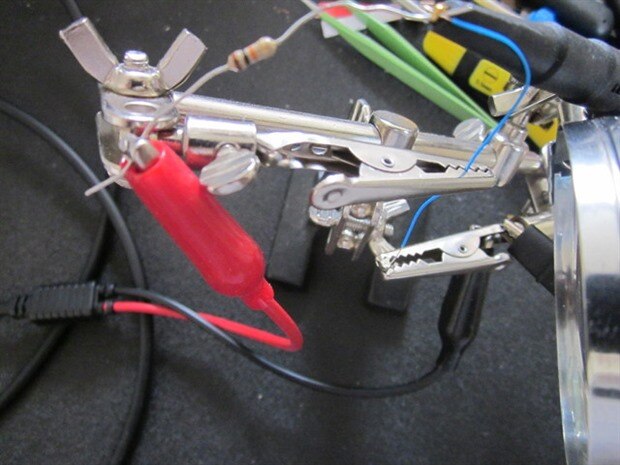
point-contact diode, and it turned out to be surprisingly easy. I simply broke one

of the small cubes away and held it in one clip of a 'helping hand' contraption.
 

image


That clip I connected to the ground of a signal generator. The drive from the

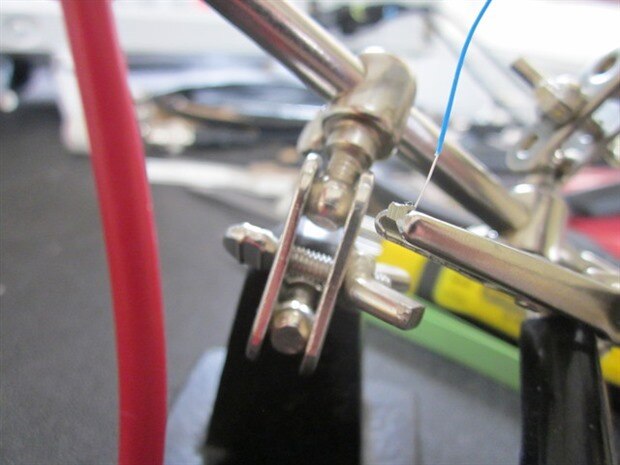
generator I fed through a 10k resistor to a piece of wire-wrap wire which I arranged

to scrape across the surface of the cube. My scope then measured the output from my

improvised diode.
 

image


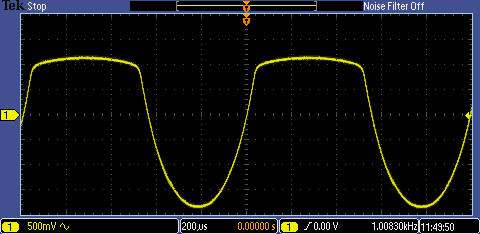
A little movement of the wire and I soon found a spot that rectified nicely [I was just

so surprised - I really didn't think that this was going to work].
 

image


The forward voltage looks to be a little over a volt. That's much higher than a

silicon metal-junction diode (a Schottky diode).


And that's it. No need to melt silica in an oven and grow it into a crystal with

99.99-whatever % purity. Instead, an instant semiconductor straight from nature.


Do I get a cat badge for this foolishness?

  • Sign in to reply

Top Comments

  • balearicdynamics
    balearicdynamics over 8 years ago +6
    The "radio" based on the crystal was the absolutely first stuff I have done when I was about 10 y.o. Synth was based on the semiconductor crystal (it was the early '70 so these stuff was not difficult…
  • jc2048
    jc2048 over 8 years ago in reply to shabaz +6
    Here's a ZN414 radio I built soon after they launched it (the ZN414 is the part that looks like a transistor, even though it's an IC). Tuning cap was a modified trimmer. Power was a small hearing-aid battery…
  • rachaelp
    rachaelp over 8 years ago +5
    Very impressive. Whatever made you think of doing this? I don't have a badge, but you can be awarded Top Cat of the day if you like?
Parents
  • balearicdynamics
    balearicdynamics over 8 years ago

    The "radio" based on the crystal was the absolutely first stuff I have done when I was about 10 y.o. Synth was based on the semiconductor crystal (it was the early '70 so these stuff was not difficult to find. By one side the crystal was pinched in a alligator and by the other side it was possible to "synthonize" the radio station with a pin touching  different points of the crystal. The "amplifier" was just a aris insulated variable capacitor and a couple of earphones. The antenna was something like 100 meters of insulated copper in spiral (5 meters spiral). Then no power was needed, and the audio was fantastic.


    As I find it I have again the model and I will make some photo.


    Enrico

    • Cancel
    • Vote Up +6 Vote Down
    • Sign in to reply
    • More
    • Cancel
Comment
  • balearicdynamics
    balearicdynamics over 8 years ago

    The "radio" based on the crystal was the absolutely first stuff I have done when I was about 10 y.o. Synth was based on the semiconductor crystal (it was the early '70 so these stuff was not difficult to find. By one side the crystal was pinched in a alligator and by the other side it was possible to "synthonize" the radio station with a pin touching  different points of the crystal. The "amplifier" was just a aris insulated variable capacitor and a couple of earphones. The antenna was something like 100 meters of insulated copper in spiral (5 meters spiral). Then no power was needed, and the audio was fantastic.


    As I find it I have again the model and I will make some photo.


    Enrico

    • Cancel
    • Vote Up +6 Vote Down
    • Sign in to reply
    • More
    • Cancel
Children
  • jc2048
    jc2048 over 8 years ago in reply to balearicdynamics

    I'd like to see the pictures of it, if you can find it.


    I too made a crystal set when I was young, like you with a commercial diode [a germanium one - would it have been an OA71, or something like that?]. I used a long aerial down the garden. Sadly, I didn't keep it.

    • Cancel
    • Vote Up +3 Vote Down
    • Sign in to reply
    • More
    • Cancel
  • shabaz
    shabaz over 8 years ago in reply to jc2048

    It's a shame the crystal set has fallen out of favour as a beginner's first project : (

    I also remember using the Ferranti ZN414Z IC, it was the go-to chip for rapidly building a usable radio with earphones/speaker.

    • Cancel
    • Vote Up +4 Vote Down
    • Sign in to reply
    • More
    • Cancel
  • jc2048
    jc2048 over 8 years ago in reply to shabaz

    Here's a ZN414 radio I built soon after they launched it (the ZN414 is the part that looks like a transistor, even though it's an IC). Tuning cap was a modified trimmer. Power was a small hearing-aid battery. The earpiece jack was also the power switch. The case was clear plastic, so that I could show off my lack of soldering skills.


    image

    • Cancel
    • Vote Up +6 Vote Down
    • Sign in to reply
    • More
    • Cancel
element14 Community

element14 is the first online community specifically for engineers. Connect with your peers and get expert answers to your questions.

  • Members
  • Learn
  • Technologies
  • Challenges & Projects
  • Products
  • Store
  • About Us
  • Feedback & Support
  • FAQs
  • Terms of Use
  • Privacy Policy
  • Legal and Copyright Notices
  • Sitemap
  • Cookies

An Avnet Company © 2026 Premier Farnell Limited. All Rights Reserved.

Premier Farnell Ltd, registered in England and Wales (no 00876412), registered office: Farnell House, Forge Lane, Leeds LS12 2NE.

ICP 备案号 10220084.

Follow element14

  • X
  • Facebook
  • linkedin
  • YouTube