element14 Community
element14 Community
    Register Log In
  • Site
  • Search
  • Log In Register
  • Community Hub
    Community Hub
    • What's New on element14
    • Feedback and Support
    • Benefits of Membership
    • Personal Blogs
    • Members Area
    • Achievement Levels
  • Learn
    Learn
    • Ask an Expert
    • eBooks
    • element14 presents
    • Learning Center
    • Tech Spotlight
    • STEM Academy
    • Webinars, Training and Events
    • Learning Groups
  • Technologies
    Technologies
    • 3D Printing
    • FPGA
    • Industrial Automation
    • Internet of Things
    • Power & Energy
    • Sensors
    • Technology Groups
  • Challenges & Projects
    Challenges & Projects
    • Design Challenges
    • element14 presents Projects
    • Project14
    • Arduino Projects
    • Raspberry Pi Projects
    • Project Groups
  • Products
    Products
    • Arduino
    • Avnet & Tria Boards Community
    • Dev Tools
    • Manufacturers
    • Multicomp Pro
    • Product Groups
    • Raspberry Pi
    • RoadTests & Reviews
  • About Us
  • Store
    Store
    • Visit Your Store
    • Choose another store...
      • Europe
      •  Austria (German)
      •  Belgium (Dutch, French)
      •  Bulgaria (Bulgarian)
      •  Czech Republic (Czech)
      •  Denmark (Danish)
      •  Estonia (Estonian)
      •  Finland (Finnish)
      •  France (French)
      •  Germany (German)
      •  Hungary (Hungarian)
      •  Ireland
      •  Israel
      •  Italy (Italian)
      •  Latvia (Latvian)
      •  
      •  Lithuania (Lithuanian)
      •  Netherlands (Dutch)
      •  Norway (Norwegian)
      •  Poland (Polish)
      •  Portugal (Portuguese)
      •  Romania (Romanian)
      •  Russia (Russian)
      •  Slovakia (Slovak)
      •  Slovenia (Slovenian)
      •  Spain (Spanish)
      •  Sweden (Swedish)
      •  Switzerland(German, French)
      •  Turkey (Turkish)
      •  United Kingdom
      • Asia Pacific
      •  Australia
      •  China
      •  Hong Kong
      •  India
      • Japan
      •  Korea (Korean)
      •  Malaysia
      •  New Zealand
      •  Philippines
      •  Singapore
      •  Taiwan
      •  Thailand (Thai)
      • Vietnam
      • Americas
      •  Brazil (Portuguese)
      •  Canada
      •  Mexico (Spanish)
      •  United States
      Can't find the country/region you're looking for? Visit our export site or find a local distributor.
  • Translate
  • Profile
  • Settings
Personal Blogs
  • Community Hub
  • More
Personal Blogs
Legacy Personal Blogs Transistors: Output Characteristic Curves
  • Blog
  • Documents
  • Mentions
  • Sub-Groups
  • Tags
  • More
  • Cancel
  • New
  • Share
  • More
  • Cancel
Group Actions
  • Group RSS
  • More
  • Cancel
Engagement
  • Author Author: jc2048
  • Date Created: 27 Mar 2017 1:31 PM Date Created
  • Views 4256 views
  • Likes 6 likes
  • Comments 6 comments
Related
Recommended

Transistors: Output Characteristic Curves

jc2048
jc2048
27 Mar 2017

This one is similar to what I did with the gain, except that this time I kept the base current constant and measured the collector current in relation to the collector-emitter voltage. I reworked the original test circuit, which is how this blog follows the last one so quickly. As before, I'm looking at an NPN bipolar junction transistor (a 2N3904) and the situation where the emitter is the common terminal between input and output.


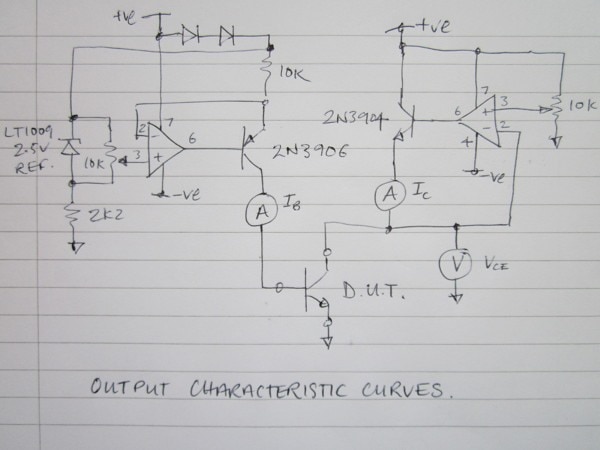
Here's the circuit (minus decoupling caps):
 

image


I've moved the constant-current source to the base and chosen a resistor that will give me base currents in the area of a few tens of microamps. The collector I'm driving with a follower so that I can set the voltage without having to account for the voltage drop of the ammeter. All the measuring I'm doing is with meters, so there's no need for great precision and accuracy - as long as it holds everything steady, that's enough.


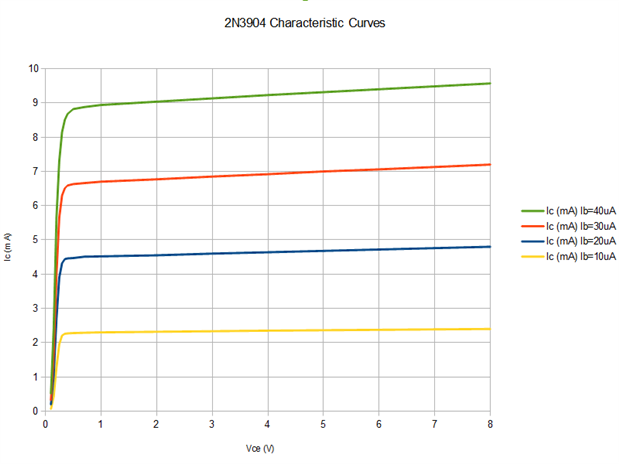
Here are the curves I get for various base currents.
 

image


If the transistor output was a perfect current sink, the output curves would be horizontal lines, each at a single value of collector current. As it is, whilst approximating a current sink, the lines slope and the transistor doesn't operate all the way down to a Vce of 0V. The situation at the bottom end is due to saturation - when the collector voltage gets down to the base voltage, the base-collector diode is no longer reverse biased and the increasing forward bias as the collector is moved lower starts to affect the way the transistor operates. The slope higher up is due to base width modulation (Early effect) - here's the Wikipedia entry if you want to read more:

https://en.wikipedia.org/wiki/Early_effect


For a fixed collector voltage, the proportionality between the base and collector currents is reasonably good. However, in a practical circuit, when a simple resistor is used to convert from the output current to an output voltage, there will be some distortion because of the variation in gain as the collector voltage varies. That distortion will be higher for a large signal than a small one.

  • Sign in to reply

Top Comments

  • jw0752
    jw0752 over 8 years ago +1
    Thank You for continuing to share your study of transistors. John
  • DAB
    DAB over 8 years ago +1
    It is always nice to see experimental results match device specifications. Good work, DAB
  • mcb1
    mcb1 over 8 years ago +1
    Good series. Was it waht you expected/remembered ??
Parents
  • mcb1
    mcb1 over 8 years ago

    Good series.

    Was it waht you expected/remembered ??

    • Cancel
    • Vote Up +1 Vote Down
    • Sign in to reply
    • More
    • Cancel
  • jc2048
    jc2048 over 8 years ago in reply to mcb1

    Remembered? It's a long, long time ago and I'm not very clear now what lectures covered. This is from Integrated Electronics by Millman and Halkias which we used as a text, so I would definitely have been introduced to it all, but unfortunately it was largely book learning - there was very little practical work - which didn't really suit me (I learn best by doing, not looking at equations on a page).


    image


    Even though it was published in 1972, the curves they show are for a germanium PNP device. They've added a curve for the maximum power dissipation and a load line for a 500 ohm resistor to 10v at the collector.


    Since I never did proper transistor design after leaving university, I'm now left with the usual ragbag of practical rules-of-thumb for the odd occasions I need to use them and would certainly struggle to explain the physics. For example, I still don't quite get what's happening when the transistor enters saturation, from the solid-state physics point of view, though I know in practical terms that the transistor bottoms somewhere in the region of 50-150mV if you massively overdrive the base current. I've avoided saturation so far, because I'm not clear what exactly I should be measuring in terms of what the dependancies are.


    I don't know if the blogs are any use to others; they're proving very useful to me - a practical road to understanding - but I need to move on a bit quicker and tackle some proper design now.

    • Cancel
    • Vote Up +1 Vote Down
    • Sign in to reply
    • More
    • Cancel
  • mcb1
    mcb1 over 8 years ago in reply to jc2048

    the usual ragbag of practical rules-of-thumb for the odd occasions I need to use them

    I've always worked on that principle.


    Never was much for the theory, just enough to understand what was happening and why ...

    I don't know if the blogs are any use to others

    They are very interesting, so thanks for doing them.


    Mark

    • Cancel
    • Vote Up +1 Vote Down
    • Sign in to reply
    • More
    • Cancel
Comment
  • mcb1
    mcb1 over 8 years ago in reply to jc2048

    the usual ragbag of practical rules-of-thumb for the odd occasions I need to use them

    I've always worked on that principle.


    Never was much for the theory, just enough to understand what was happening and why ...

    I don't know if the blogs are any use to others

    They are very interesting, so thanks for doing them.


    Mark

    • Cancel
    • Vote Up +1 Vote Down
    • Sign in to reply
    • More
    • Cancel
Children
No Data
element14 Community

element14 is the first online community specifically for engineers. Connect with your peers and get expert answers to your questions.

  • Members
  • Learn
  • Technologies
  • Challenges & Projects
  • Products
  • Store
  • About Us
  • Feedback & Support
  • FAQs
  • Terms of Use
  • Privacy Policy
  • Legal and Copyright Notices
  • Sitemap
  • Cookies

An Avnet Company © 2025 Premier Farnell Limited. All Rights Reserved.

Premier Farnell Ltd, registered in England and Wales (no 00876412), registered office: Farnell House, Forge Lane, Leeds LS12 2NE.

ICP 备案号 10220084.

Follow element14

  • X
  • Facebook
  • linkedin
  • YouTube