


We begin our review of the B&K Precision BA6010 Battery Analyser with a Market Survey, but it’s probably worth going over some of the basics about battery analysis.
Quick Introduction to Battery Analysis
If you look around for information about battery testing, there is a lot of often confusing and contradictory statements around. There have been a lot of debates about different test methods providing different test results and whether certain methods of testing are equivalent, valid or not. Part of this confusion stems from the comparison of test results obtained through different methods which often differ for non-obvious reasons. Worse still, if you dig just a little below the surface, you will find some supposedly authoritative sources of information to be operated by companies which produce such battery analysers. Add to this, a layer of “marketing fluff” and “secret sauces” – it’s easy to be confused.
I can’t claim to be a battery expert. While I have a lot of interest in batteries and battery testing, I’m not a chemist, I don’t do post-mortems on batteries and I don’t operate a battery manufacturing plant. As a result, I’ll go through a few of the basic principles and try to clear few potential points of confusion without delving deeply into the underlying math or chemistry.
At the simplest, we can consider a battery merely an ideal voltage source, although in reality, this is not the case as the voltage across a battery falls as a function of state of charge as well as the rate of discharge. The reasoning behind this is a combination of electrochemical reasons and cell design. When it comes to the AC behaviour (i.e. impedance) of a battery, the one most favoured is the Randles Circuit which models a battery as a couple of resistors, an inductor and capacitor which describe the resistance of the electrolyte, the charge transfer resistance and electrochemical diffusion contribution. But for the most part, we don’t need to consider ourselves too much with the fine details.
Battery Testing Methodologies
When it comes to battery testing, there are a number of methodologies commonly used each with their own advantages and disadvantages. A summary of some of these are given below:
- Open circuit voltage test – this is the simplest test and can be done rapidly with a multimeter. This can provide information about state of charge and whether the cell has completely failed, but cannot provide information about the capacity or power delivery capability of the cells. Accurate estimation can only be made from batteries with a significant “slope” in their voltage function and will be skewed if the battery is under load or recently taken off the charger (due to surface charge) and may be dependent on temperature.
- Load testing – this involves discharging a battery under known load and timing the process to prove the energy available from a battery. This is time consuming, loads required can be large or expensive, can involve taking the unit out of service, cannot be accurately performed while a battery is being charged or drawn from and it will consume cycle life from a battery. However, load tests are the only way to guarantee that the battery can deliver a given amount of charge at a set rate. By pulsing the load, it is possible to determine a “DC” internal resistance reading.
- AC impedance / conductance testing – this involves injecting an AC signal of a fixed frequency into the battery and measuring the ripple developed at the terminals. This is convenient as it is fast, can be performed while the battery is in service and does not “damage” the battery or consume power from it. It provides some information as to the health of the battery (i.e. the impedance of the cells including interconnections) which can be charted over time to detect battery failure prematurely. However, it cannot be used to prove capacity (although some units may estimate battery capacity based on the readings, the accuracy is disputed). This is often used for production screening of batteries, with some vendors providing a guideline value on datasheets based on the 1khz AC method, however, these values often do not directly correspond to the DC internal resistance derived from pulsed load tests.
- Electrochemical Impedance Spectroscopy (EIS) testing – this is a more sophisticated version of AC impedance testing which uses a number of frequencies instead of just one, in order to try and better characterise what is happening within the cell. This produces more data, but translating this into capacity and health seems to be a proprietary algorithm available from only a few select vendors with disputed accuracy.
As a result, the choice of test method depends on what knowledge you are trying to glean from your batteries – the choice is different depending on whether you need something that is non-destructive and fast for production screening or actually need to prove the capacity through an actual discharge say for sample testing.
Battery Tester vs. Battery Analyser
Unfortunately, in this particular market segment, it can be a bit confusing when it comes to shopping. Some companies like to use the term “battery tester” synonymously with “battery analyser”, even though there is a subtle difference, whereas some battery testers have some features which may be found on analysers but are still called testers.
To my understanding, battery testers are often lower-cost devices which may test the battery by applying a load to the battery, often providing a qualitative or limited-quantitative reading of the state of the battery (often, just the state of charge or voltage). These devices are often portable and intended for field use, although some do incorporate more sophisticated testing.
Battery analysers are often more expensive and sophisticated devices, which aim to provide quantitative readings which can be used to determine the state of health of a battery. Often these rely on a non-load-based test method (e.g. 1khz AC stimulus, low-frequency AC stimulus or multi-frequency electrochemical impedance spectroscopy) which is used to report on a number of parameters (e.g. resistance, voltage) which may include estimated values based on look-up tables (e.g. estimated CCA, capacity). Many of these units, however, cannot be used to perform a real “load-test”.
As a result, no matter how a unit is marketed, one has to clearly look at the specifications to understand what is being tested and how it’s being tested, otherwise they could end up with an analyser that does not meet their needs and does not produce values which they could compare with other data sources (e.g. battery datasheets).
Market Survey
The culmination of all of this discussion means that it’s difficult to do a proper market survey. While a number of so-called “Battery Analysers” are on the market, many of them from larger names are handheld units for site-servicing which is not the same market as those who might want a benchtop unit. They also tend to use different testing methodologies as well, some being extremely crude, while others specialise towards testing of particular types of batteries (e.g. automotive). Other bench-top units can be more sophisticated units which combine load-testing and reconditioning on top of impedance-based tests. Some similar units do exist, but from lesser-known entities with pricing and availability uncertain.
However, I thought I’d probably at least give it my best shot to include a few big-names and many little ones alike. To be considered for this comparison, the unit must be a single-channel battery analyser using the 1Khz AC test method with internal resistance and voltage measurement. Please note that all information is provided in good faith based on information available from manufacturers' brochures and datasheets for discussion purposes. I do not accept any responsibility for errors or omissions, or consequences from using or your inability to use this data. Please do your own research before purchasing.
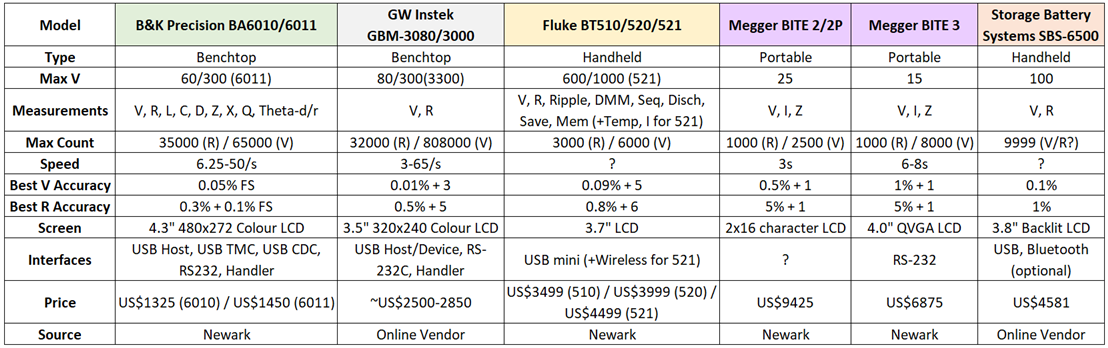
We begin by comparing the BA6010 to the options provided by the more established test equipment providers. The BA6010 is already off to a good start in this first table, being the most inexpensive of all options while offering the more measurement modes, faster measurement times, better accuracy than most and a larger screen. The only other benchtop competitor, the GW Instek GBM-3080/3000, seems to slightly beat the BA6010 on voltage accuracy and resolution but at a cost of nearly twice as much. As the other units are portable or handheld units, their lower accuracy is not unexpected as they are more suited for field applications.
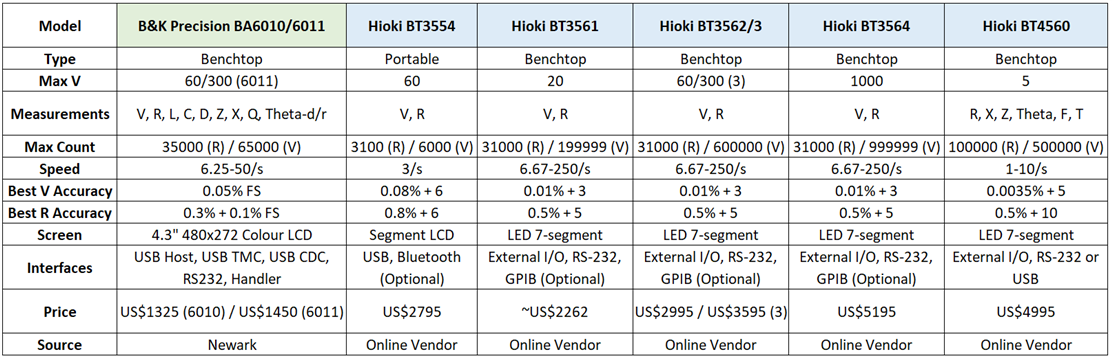
Stepping up the competition to the Hioki products, whose lineup consists mostly of bench-top units, the BA6010 remains the most inexpensive of the bunch. It offers the most measurement modes and still offers the superior user interface and remote interfaces. The Hioki equipment, however, achieves better voltage accuracy and resolution across the board. Considering the price differential, the BA6010 is still the value-for-money winner.
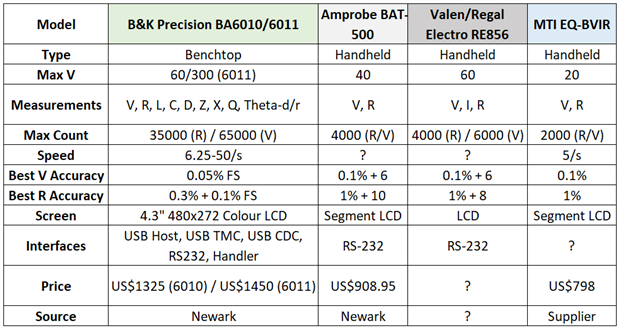
Comparing the BA6010 to lesser known systems from some other companies, it’s seen that some of these lower-cost handheld units are not anywhere near the BA6010 for specifications even though the BA6010 is only slightly more expensive. If you don’t need the portability, the BA6010 might be the better choice.
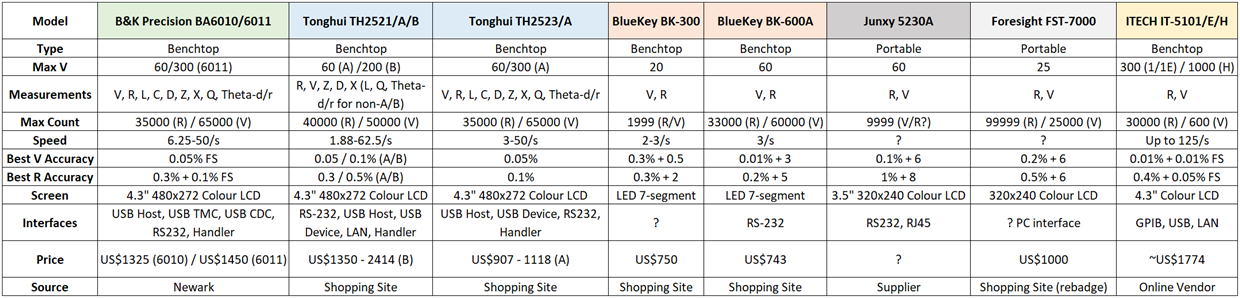
Finally, it’s probably worthwhile comparing the BA6010 to the numerous options from China. Prices for these may be somewhat unrealistically low, owing to taking the lowest cost from an online shopping site where you might be occasionally bitten by a scam or two. The bigger problem seems to be that the specs for some of these products change depending on who you buy it from even though it’s the same item, so take the specs with a grain of salt. However, because of the niche nature of the product, it seems that this is where the most variety of options to compare with.
Compared to the other Tonghui products, we can see the BA6010 is basically the TH2523, the latest of their offerings and the price that Newark is selling it for is actually not much more than the price offered from the “shady” shopping site. That’s a good sign, especially as that means you’re not paying much for the additional warranty, support and peace of mind. Compared with some of their less “reputable” cousins, it seems that the unit is quite competitive on specs. It’s occasionally beaten on voltage accuracy, but holds its own when it comes to resistance accuracy.
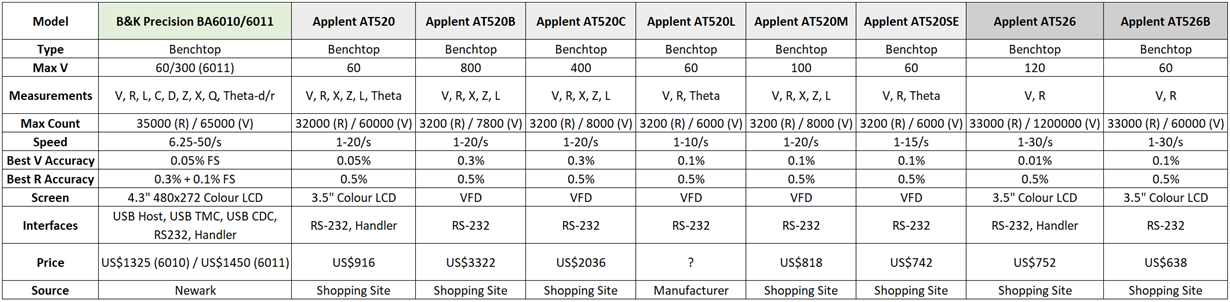
In being exhaustive, I’ve also compared the BA6010 to the Applent benchtop cousins. The results are very similar to that above in regards to the specifications, making the BA6010 a solid choice all-round especially considering that the majority of the Applent products use a VFD display and have more limited connectivity and lower accuracy.
Conclusion
Batteries themselves are not “simple” ideal voltage sources. Battery analysis can be a rather confusing topic owing to the variety of test methods which produce incomparable results. When shopping for a battery analyser, it’s important to read the datasheet thoroughly so as to understand what your unit actually does, the values it can report, how these are derived and how they relate to the parameters you are interested in.
When it comes to the B&K Precision BA6010, it offers a very compelling package for the price. Compared with the more well-known brands, the analyser is very much cheaper than the competition while offering more measurement modes, better connectivity and a better display. While it is not portable, it does also offer quite competitive resistance accuracy. The only downside is that the voltage accuracy and resolution is not the best – however, it’s still better than a good slice of the competition for under half the price.
As the unit is a bit of a “niche” product, the main competition actually seems to originate from Chinese test equipment manufacturers. When even compared to these analysers, the BA6010 still offers close to the best specifications at a price only marginally more than you might get if you “risked” buying one from a shady shopping site, foregoing after-sales support, warranties or even assurance that the claimed accuracy levels can be achieved as it seems to vary from seller to seller for the same unit.
As a result, if you’re after a benchtop battery analyser that does voltage and resistance/impedance-based measurements, the B&K Precision BA6010 is actually a no-brainer choice. You’d likely spend at least twice as much to buy another reputable analyser, or save a few pennies buying an “unknown” but risk headaches further down the track.
---
This blog is part of a series of posts for the B&K Precision BA6010 Battery Analyser RoadTest, where you will find all the links to the other parts of the review.
Top Comments