


Having recently finished my blog series for the Experimenting with Thermistors Design Challenge, and taking a breather on a RoadTest at the moment, I found some time to embark on a project that I had wanted to do during the challenge but did not have time to. Part of my experimentation used a mechanical relay multiplexer shield that I built to measure multiple thermistors quasi-simultaneously with the DMMs I have. Unfortunately, that relay multiplexer being mechanical has a limited lifetime and makes quite the racket - not ideal for use in a bedroom. The ten inputs were also a potential limitation for future experiments
As a result, I decided to embark on a journey to build a solid-state relay multiplexer that could operate in one-wire, two-wire or four-wire mode. I also decided it would be a good chance to put the RP2040 into action as well, being my first project to use the Raspberry Pi Pico microcontroller. I fought component shortages, redesigned the PCB after missing out on stock and did my best to do SMD at home with the minimal equipment (double sided too!) and 3D printed myself a matching case to go with it.
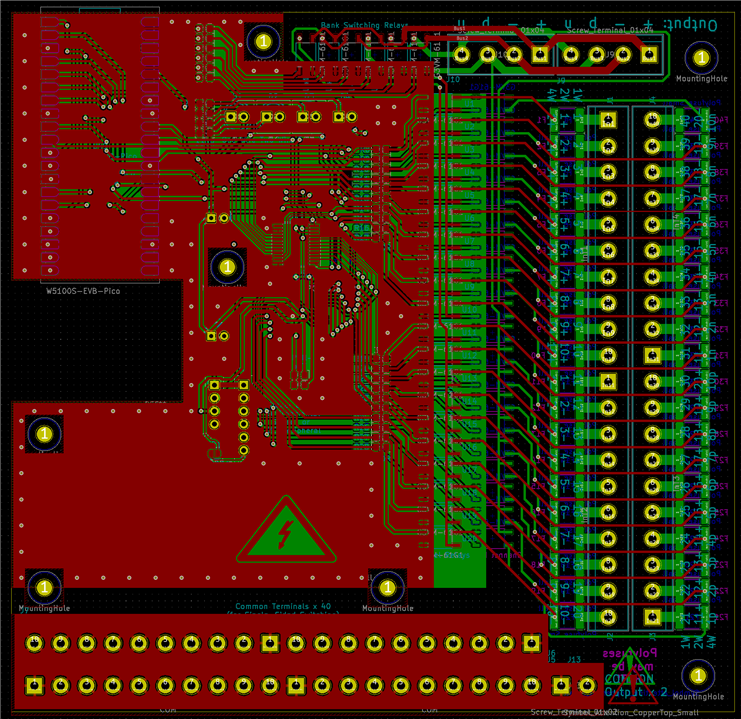

In the end, I managed to get it all working just as I expected ... building something I just couldn't commercially buy at a price which was a fraction of what such modules would cost assuming I had the right scanning DMM to go with them. Performance was not bad either - the RP2040 is a bit of a beast. Even my spaghetti code decided to hold in there, with stress testing running over 5.25-million select operations without a single failure ...
Read the full article over at my personal blog - https://goughlui.com/2022/09/24/project-usb-lan-40-input-1w-2w-4w-solid-state-relay-multiplexer-w-rp2040/


