element14 Community
element14 Community
    Register Log In
  • Site
  • Search
  • Log In Register
  • Community Hub
    Community Hub
    • What's New on element14
    • Feedback and Support
    • Benefits of Membership
    • Personal Blogs
    • Members Area
    • Achievement Levels
  • Learn
    Learn
    • Ask an Expert
    • eBooks
    • element14 presents
    • Learning Center
    • Tech Spotlight
    • STEM Academy
    • Webinars, Training and Events
    • Learning Groups
  • Technologies
    Technologies
    • 3D Printing
    • FPGA
    • Industrial Automation
    • Internet of Things
    • Power & Energy
    • Sensors
    • Technology Groups
  • Challenges & Projects
    Challenges & Projects
    • Design Challenges
    • element14 presents Projects
    • Project14
    • Arduino Projects
    • Raspberry Pi Projects
    • Project Groups
  • Products
    Products
    • Arduino
    • Avnet & Tria Boards Community
    • Dev Tools
    • Manufacturers
    • Multicomp Pro
    • Product Groups
    • Raspberry Pi
    • RoadTests & Reviews
  • About Us
  • Store
    Store
    • Visit Your Store
    • Choose another store...
      • Europe
      •  Austria (German)
      •  Belgium (Dutch, French)
      •  Bulgaria (Bulgarian)
      •  Czech Republic (Czech)
      •  Denmark (Danish)
      •  Estonia (Estonian)
      •  Finland (Finnish)
      •  France (French)
      •  Germany (German)
      •  Hungary (Hungarian)
      •  Ireland
      •  Israel
      •  Italy (Italian)
      •  Latvia (Latvian)
      •  
      •  Lithuania (Lithuanian)
      •  Netherlands (Dutch)
      •  Norway (Norwegian)
      •  Poland (Polish)
      •  Portugal (Portuguese)
      •  Romania (Romanian)
      •  Russia (Russian)
      •  Slovakia (Slovak)
      •  Slovenia (Slovenian)
      •  Spain (Spanish)
      •  Sweden (Swedish)
      •  Switzerland(German, French)
      •  Turkey (Turkish)
      •  United Kingdom
      • Asia Pacific
      •  Australia
      •  China
      •  Hong Kong
      •  India
      • Japan
      •  Korea (Korean)
      •  Malaysia
      •  New Zealand
      •  Philippines
      •  Singapore
      •  Taiwan
      •  Thailand (Thai)
      • Vietnam
      • Americas
      •  Brazil (Portuguese)
      •  Canada
      •  Mexico (Spanish)
      •  United States
      Can't find the country/region you're looking for? Visit our export site or find a local distributor.
  • Translate
  • Profile
  • Settings
Personal Blogs
  • Community Hub
  • More
Personal Blogs
John Wiltrout's Blog Calibration of My 43 year Old BK Dynascan 1460 Scope
  • Blog
  • Documents
  • Mentions
  • Sub-Groups
  • Tags
  • More
  • Cancel
  • New
  • Share
  • More
  • Cancel
Group Actions
  • Group RSS
  • More
  • Cancel
Engagement
  • Author Author: jw0752
  • Date Created: 18 Dec 2017 6:13 AM Date Created
  • Views 1863 views
  • Likes 11 likes
  • Comments 11 comments
  • bk_dynascan_1460
Related
Recommended

Calibration of My 43 year Old BK Dynascan 1460 Scope

jw0752
jw0752
18 Dec 2017

For my 25th birthday in 1974 I bought a 10 MHz BK Dynascan 1460 Oscilloscope for $450.00. It was my first scope and I was servicing Audio Electronics at the time with an occasional TV thrown in. My primary job was as an independent service tech for 20 Radio Shack stores in Wisconsin and Minnesota. I had hopes that the scope would help me to diagnose some of the tougher puzzles that came across my bench. Since that time I have had dozens of shops and the BK scope has always been there for me.
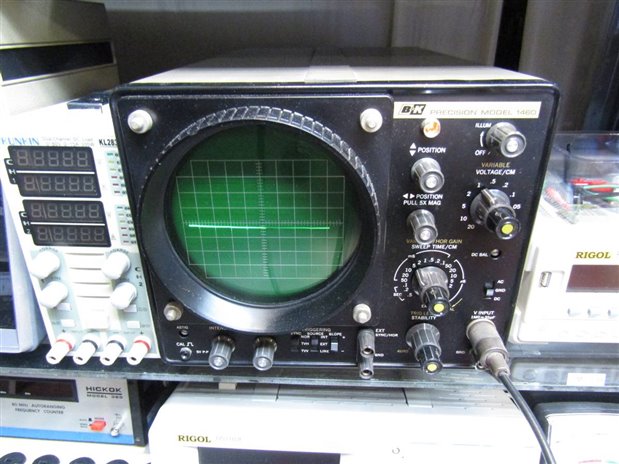
 

image


I like to take care of my things so I have always made sure it was handled carefully and stored properly when not in use. I have also kept track of the Owners and Service Manual which came with it.
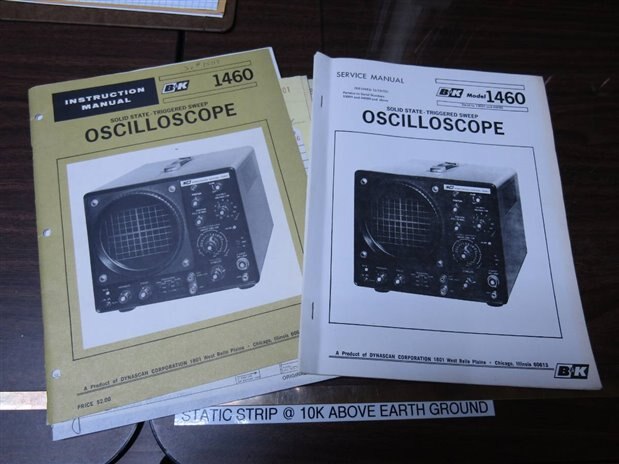
 

image


I have not used it very often since I bought a modern digital scope a few years ago but I still like it. Recently I have noticed that it had gotten quite a bit out of calibration. When I would switch between the different vertical voltage settings the trace would not stay centered. When changing from 1 v/div to 2 v/div or 5 v/div it would be necessary to recenter the trace. The horizontal trace had also shrunk so that it only covered the left 3/4 of the screen. I was pretty sure that the vertical voltage and sweep times were also off. Finally I wanted to upgrade the input connector from the SO259 that it was supplied with to a female BNC so that a modern scope probe could be attached.


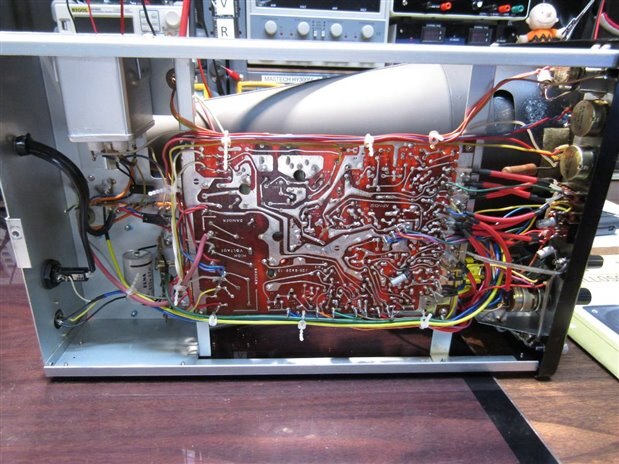
The first step was to break it open and clean some of the dust off the circuit boards.
 

image

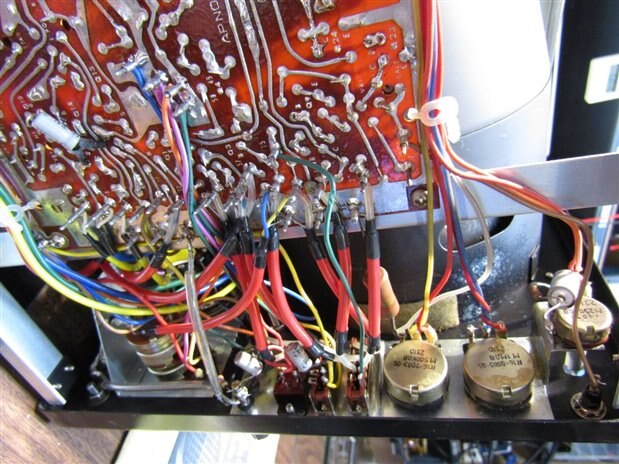
This is state of the art for a low price scope in 1974. It is all transistors except for the CRT. The cabling to the boards is wire wrapped to pins. This is the underside of the Horizontal Control Board. I began my repair process by spraying and cleaning all the pots.
 

image


image


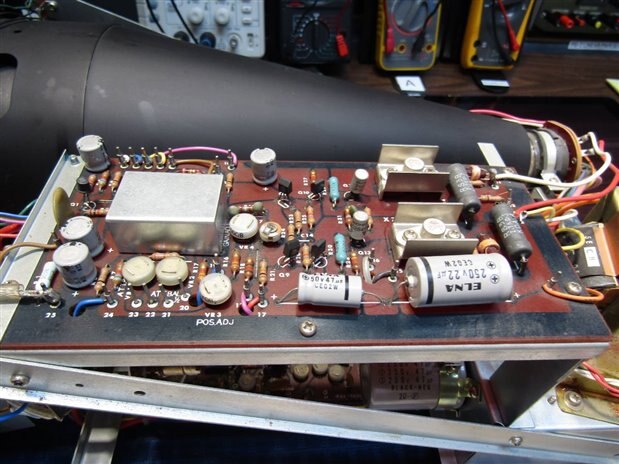
This is the Vertical control board. The service manual had a step by step procedure for calibrating the scope. Within an hour I had the vertical board adjusted so that there was no shifting of the trace as I switched between 1, 2, and 5 volts/div. I also had the trace set on zero when the vertical position knob on the front panel was centered. I had also used a reference voltage to calibrate the gain so that as accurately as possible the trace would indicate the proper voltage. Keep in mind this is nothing like the convenience we have with the present generation of digital scopes. Reading voltages and frequencies with this scope requires sharp eyes, taking measurements and doing the math to calculate frequency from how many divisions are crossed by a wave form.


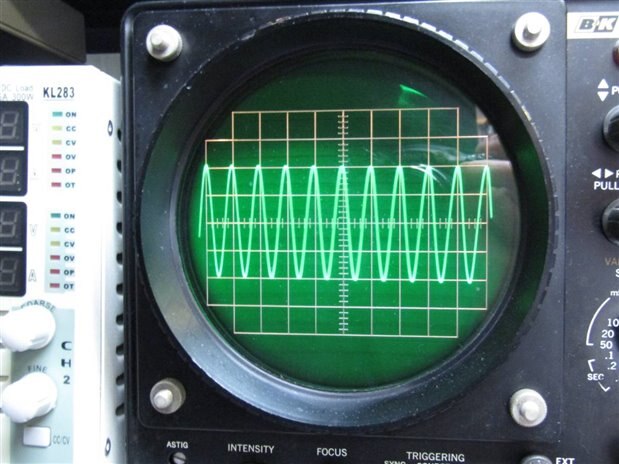
The next step was to calibrate the Horizontal sweep. Once again the service manual had a step by step procedure to accomplish this. I can't over emphasize how important it is to keep track of manuals and support information. Without the manuals this scope would not have been able to be fixed. After all the trimmers were properly twisted into place here is the results.
 

image


The signal generator is set on 1 kHz and 4 volts peak to peak. The scope is set on vertical 1 volt/div and Horizontal 1 mS/ div.
 

image


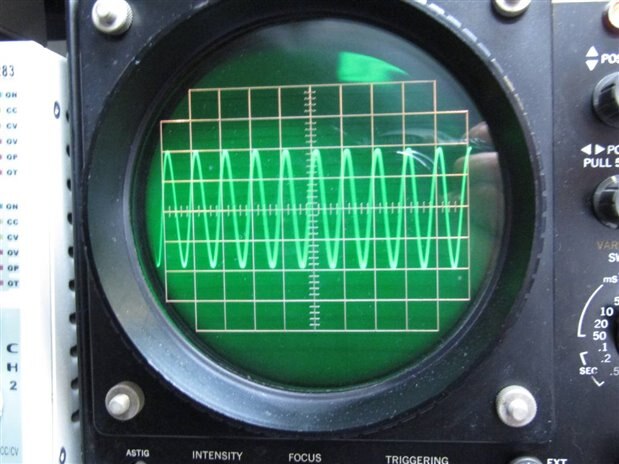
Here we have the signal generator set on 1 MHz and 4 volts PP. The scope is set on 1 volt/div and Horizontal is 1 uS/div.


If you look carefully at the screen you can see me holding the camera. I was also holding a black screen as the problem with reflections in the pictures is always a concern.


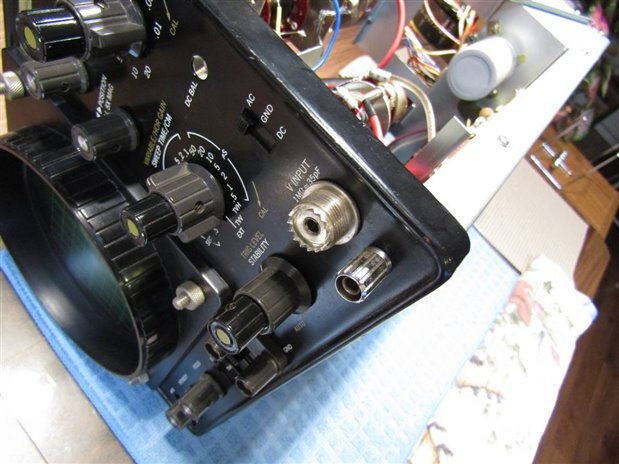
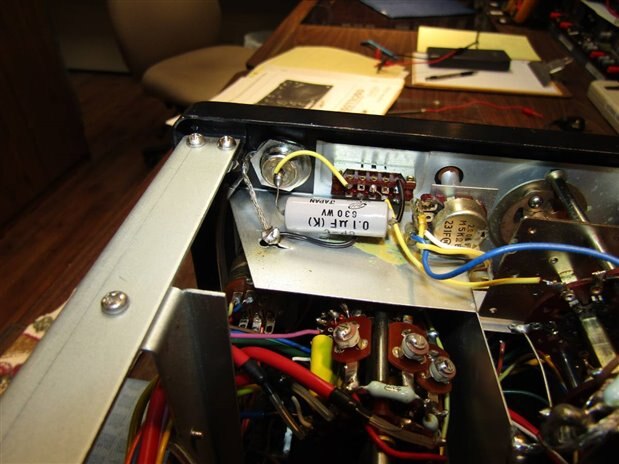
The final thing I wanted to do was to get rid of the old clumsy original probe with its PL259 connector. My first thought was to remove the SO259 on the panel of the scope and use washers to position the much smaller female BNC jack.
 

image


image


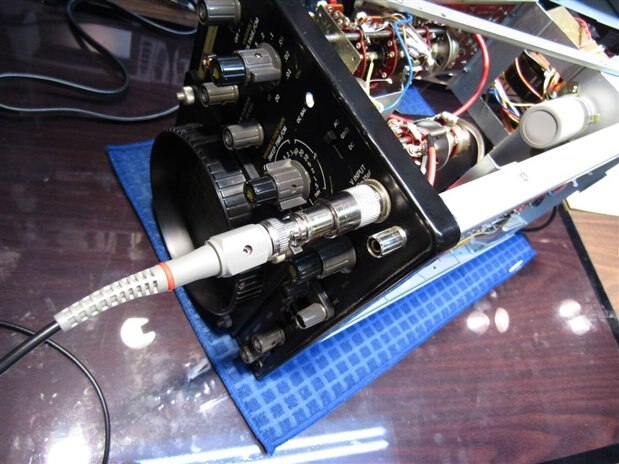
However after studying the situation I decided instead to build a PL259 to BNC female adapter and leave the original SO259 in place. I did not feel that I could do a professional looking job. While the adapter would stick out, the position of the scope on my bench would not make this a problem. Here is the finished scope with its new adapter and probe.
 

image


When I consider what kind of scope can be purchased now days for $450 compared to this scope we have come a long ways in value for our money. Keep in mind that this was purchased with 1974 dollars. The one thing that I can say for this scope is that at 43 years old it is still working nearly as well as the day I bought it. I will not live to see the condition or functionality of my newer Rigol 40 years from now but I have my doubts that we will be able to say the same about it.


John

  • Sign in to reply

Top Comments

  • shabaz
    shabaz over 7 years ago +5
    Hi John, Great blog post! Impressive how it is still spot-on once you made the adjustments. It was interesting seeing the attention to detail in the construction, like the red coax connections with the…
  • rachaelp
    rachaelp over 7 years ago +5
    Excellent post John! Everybody should learn how to use an oscilloscope on an old style CRT type unit like this! It really makes you appreciate how it works and what's going on! Nice job on the calibration…
  • jw0752
    jw0752 over 7 years ago in reply to rachaelp +5
    Hi Rachael, 2057 Thanks to medical advancement John, Age 108, prepared to calibrate his 51 year old Rigol Oscilloscope. It was either this or a picture of Captain Pike. John
Parents
  • DAB
    DAB over 7 years ago

    Great post John.


    My first scope was an old Dumont, which was fine for TV's, but lacked bandwidth for much else.


    DAB

    • Cancel
    • Vote Up +3 Vote Down
    • Sign in to reply
    • More
    • Cancel
Comment
  • DAB
    DAB over 7 years ago

    Great post John.


    My first scope was an old Dumont, which was fine for TV's, but lacked bandwidth for much else.


    DAB

    • Cancel
    • Vote Up +3 Vote Down
    • Sign in to reply
    • More
    • Cancel
Children
No Data
element14 Community

element14 is the first online community specifically for engineers. Connect with your peers and get expert answers to your questions.

  • Members
  • Learn
  • Technologies
  • Challenges & Projects
  • Products
  • Store
  • About Us
  • Feedback & Support
  • FAQs
  • Terms of Use
  • Privacy Policy
  • Legal and Copyright Notices
  • Sitemap
  • Cookies

An Avnet Company © 2025 Premier Farnell Limited. All Rights Reserved.

Premier Farnell Ltd, registered in England and Wales (no 00876412), registered office: Farnell House, Forge Lane, Leeds LS12 2NE.

ICP 备案号 10220084.

Follow element14

  • X
  • Facebook
  • linkedin
  • YouTube