element14 Community
element14 Community
    Register Log In
  • Site
  • Search
  • Log In Register
  • Community Hub
    Community Hub
    • What's New on element14
    • Feedback and Support
    • Benefits of Membership
    • Personal Blogs
    • Members Area
    • Achievement Levels
  • Learn
    Learn
    • Ask an Expert
    • eBooks
    • element14 presents
    • Learning Center
    • Tech Spotlight
    • STEM Academy
    • Webinars, Training and Events
    • Learning Groups
  • Technologies
    Technologies
    • 3D Printing
    • FPGA
    • Industrial Automation
    • Internet of Things
    • Power & Energy
    • Sensors
    • Technology Groups
  • Challenges & Projects
    Challenges & Projects
    • Design Challenges
    • element14 presents Projects
    • Project14
    • Arduino Projects
    • Raspberry Pi Projects
    • Project Groups
  • Products
    Products
    • Arduino
    • Avnet & Tria Boards Community
    • Dev Tools
    • Manufacturers
    • Multicomp Pro
    • Product Groups
    • Raspberry Pi
    • RoadTests & Reviews
  • About Us
    About the element14 Community
  • Store
    Store
    • Visit Your Store
    • Choose another store...
      • Europe
      •  Austria (German)
      •  Belgium (Dutch, French)
      •  Bulgaria (Bulgarian)
      •  Czech Republic (Czech)
      •  Denmark (Danish)
      •  Estonia (Estonian)
      •  Finland (Finnish)
      •  France (French)
      •  Germany (German)
      •  Hungary (Hungarian)
      •  Ireland
      •  Israel
      •  Italy (Italian)
      •  Latvia (Latvian)
      •  
      •  Lithuania (Lithuanian)
      •  Netherlands (Dutch)
      •  Norway (Norwegian)
      •  Poland (Polish)
      •  Portugal (Portuguese)
      •  Romania (Romanian)
      •  Russia (Russian)
      •  Slovakia (Slovak)
      •  Slovenia (Slovenian)
      •  Spain (Spanish)
      •  Sweden (Swedish)
      •  Switzerland(German, French)
      •  Turkey (Turkish)
      •  United Kingdom
      • Asia Pacific
      •  Australia
      •  China
      •  Hong Kong
      •  India
      •  Japan
      •  Korea (Korean)
      •  Malaysia
      •  New Zealand
      •  Philippines
      •  Singapore
      •  Taiwan
      •  Thailand (Thai)
      •  Vietnam
      • Americas
      •  Brazil (Portuguese)
      •  Canada
      •  Mexico (Spanish)
      •  United States
      Can't find the country/region you're looking for? Visit our export site or find a local distributor.
  • Translate
  • Profile
  • Settings
Personal Blogs
  • Community Hub
  • More
Personal Blogs
John Wiltrout's Blog DC Load Unit "La Carga" Episode IV  Errata and Two Steps Back
  • Blog
  • Documents
  • Mentions
  • Sub-Groups
  • Tags
  • More
  • Cancel
  • New
  • Share
  • More
  • Cancel
Group Actions
  • Group RSS
  • More
  • Cancel
Engagement
  • Author Author: jw0752
  • Date Created: 9 Aug 2015 5:24 AM Date Created
  • Views 494 views
  • Likes 1 like
  • Comments 4 comments
  • dc_load
Related
Recommended

DC Load Unit "La Carga" Episode IV  Errata and Two Steps Back

jw0752
jw0752
9 Aug 2015

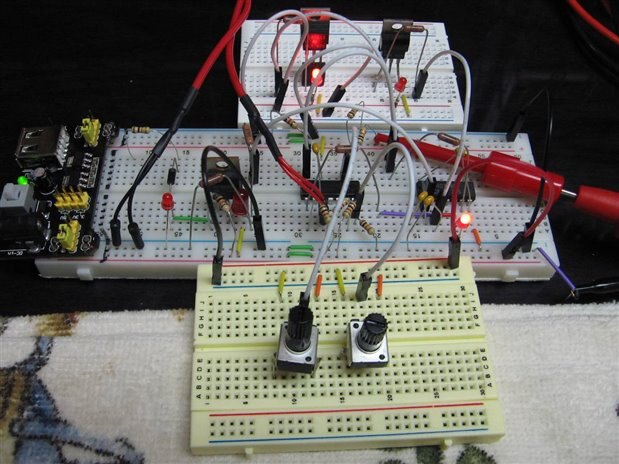
Last night I was doing the preparatory work prior to the assembly of the final board for the DC Load. This is the board that handles the limits I want to protect like: Over Voltage, Over Current, and Reversed Polarity. I bread boarded the circuit that I presented to you in Episode II Schematics. To my dismay I found that it was not working as I had planned. Since my initial design and bread boarding I had made minor changes. Also my expectations for this circuit had also expanded. Finally it seems that my original bread board tests had been less than comprehensive. The results were that a trip back to the drawing board would be needed.
 

image


By 4AM I finally had a working replacement circuit. The most difficult part for me was devising a way to test for polarity reversal. My original circuit had used a comparator circuit but I could only make this work if both Pos and Neg inputs were isolated from the ground of the circuit. This was not the case for this unit so the comparator was out. After a lot of trial and error I built a working circuit using a P Channel Enhanced MOSFET, a diode, an LED, and a couple resistors. My original circuit, that I posted last week, was only designed to trip a latching relay cutting the test input from the Load Unit. In this revised circuit I wanted the fault condition, whether Over Voltage, Over Current, or Polarity to be displayed on a set of indicator LEDs and remain lit until I pushed the reset button. Fortunately some of my original design was useful with the appropriate modifications.


Here is a revised schematic of the Limit Board. I have been over it with a fine tooth comb but with the low level of sleep I probably missed something.


image


To help understand how this piece of circuit fits into the rest I will attempt to cover the obscure parts. There is a +5 volt denoted as "B" and a +12 volt rail denoted as "C".  "M" is the positive input jack of the unit. "M" is in the circuit before the cut off relay. This means that even when the unit has detected a fault and cut the connection to the test equipment the Limit board can continue to monitor the voltage and polarity of the input. If the fault was caused by Over Current  the Unit retains memory of this on the lit LED on the front panel but since the latching relay has opened the connection to the Load there is no more Current in the unit. The Reset switch of the unit is a normally closed push button with one pin tied to ground. OC Sense IN comes from the high side of the current sensing resistor. OC Sense Ref comes from a resistive divider on the Main circuit board that sits at a slightly higher voltage than the max voltage available to the main MOSFET's Control circuit. If the MOSFET were to short out this will be detected and the latch relay should immediately open the connection to the unit under test.


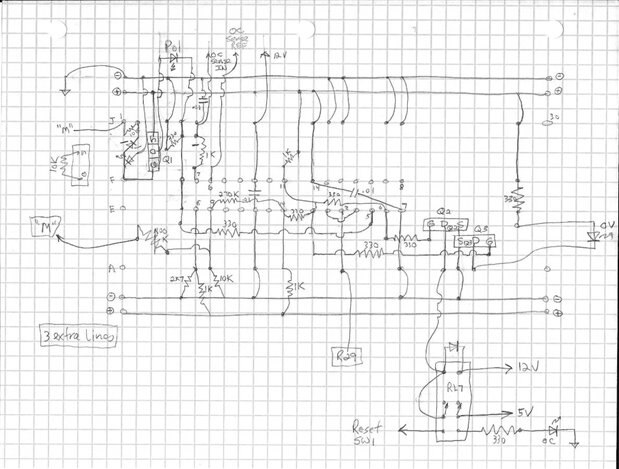
I have also made a preliminary board layout for the components. This is hand drawn and fairly crude. I have also packed the components tightly so that I could get them all one a standard 30 column solderable breadboard. The relay (RL7) is actually mounted to the chassis and is displayed in the drawing simply for wiring clarification.
 

image


The main purpose of showing the board layout is to illustrate the process that I go through when I build. Since it is heavy with my own conventions and habits it may be difficult to interpret. At this point I am back on track and in a few days I will put together a blog with more details on the building of the boards for this unit.


Thanks for checking it out.


John

  • Sign in to reply

Top Comments

  • DAB
    DAB over 10 years ago +1
    Finding and fixing designs are all part of the implementation process. Even the best ideas are sometimes found to be less than optimal. DAB
  • DAB
    DAB over 10 years ago in reply to jw0752 +1
    I usually finish most projects wishing I could do it all over again with the knowledge I gained during the design, build and testing. You always end a project wiser than you entered it. DAB
  • jw0752
    jw0752 over 10 years ago in reply to DAB

    I have on a couple occasions had the opportunity to do a project a second time and you are correct, the second unit comes together much more quickly and with some nice improvements.

    • Cancel
    • Vote Up 0 Vote Down
    • Sign in to reply
    • More
    • Cancel
  • DAB
    DAB over 10 years ago in reply to jw0752

    I usually finish most projects wishing I could do it all over again with the knowledge I gained during the design, build and testing.


    You always end a project wiser than you entered it.


    DAB

    • Cancel
    • Vote Up +1 Vote Down
    • Sign in to reply
    • More
    • Cancel
  • jw0752
    jw0752 over 10 years ago in reply to DAB

    Actually it is part of the fun too. Even though I agonize while it is happening to me I always find a sense of accomplishment when I make it through.


    The "Less Than Optimal"  might make a pretty cool Epitaph.


    John

    • Cancel
    • Vote Up 0 Vote Down
    • Sign in to reply
    • More
    • Cancel
  • DAB
    DAB over 10 years ago

    Finding and fixing designs are all part of the implementation process.


    Even the best ideas are sometimes found to be less than optimal.


    DAB

    • Cancel
    • Vote Up +1 Vote Down
    • Sign in to reply
    • More
    • Cancel
element14 Community

element14 is the first online community specifically for engineers. Connect with your peers and get expert answers to your questions.

  • Members
  • Learn
  • Technologies
  • Challenges & Projects
  • Products
  • Store
  • About Us
  • Feedback & Support
  • FAQs
  • Terms of Use
  • Privacy Policy
  • Legal and Copyright Notices
  • Sitemap
  • Cookies

An Avnet Company © 2026 Premier Farnell Limited. All Rights Reserved.

Premier Farnell Ltd, registered in England and Wales (no 00876412), registered office: Farnell House, Forge Lane, Leeds LS12 2NE.

ICP 备案号 10220084.

Follow element14

  • X
  • Facebook
  • linkedin
  • YouTube