element14 Community
element14 Community
    Register Log In
  • Site
  • Search
  • Log In Register
  • Community Hub
    Community Hub
    • What's New on element14
    • Feedback and Support
    • Benefits of Membership
    • Personal Blogs
    • Members Area
    • Achievement Levels
  • Learn
    Learn
    • Ask an Expert
    • eBooks
    • element14 presents
    • Learning Center
    • Tech Spotlight
    • STEM Academy
    • Webinars, Training and Events
    • Learning Groups
  • Technologies
    Technologies
    • 3D Printing
    • FPGA
    • Industrial Automation
    • Internet of Things
    • Power & Energy
    • Sensors
    • Technology Groups
  • Challenges & Projects
    Challenges & Projects
    • Design Challenges
    • element14 presents Projects
    • Project14
    • Arduino Projects
    • Raspberry Pi Projects
    • Project Groups
  • Products
    Products
    • Arduino
    • Avnet & Tria Boards Community
    • Dev Tools
    • Manufacturers
    • Multicomp Pro
    • Product Groups
    • Raspberry Pi
    • RoadTests & Reviews
  • About Us
    About the element14 Community
  • Store
    Store
    • Visit Your Store
    • Choose another store...
      • Europe
      •  Austria (German)
      •  Belgium (Dutch, French)
      •  Bulgaria (Bulgarian)
      •  Czech Republic (Czech)
      •  Denmark (Danish)
      •  Estonia (Estonian)
      •  Finland (Finnish)
      •  France (French)
      •  Germany (German)
      •  Hungary (Hungarian)
      •  Ireland
      •  Israel
      •  Italy (Italian)
      •  Latvia (Latvian)
      •  
      •  Lithuania (Lithuanian)
      •  Netherlands (Dutch)
      •  Norway (Norwegian)
      •  Poland (Polish)
      •  Portugal (Portuguese)
      •  Romania (Romanian)
      •  Russia (Russian)
      •  Slovakia (Slovak)
      •  Slovenia (Slovenian)
      •  Spain (Spanish)
      •  Sweden (Swedish)
      •  Switzerland(German, French)
      •  Turkey (Turkish)
      •  United Kingdom
      • Asia Pacific
      •  Australia
      •  China
      •  Hong Kong
      •  India
      •  Japan
      •  Korea (Korean)
      •  Malaysia
      •  New Zealand
      •  Philippines
      •  Singapore
      •  Taiwan
      •  Thailand (Thai)
      •  Vietnam
      • Americas
      •  Brazil (Portuguese)
      •  Canada
      •  Mexico (Spanish)
      •  United States
      Can't find the country/region you're looking for? Visit our export site or find a local distributor.
  • Translate
  • Profile
  • Settings
Personal Blogs
  • Community Hub
  • More
Personal Blogs
John Wiltrout's Blog Oh No! Not another  #@&%# Power Supply
  • Blog
  • Documents
  • Mentions
  • Sub-Groups
  • Tags
  • More
  • Cancel
  • New
  • Share
  • More
  • Cancel
Group Actions
  • Group RSS
  • More
  • Cancel
Engagement
  • Author Author: jw0752
  • Date Created: 11 Feb 2017 6:18 AM Date Created
  • Views 1691 views
  • Likes 13 likes
  • Comments 8 comments
  • bench top power supply
Related
Recommended

Oh No! Not another  #@&%# Power Supply

jw0752
jw0752
11 Feb 2017

Sorry I couldn't Resist.


It all started when I ordered a couple of these kits from Bangood in China:


http://www.banggood.com/0-30V-2mA-3A-Adjustable-DC-Regulated-Power-Supply-DIY-Kit-p-958308.html?rmmds=myorder


image


At $6.87 including postage I could not resist. The kit came with all the components needed except the heat sink and transformer. There were even pin jacks and wire pigtails so that the Voltage and Current control potentiometers could be extended off the board. The instructions which were downloadable were better than average for a kit from China and it even included the semblance of a schematic.


image

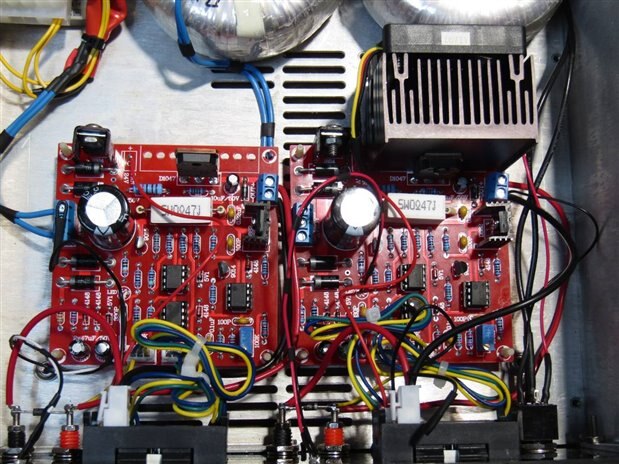
After assembling the circuit board I ran tests on it to see if it was stable and worked properly. I found that it could be used either in a constant current mode from 2 mA to 3 Amps and also in a constant voltage mode from zero to 30 volts. The circuit even had an offset adjustment trimmer on the voltage control op amp so that the potentiometer could be zeroed. The circuit requested a 24 volt transformer to work this full range. After checking my salvage stock the closest I could find to the required transformer were a couple of 21 volt toroidals. This would ultimately provide a 0 to 24 volt output which was acceptable. Unlike my previous switching power supply build this would be a linear supply. Dissipating heat would be a serious consideration. A check of the salvage showed I had an old CPU heat sink with a mounted fan that I got from the Radio Shack 20 years ago. Unfortunately there was only one. A check of EBay turned up a second heat sink for the second channel. Here is a picture of the build when I was still waiting for the second heat sink.
 

image


While it is not on the schematic the board provides a separate 7824 voltage regulator to drive a fan. It is visible in the upper left corner of the circuit board. Since the CPU fan was 12 volt I initially replaced the 7824 with a 7812.


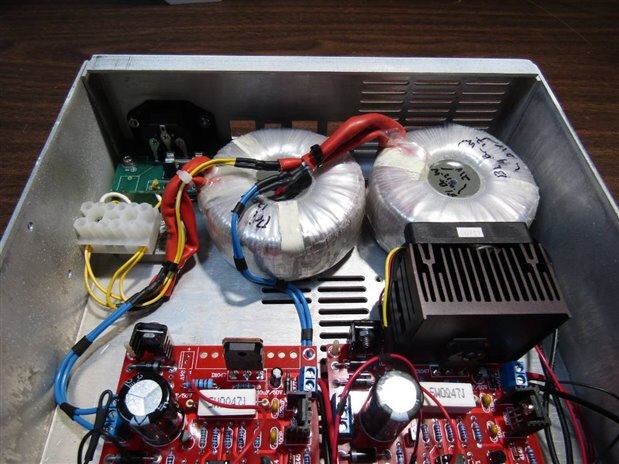
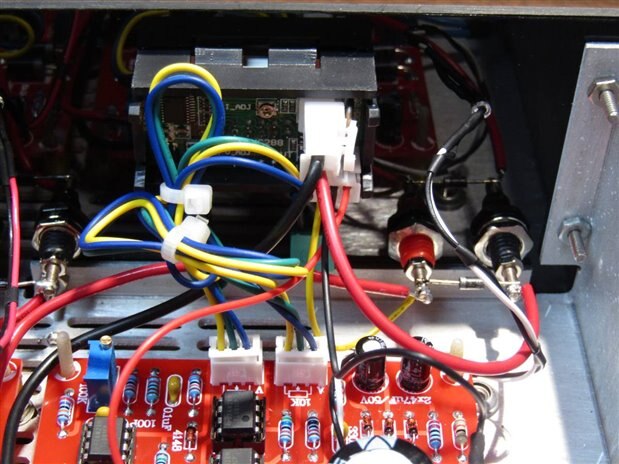
I am using an identical case for this linear dual bench power supply that I used for the previous switching supply. Even though the switching power supply had larger toroidal transformers space was more of a problem this time since the regulator boards with their heat sinks were so much bigger than the switching modules. Here are three pictures of the entire unit so that the layout is more apparent.
 

image


image


image


The display units are only 3 digit and are just inexpensive $4.00 modules from China but they had the advantage of having internal current shunts this time so I did not have to try to make my own. Each display also had its own current and voltage calibration trimmers. Don't get me wrong if you need mA precission this is probably not the meter for you but for most of my kinds of experiments it will be more than adequate and there are always the more precision bench meters if I need better accuracy.


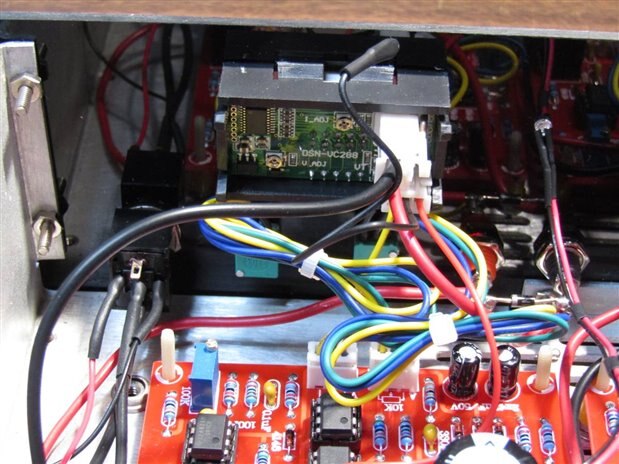
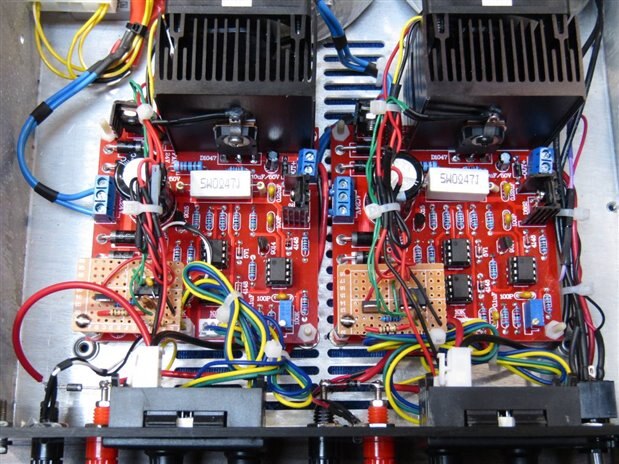
I had to wait about a week for the second CPU heat sink fan assembly to arrive. After it was installed however I was not happy with the noise that the two cooling fans made as each were running at the full 12 volts even when no load was being driven. The answer was to build a simpleTLE 2142 op amp circuit with a thermistor as a sensor and a MOSFET to drive the fan. I still wanted to be able to run the fans at the full 12 volts when things got hot so I had to upgrade the 7812 regulators on the boards to 7815. This gave me a 15 volt supply and the drop out of my little sensor driver circuit was about 3 volts. Here is a picture of the unit with the second heat sink installed as well as the two op amp circuits mounted above the lower left side of each regulator board.
 

image

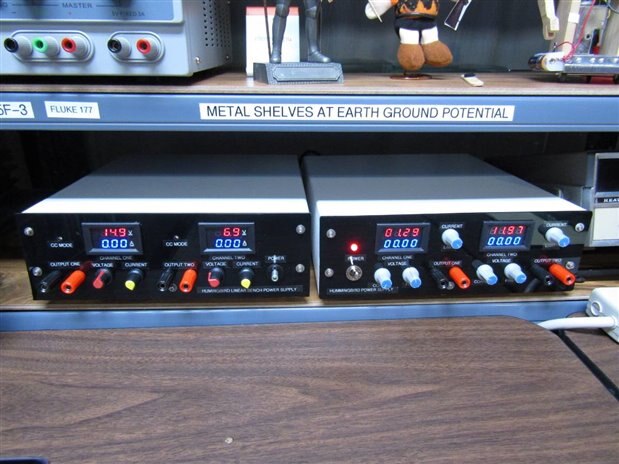
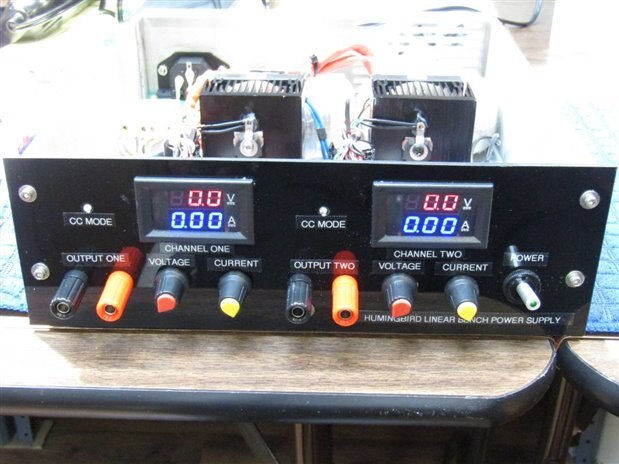
Now we were in business. The unit under no load has the fans driven with 6 volts which ramps up to 12 volts as the heat sinks warm up. The front panel of this unit is very similar to the front panel of the previous build. In fact I used the same template to mark and cut it. Unfortunately I slipped and scratched it which inspired me to flip it over and use the mirror side for this unit.  Here is a picture of the front panel.
 

image


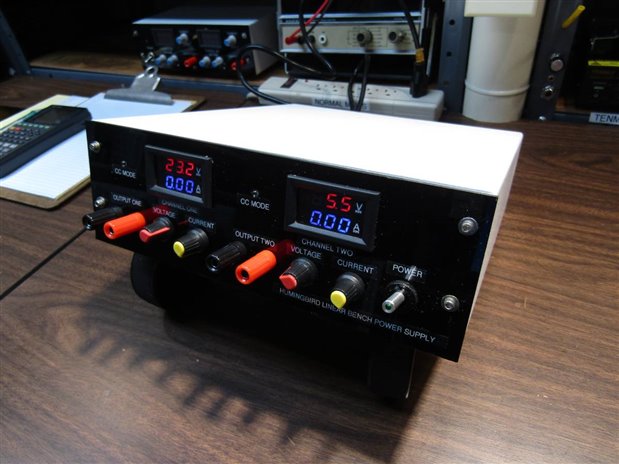
Here is the completed unit in its case and also a picture of it with its brother.
 

image


image


Now I would like to tell you that this will be the last power supply for a while but  son Mike just dropped by and brought 5 more dental camera units for me to salvage out. Aye! my work is never finished. image


John

  • Sign in to reply

Top Comments

  • michaelkellett
    michaelkellett over 9 years ago +3
    Nice one John, that's what I call a proper power supply ! I have a few bought in switchers and several linear bench supplies - I much prefer the linear supplies for bench work - you get a lot fewer surprises…
  • DAB
    DAB over 9 years ago +3
    Great project John. One thing I have learned is that you can never have too many power supplies. This build is very well made. You did a great job of integrating everything together. DAB
  • jw0752
    jw0752 over 9 years ago in reply to michaelkellett +3
    Hi Michael, I will put together an experiment tonight and see if I can get a few good traces of how they compare. Thanks for the great follow up idea. John
  • jw0752
    jw0752 over 9 years ago in reply to michaelkellett

    Hi Michael,

    Thanks for the suggestion to compare the supplies. I also added in my inexpensive commercial Mastech supply. It was very informative. Due to the size of the post I decided to create a separate blog about it.


    https://www.element14.com/community/people/jw0752/blog/2017/02/12/comparing-power-supplies


    If you have some insights for me after looking at the oscilloscope scans they would be appreciated. I am always in the learning mode and my non-formal education is full of holes and gaps.

    Thanks John

    • Cancel
    • Vote Up +2 Vote Down
    • Sign in to reply
    • More
    • Cancel
  • jw0752
    jw0752 over 9 years ago in reply to michaelkellett

    Hi Michael,

    I will put together an experiment tonight and see if I can get a few good traces of how they compare. Thanks for the great follow up idea.

    John

    • Cancel
    • Vote Up +3 Vote Down
    • Sign in to reply
    • More
    • Cancel
  • jw0752
    jw0752 over 9 years ago in reply to c4m4ch0

    Hi, The power supply boards limit current to 3 Amps or less and the max voltage that can be used at 3 amps is about 20 volts so we have about 60 watts per channel. Thank you.

    John

    • Cancel
    • Vote Up +2 Vote Down
    • Sign in to reply
    • More
    • Cancel
  • DAB
    DAB over 9 years ago

    Great project John.


    One thing I have learned is that you can never have too many power supplies.


    This build is very well made.  You did a great job of integrating everything together.


    DAB

    • Cancel
    • Vote Up +3 Vote Down
    • Sign in to reply
    • More
    • Cancel
  • dougw
    dougw over 9 years ago

    Great job - it looks professional - an equivalent commercial supply can be quite expensive.

    • Cancel
    • Vote Up +2 Vote Down
    • Sign in to reply
    • More
    • Cancel
>
element14 Community

element14 is the first online community specifically for engineers. Connect with your peers and get expert answers to your questions.

  • Members
  • Learn
  • Technologies
  • Challenges & Projects
  • Products
  • Store
  • About Us
  • Feedback & Support
  • FAQs
  • Terms of Use
  • Privacy Policy
  • Legal and Copyright Notices
  • Sitemap
  • Cookies

An Avnet Company © 2026 Premier Farnell Limited. All Rights Reserved.

Premier Farnell Ltd, registered in England and Wales (no 00876412), registered office: Farnell House, Forge Lane, Leeds LS12 2NE.

Follow element14

  • X
  • Facebook
  • linkedin
  • YouTube