element14 Community
element14 Community
    Register Log In
  • Site
  • Search
  • Log In Register
  • Community Hub
    Community Hub
    • What's New on element14
    • Feedback and Support
    • Benefits of Membership
    • Personal Blogs
    • Members Area
    • Achievement Levels
  • Learn
    Learn
    • Ask an Expert
    • eBooks
    • element14 presents
    • Learning Center
    • Tech Spotlight
    • STEM Academy
    • Webinars, Training and Events
    • Learning Groups
  • Technologies
    Technologies
    • 3D Printing
    • FPGA
    • Industrial Automation
    • Internet of Things
    • Power & Energy
    • Sensors
    • Technology Groups
  • Challenges & Projects
    Challenges & Projects
    • Design Challenges
    • element14 presents Projects
    • Project14
    • Arduino Projects
    • Raspberry Pi Projects
    • Project Groups
  • Products
    Products
    • Arduino
    • Avnet & Tria Boards Community
    • Dev Tools
    • Manufacturers
    • Multicomp Pro
    • Product Groups
    • Raspberry Pi
    • RoadTests & Reviews
  • About Us
    About the element14 Community
  • Store
    Store
    • Visit Your Store
    • Choose another store...
      • Europe
      •  Austria (German)
      •  Belgium (Dutch, French)
      •  Bulgaria (Bulgarian)
      •  Czech Republic (Czech)
      •  Denmark (Danish)
      •  Estonia (Estonian)
      •  Finland (Finnish)
      •  France (French)
      •  Germany (German)
      •  Hungary (Hungarian)
      •  Ireland
      •  Israel
      •  Italy (Italian)
      •  Latvia (Latvian)
      •  
      •  Lithuania (Lithuanian)
      •  Netherlands (Dutch)
      •  Norway (Norwegian)
      •  Poland (Polish)
      •  Portugal (Portuguese)
      •  Romania (Romanian)
      •  Russia (Russian)
      •  Slovakia (Slovak)
      •  Slovenia (Slovenian)
      •  Spain (Spanish)
      •  Sweden (Swedish)
      •  Switzerland(German, French)
      •  Turkey (Turkish)
      •  United Kingdom
      • Asia Pacific
      •  Australia
      •  China
      •  Hong Kong
      •  India
      •  Japan
      •  Korea (Korean)
      •  Malaysia
      •  New Zealand
      •  Philippines
      •  Singapore
      •  Taiwan
      •  Thailand (Thai)
      •  Vietnam
      • Americas
      •  Brazil (Portuguese)
      •  Canada
      •  Mexico (Spanish)
      •  United States
      Can't find the country/region you're looking for? Visit our export site or find a local distributor.
  • Translate
  • Profile
  • Settings
Personal Blogs
  • Community Hub
  • More
Personal Blogs
John Wiltrout's Blog Shop Tips -  Intrusive Meter Probe
  • Blog
  • Documents
  • Mentions
  • Sub-Groups
  • Tags
  • More
  • Cancel
  • New
  • Share
  • More
  • Cancel
Group Actions
  • Group RSS
  • More
  • Cancel
Engagement
  • Author Author: jw0752
  • Date Created: 4 Sep 2016 6:47 AM Date Created
  • Views 5042 views
  • Likes 14 likes
  • Comments 44 comments
  • probe_improvement
  • probe_tip
  • shop_tips
Related
Recommended

Shop Tips -  Intrusive Meter Probe

jw0752
jw0752
4 Sep 2016

I frequently work on circuit boards from Dental Equipment. Since these circuit boards are often used in wet or humid environments the manufacturers like to coat the boards in a thick layer of epoxy or other hard sealant. Probing these boards has always been a challenge as my meter probes would not penetrate the epoxy and I would get false readings on the components under test. The usual method for working with boards like this is to use probe tips that are very sharp and to push hard until a reading is registering on the meter. The sharper the tip the faster they dull and break and it is a nuisance to have to be constantly sharpening. In addition once you have sharpened and the nice nickel coating is gone the underlying brass is way to soft to hold a point. The final frustration with these very sharp tips is that it is easy to get stuck by them.


Tonight I assembled some parts and made some tips that solve the problem of penetrating the epoxy, are not dangerously sharp, are very durable, and are easily replaceable. To do this I am going to adapt another piece of Dental technology, the drill or bur that is used to cut tooth material. One particular bur numbered 557 is a good fit for my needs:


image


The 557 bur is about 1.5 mm in diameter and a little less than 2 cm long. The tip of the bur that usually cuts the tooth material is made of tungsten carbide and has flutes along its sides and has a sharp star pattern on the tip itself. My plan is to make a chuck for the dental burs and mount the chuck on a meter probe handle. I will have wires coming from the chucks back to pin jacks which will accept the tips of my normal meter probes. Now when I need to probe a board covered in epoxy I will attach the new probes to the meter probes and use the dental burs as the tips. Here is how the fabrication came together. Please excuse my poor machining which is 50% having very cheap tools and 50% having a poor machinist. Here is a picture of the assembled probe tip:
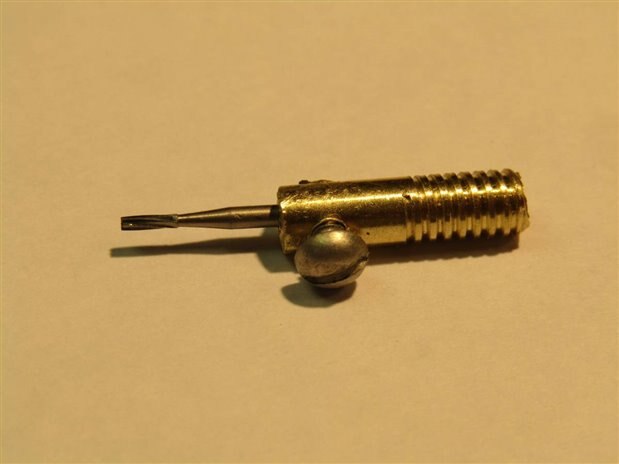
 

image


I have taken a piece of solid brass rod and threaded it so that it will screw into my probe handle. I next drilled a 1.5 mm hole down the center to accommodate the bur. Finally I cross drilled and tapped a hole for a set screw to retain the bur. Here are all the parts for the probe extensions before and after assembly;

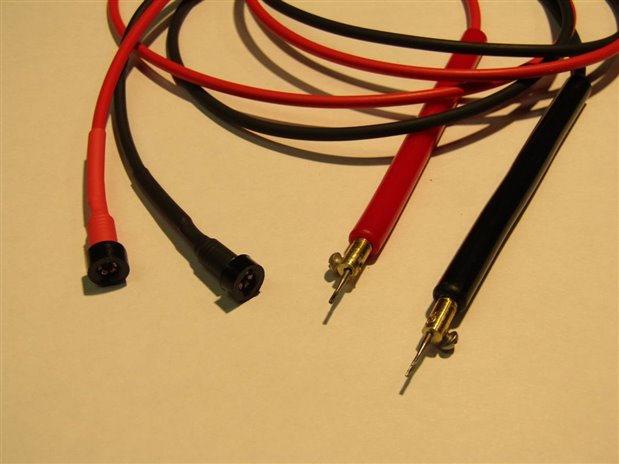
 

image


image

Placing the bur on the epoxy above the pad or component that I want to probe and with light pressure and a slight twist the sharp points of the bur cut down to the metal and a dependable reading is obtained on the meter. These burs are very common and probably can be purchased from any dentist. You will find that even used burs will work well as the dentist uses the flutes on the sides to cut and we are mainly interested in the star flutes on the tip. The bur shaft is made of steel and the tips are tungsten carbide. This material has a higher resistance than the usual metal used for probe tips. My probe extensions and tips added about 0.1 ohm of series resistance which I can mentally add into my readings. It of course doesn't impact the voltage readings.


John

  • Sign in to reply

Top Comments

  • jw0752
    jw0752 over 9 years ago +6
    Here is one more iteration of the idea. I have made adapters to go one the tips of my meter probes and eliminated the extra wire. John
  • jw0752
    jw0752 over 8 years ago in reply to rachaelp +6
    Hi Rachael, Thank you very much for the report on how the non-slip tips made your measurement easier. I am still enthused about them and I continue to try to show them to people who I believe would find…
  • jw0752
    jw0752 over 9 years ago +5
    Update to this Blog: I have continued to work on this idea and to refine it. The goals that I had for this iteration of the idea are to modify a set of meter test probes so that the probe itself has a…
  • jw0752
    jw0752 over 10 years ago

    UPDATE!


    Since putting these probes together last night I have made a couple of improvements. The first thing that I did was to replace the bulky slot headed set screws with some nice, more recessed, Allen head set screws. This will make the probes more accessible to tight spaces.


    image


    The next improvement was insulation of the chucks at the tip of the probes. This will also improve accessibility to tight spaces as I will not have to be concerned with shorting to neighboring components. Here is what the finished improved tip looks like:


    image


    I mentioned that the tips of these probes are not pointy sharp like a needle would be. Here you can see how I can press the probe tip hard into my palm without penetrating the skin.


    image


    On the other hand the points on the flutes of the bur are so sharp and hard that they will actually bite into glass as illustrated by the ability of the the probe to support itself against slipping on this glass plate.


    image


    I have also looked at a dental bur catalog and identified several other bur tips that will be useful for special situations. Here are some possibilities:


            imageimageimage


    The dental bur situation in the dental business is very similar to the transistor situation in electronics. The manufacturers all have their own numbers and there seems to be way more than enough choices to cover the different needs. These are shots from a German manufacturer called Meisinger. I am not sure that they still do it but at one time they made all the cutters for the Drehmel Tools. The numbers listed on the pages are the German numbers and the numbers that I have circled in the charts are the USA equivalent numbers.


    John

    • Cancel
    • Vote Up +4 Vote Down
    • Sign in to reply
    • More
    • Cancel
  • jw0752
    jw0752 over 10 years ago in reply to shabaz

    Hi Shabaz,

    Yes, many times the commercial products are just good resource material to build what is really needed. Sometimes I wonder why manufacturers do not go out and survey end users before they design and manufacture so that the insights of the end user can be incorporated into the product.

    John

    • Cancel
    • Vote Up +1 Vote Down
    • Sign in to reply
    • More
    • Cancel
  • shabaz
    shabaz over 10 years ago

    Hi John,


    You always have great solutions! To be honest most probes/leads have a measurable resistance in the tens to low hundreds of milliohm, as you say no significant impact normally.

    Sometimes off-the-shelf test leads are so poor (breaking at the junction between wire and probe) it is a good opportunity to reuse the cable and build custom leads.

    I built my own test leads too (4mm banana ones) since the ones from a nearby retail store weren't great..

    • Cancel
    • Vote Up +1 Vote Down
    • Sign in to reply
    • More
    • Cancel
  • Jan Cumps
    Jan Cumps over 10 years ago

    It's always more fun when they use conformal coating instead of hard epoxy to seal boards.

    You still have a fair chance to access the components with a probe.

    • Cancel
    • Vote Up +1 Vote Down
    • Sign in to reply
    • More
    • Cancel
<
element14 Community

element14 is the first online community specifically for engineers. Connect with your peers and get expert answers to your questions.

  • Members
  • Learn
  • Technologies
  • Challenges & Projects
  • Products
  • Store
  • About Us
  • Feedback & Support
  • FAQs
  • Terms of Use
  • Privacy Policy
  • Legal and Copyright Notices
  • Sitemap
  • Cookies

An Avnet Company © 2026 Premier Farnell Limited. All Rights Reserved.

Premier Farnell Ltd, registered in England and Wales (no 00876412), registered office: Farnell House, Forge Lane, Leeds LS12 2NE.

Follow element14

  • X
  • Facebook
  • linkedin
  • YouTube