element14 Community
element14 Community
    Register Log In
  • Site
  • Search
  • Log In Register
  • Community Hub
    Community Hub
    • What's New on element14
    • Feedback and Support
    • Benefits of Membership
    • Personal Blogs
    • Members Area
    • Achievement Levels
  • Learn
    Learn
    • Ask an Expert
    • eBooks
    • element14 presents
    • Learning Center
    • Tech Spotlight
    • STEM Academy
    • Webinars, Training and Events
    • Learning Groups
  • Technologies
    Technologies
    • 3D Printing
    • FPGA
    • Industrial Automation
    • Internet of Things
    • Power & Energy
    • Sensors
    • Technology Groups
  • Challenges & Projects
    Challenges & Projects
    • Design Challenges
    • element14 presents Projects
    • Project14
    • Arduino Projects
    • Raspberry Pi Projects
    • Project Groups
  • Products
    Products
    • Arduino
    • Avnet & Tria Boards Community
    • Dev Tools
    • Manufacturers
    • Multicomp Pro
    • Product Groups
    • Raspberry Pi
    • RoadTests & Reviews
  • About Us
  • Store
    Store
    • Visit Your Store
    • Choose another store...
      • Europe
      •  Austria (German)
      •  Belgium (Dutch, French)
      •  Bulgaria (Bulgarian)
      •  Czech Republic (Czech)
      •  Denmark (Danish)
      •  Estonia (Estonian)
      •  Finland (Finnish)
      •  France (French)
      •  Germany (German)
      •  Hungary (Hungarian)
      •  Ireland
      •  Israel
      •  Italy (Italian)
      •  Latvia (Latvian)
      •  
      •  Lithuania (Lithuanian)
      •  Netherlands (Dutch)
      •  Norway (Norwegian)
      •  Poland (Polish)
      •  Portugal (Portuguese)
      •  Romania (Romanian)
      •  Russia (Russian)
      •  Slovakia (Slovak)
      •  Slovenia (Slovenian)
      •  Spain (Spanish)
      •  Sweden (Swedish)
      •  Switzerland(German, French)
      •  Turkey (Turkish)
      •  United Kingdom
      • Asia Pacific
      •  Australia
      •  China
      •  Hong Kong
      •  India
      • Japan
      •  Korea (Korean)
      •  Malaysia
      •  New Zealand
      •  Philippines
      •  Singapore
      •  Taiwan
      •  Thailand (Thai)
      • Vietnam
      • Americas
      •  Brazil (Portuguese)
      •  Canada
      •  Mexico (Spanish)
      •  United States
      Can't find the country/region you're looking for? Visit our export site or find a local distributor.
  • Translate
  • Profile
  • Settings
Personal Blogs
  • Community Hub
  • More
Personal Blogs
John Wiltrout's Blog Tree Roots in the Sewer Pipe
  • Blog
  • Documents
  • Mentions
  • Sub-Groups
  • Tags
  • More
  • Cancel
  • New
  • Share
  • More
  • Cancel
Group Actions
  • Group RSS
  • More
  • Cancel
Engagement
  • Author Author: jw0752
  • Date Created: 13 Sep 2016 5:52 AM Date Created
  • Views 1173 views
  • Likes 3 likes
  • Comments 24 comments
  • automatic_flood_protection
  • lm393
  • water_sensor
Related
Recommended

Tree Roots in the Sewer Pipe

jw0752
jw0752
13 Sep 2016

Earlier this summer my son-in-law John and daughter found themselves with a bad problem in the basement of their home. Tree roots had gotten into the sewer main leading from their home and one day the water stopped draining. Unfortunately the water backed up onto their newly installed laminate wood floor and before the disaster was over much of the floor had to be replaced. Last weekend, while at our home for a Labor Day get together, John asked if I could come up with anything that would give him a warning should the roots grow back. I would love to have John come over and do some electronics with me but he is very busy with his work as well as being in the Air Force Reserve which takes up a lot of time. I decided that I would have to get the ball rolling and I will probably have to do much of the work on my own but this is something that he really needs and perhaps I can get the project to the point where he can come over and assemble the system like a kit.


Here is the schematic plan that I came up with to provide a simple alarm for the backing up of water in the sewer. Fortunately he has a clean out situated at the low point in the system where we can put a couple probes that can normally sit above drain water level but will be the first to be contacted with backup should the pipe become clogged again.


image


The circuit will be powered with a 10V to 12V wall wart. There is a green power LED to confirm that the unit is on. The sensor interpretation circuit is a simple LM393 comparator that drives an N channel MOSFET which in turn powers a flashing LED and a Piezo buzzer which is pulsed at about 2 Hz by a 555 timer circuit. An SPDT toggle switch allows the operator to turn off the audio alarm but this also turns on a red LED which gives notice that the audio circuit is no longer on line. This circuit has been bread boarded and tested using plain water in a beaker.
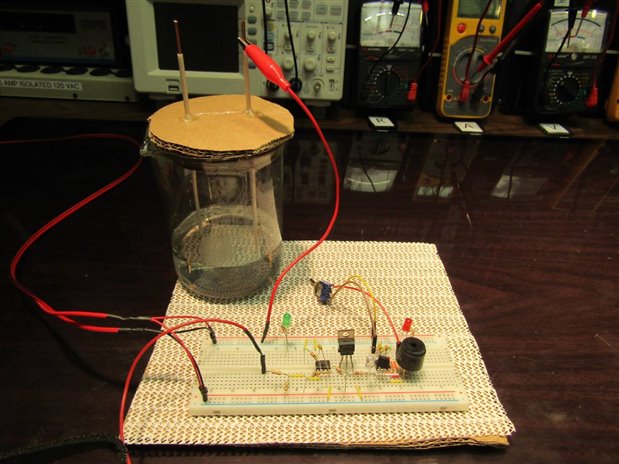
 

image


When power is applied to the circuit but the circuit to the sensor is open we get only the Green Power light. See below.
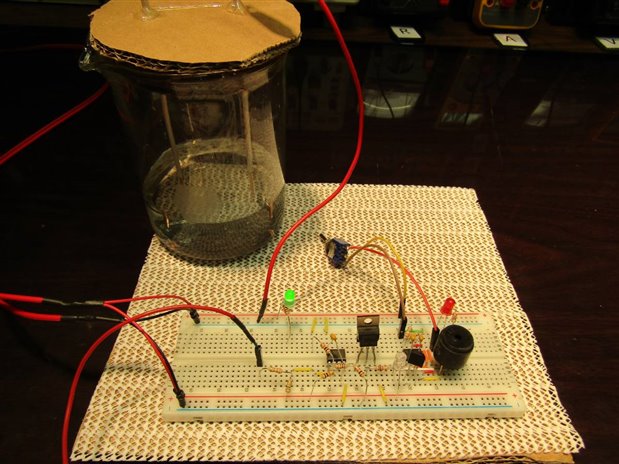
 

image


Connection of the wire to the sensor probes whose ends are in water triggers the alarm which powers the RED / BLUE flasher LED and the buzzer. Imagine you can hear the beep  beep  beep ...
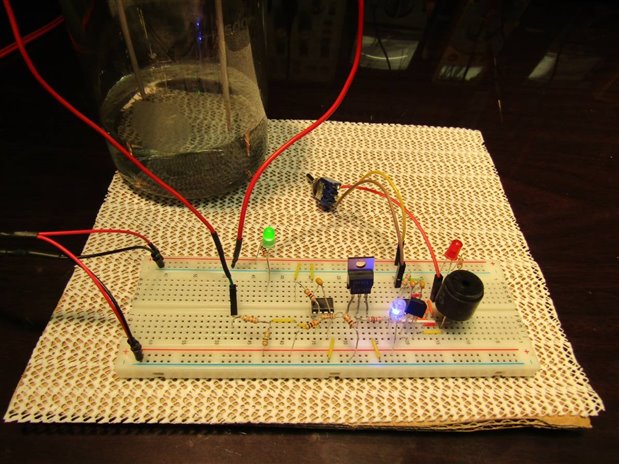
 

image


Since the beep beep beep drives me crazy I have switched the toggle and the beeping stops but the red warning LED is now lit and since the water condition is still present the Flasher ID continues to flash.


image


I will have to wait for John to find time to come over to OK the continuation of this project but since I had some extra time this evening I decided to begin the process of blogging about it. I will add to the blog right through to the finished unit if it goes any further than these preliminaries. Since the problem of backing up water could be a universal problem and this solution is not complicated feel free to make one for yourself and post a picture of your unit so I can see what you made.


John W.

  • Sign in to reply

Top Comments

  • Jan Cumps
    Jan Cumps over 9 years ago +2
    Do you have the risk that the probes corrode in their harsh environment - and become non-conductive when the water touches them?
  • jw0752
    jw0752 over 9 years ago in reply to Jan Cumps +2
    Hi Jan, You make a very good point. My bench test probes are made of copper and would corrode but for the real deal I will cut sections from an old stainless steel car antenna and use them. The stainless…
  • mcb1
    mcb1 over 9 years ago +1
    We once had a similar issue. They used clay pipes and at some point the roots had found their way into a joint that had cracked. The drainlayer used a cutter (which is similar to a hole saw) and fed it…
  • shabaz
    shabaz over 9 years ago in reply to jw0752

    I built something similar for someone a couple of years ago, unfortunately I have no schematic (it was on-the-fly on some stripboard, housed inside a IP68 enclosure and I think from memory it switched a relay.

    I too just used some simple bare probes connected to the end of some wire, and they are held above the drain level. I did warn the customer that they may need cleaning or even eventual replacing without further design thought such as an AC waveform or maybe a float method. He wanted a quick solution built in a day and he was fine with the occasional manual scrub clean. This was at ground level so he could check it regularly (I think the use-case was something to do with a drain that if clogged could possibly allow water to overflow into space where it would then trickle down into underground storage space).

    • Cancel
    • Vote Up +1 Vote Down
    • Sign in to reply
    • More
    • Cancel
  • jw0752
    jw0752 over 9 years ago in reply to mcb1

    Hi Mark,

    To be honest I said herbicide but I really have no idea what the composition of the chemical is that is being used to suppress root growth.

    John

    • Cancel
    • Vote Up 0 Vote Down
    • Sign in to reply
    • More
    • Cancel
  • mcb1
    mcb1 over 9 years ago in reply to jw0752

    water and sewer utility lines are buried about 4 meters deep

    Best you wait until summer to dig them.


    I'd use a smaller digger, rather than a shovel ...but either way it looks like a large job. image

    • Cancel
    • Vote Up 0 Vote Down
    • Sign in to reply
    • More
    • Cancel
  • mcb1
    mcb1 over 9 years ago in reply to DAB

    Salt has to be much better than the herbicide ...


    thankfully all ours are now plastic.

    • Cancel
    • Vote Up 0 Vote Down
    • Sign in to reply
    • More
    • Cancel
  • mcb1
    mcb1 over 9 years ago in reply to D_Hersey

    Don

    I was thinking the same thing.

    You can use a float inside a tube with a small vent tube going to where the toilet would normally vent.


    Mark

    • Cancel
    • Vote Up 0 Vote Down
    • Sign in to reply
    • More
    • Cancel
<>
element14 Community

element14 is the first online community specifically for engineers. Connect with your peers and get expert answers to your questions.

  • Members
  • Learn
  • Technologies
  • Challenges & Projects
  • Products
  • Store
  • About Us
  • Feedback & Support
  • FAQs
  • Terms of Use
  • Privacy Policy
  • Legal and Copyright Notices
  • Sitemap
  • Cookies

An Avnet Company © 2026 Premier Farnell Limited. All Rights Reserved.

Premier Farnell Ltd, registered in England and Wales (no 00876412), registered office: Farnell House, Forge Lane, Leeds LS12 2NE.

ICP 备案号 10220084.

Follow element14

  • X
  • Facebook
  • linkedin
  • YouTube