


We seem to talk a lot about power supplies on E14 - not unreasonable - you can't do much electronics without a decent bench power supply.
You can buy a new single channel 30V 5A sort of thing for about £50 - and if cash is tight and your application not too demanding that might be a good start.
There was road test not that long ago of the Rhode and Schwarz MHP4040 - quite a nice box for £2015 a pop. You might prefer the Keysight E3613A
with HPIB for £1354 ( it has some neat ways of linking the three supplies).
But there is another way if you are on a budget - what would you say to 4 channels, HPIB control the big name manufacturer with a bit of classic chic thrown in,
all for less than £150 ?
You might need to club together with some mates but it can be done.
I recently bought 9 Hewlet Packard HP66xx power supplies at an online auction. Including getting them delivered (on a pallet, total weight 250kg),
they cost a total of about £450 - £50 each.
I have not tested them all yet but so far two just work, one has a blown custom output voltage regulator and one I shall talk about today.
It's a 6629A with 4 identical channels each able to supply 50V @ 1A or 16V @ 2A. You can find full spec, tech manuals, schematics etc on the web.
I made a breakout box to connect the terminals on the back of these supplies, to a handy bench top box - you can see it in the pictures. It uses rather fancy wire
but any decent high current 4 core cable would do. Every channel has remote sensing and I've wired it to the breakout box.
These power supplies can be controlled from the front panel but they are HUGE, so you might rather use a USB to GPIB interface and stick
the supply out of sight and use the breakout box. You can then control the supply from your PC (you'll need to write some code unless you have Labview
or something like it.)
When I powered up this 6629A it seemed to work fine but the fan was silent. I wondered if this was a clever control feature I didn't know about so I
opened the box up to have a look. As I expected the fan was bust (seized up solid) - I replaced it (I'm sad enough to have spare fans for 66xx supplies
lying around !) - and all was fine.
I've done some load checks and you can see from the pictures that the calibration is pretty good. There is a full calibration procedure in the manual if
necessary.
The only sad thing is that the previous owners tend to plaster test gear with calibration and inventory tracking stickers. The auction people always put
the lot number sticker right across the display. This power supply had been written on with very indelible pen. The front panel still looks a bit rough
after a good 30 minutes work with IPA and a mild scourer pad. I may experiment on the really duff power supply with more aggressive solvents.
So there you are, £50 for the supply, £32.26 for a new fan, £25 toward the supplies I can't fix, something for the breakout box - £150.

Power supply opened up - note that wonderful hinge out feature so you see it all without pulling a single plug.
See how it dwarfs the other stuff on my bench, and admire that transformer !
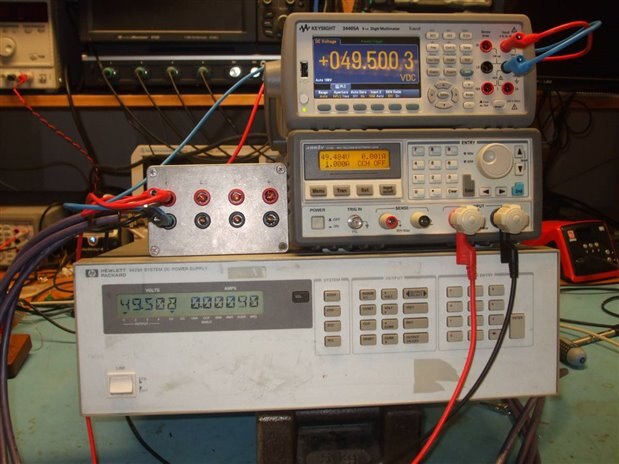
49.5V no load. That scruffy front panel hides a heart of surprising accuracy, for a box that HP last calibrated in 2002 !
The funny 5th digit is toggling between 2 and 5 mV - blame slow camera setting.
The demand was set to 49.5V - so the error as indicated on my meter is 300uV = 6ppm !! The error in
the 6629A's own read back is about 2 or 5mV - a more believable 101ppm (0.01%).
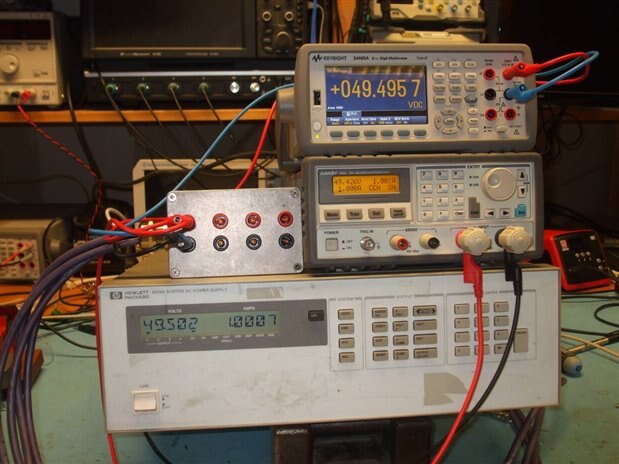
49.5V, 1A load.
You can see that the 6629A thinks it is holding the voltage on the remote sense point on the break out box
at 49.502V but the meter is reading 4.6mV down - but that could easily be due to contact resistance on the
4mm plug to socket, it would only need 4.6mR.
17/06/2019
I've done a bit more since the original post and made some attempts to measure noise and transient performance.
I looked at some of the Road Test reviews on power supplies an found them surprisingly short of transient measurements
and also that several people had trouble measuring noise.
I've also had trouble measuring the noise - so much so that I can't say with any certainty what the actual noise
generated by the psu is.
I found the Picoscope 5444B is a good deal quieter than the LeCroy I use most of the time so I used the Pico for
all the tests.
The test set up was like this:
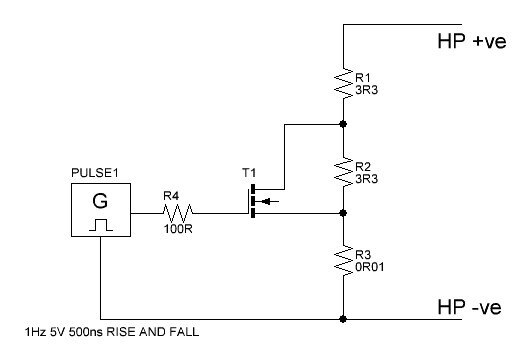
The Pico was connected to the HP terminals. (These are the terminals on my breakout box and 2m of cable away from the
HP box itself.)
My noise looked like this when I had added a 470nF capacitor across the scope, about 4mV pk-pk and
325uV RMS (the HP spec is 500uV and 3mV pk-pk).
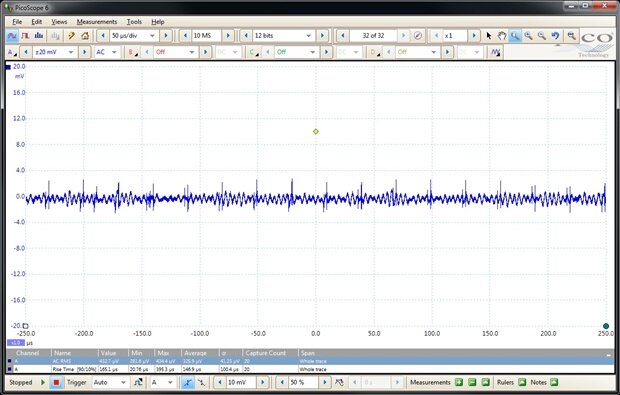
So I might have been happy except that I don't believe that periodic stuff is really coming out of a linear
power supply. So I turned the HP off at the mains and got this:
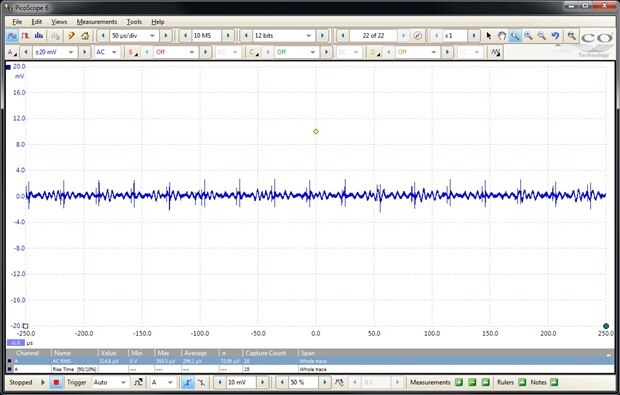
My conclusion is that I'm not really measuring the power supply noise at all - I only fitted the 470nF cap to
see if the spiky stuff would go away (it's a lot worse without the cap). My guess is that the noise is picked
up in the cables and that the psu is quite a high impedance at MHz+ frequencies. The noise is obviously
quite low - just can't tell how low without a different set up.
I started with looking at the rise time with the current limit set to 2.03A and the voltage to 13.2. (Which
should give just under 2A into the 6.61 (+ leads) load.
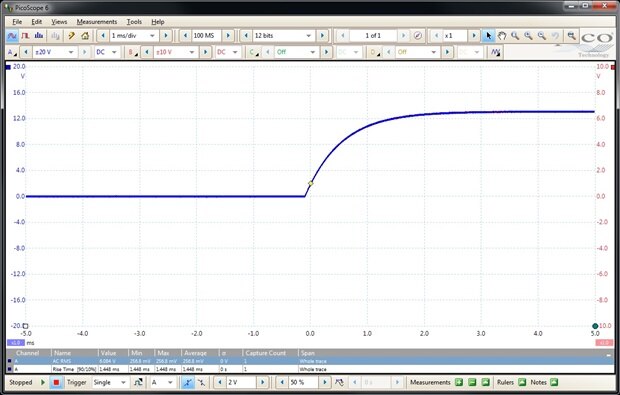
The result is quite good at about 1.5ms for 10% - 90%.
Then I tired the rise time with the current limit at 1A so that the ultimate voltage should be determined
by current control. The result is less good:
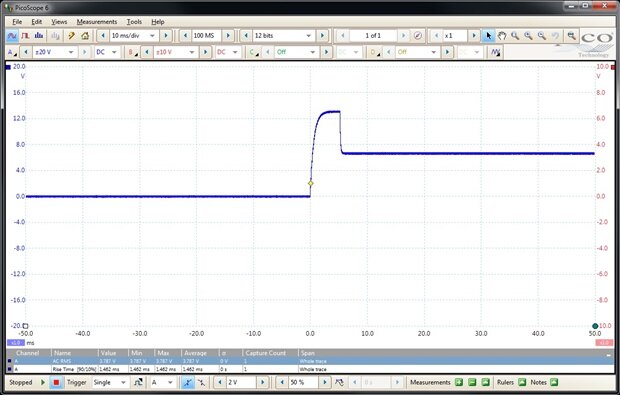
The load is subjected to 5ms of double the current limit. This is not untypical but demonstrates that
the supply is primarily designed for voltage control with current limiting - if you use it as a current source
then take care ! The results are quite similar to those obtained by jadew and Gough Lui in their
reviews of the R&S HMP4040.
Then I increased the current limit so that the supply would move from current limited to voltage limited:
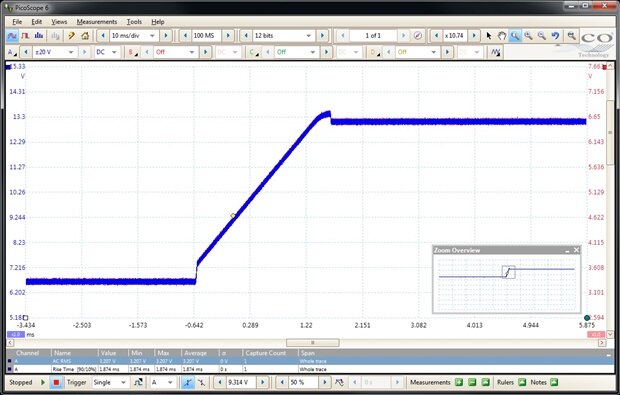
A is usual with power supplies this transition works a lot better.
Very few of the reviews on E14 have good traces for load steps. I used a signal generator to pulse the
power MOSFET on and off at 1Hz. The rise and fall time of the drive pulses was limited to 500ns to reduce
ringing in the current waveform (not entirely successfully).
Switching the load between 6R6 to 3R3 gives this for increasing load:
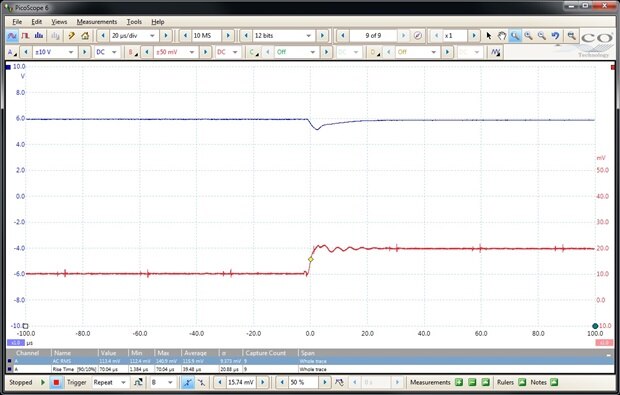
The blue trace is the load voltage and the red is the load current (10mV per amp).
For a decreasing load it's a little less pretty:

A better drive circuit for the MOSFET would have helped (on of those Infineon differential drivers that
Gough and Jan have review recently ?).
Another trick, which helps with noise and transient performance is to add a small capacitor across the
load at the breakout box. I used 470nF and got this for the increasing load:

and this for the decreasing load:
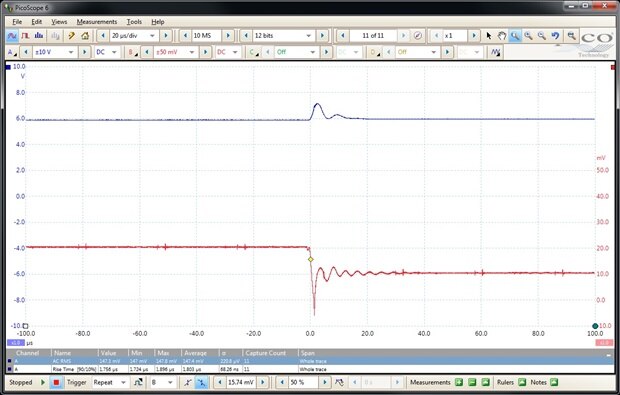
The load reducing transient is only about half the amplitude with the 470nF cap fitted. I'll almost certainly
fit some capacitors in the breakout box - there might even be room for switches - so I could have 0, 1uF
or 10uF.
Overall I'm quite impressed by how well the HP still works - and that it's performance is pretty good
even compared with modern supplies.
SInce I've got everything set up I'll try a quick comparison with my TTi QL564TP, which is my every day
bench PSU.
MK
Top Comments
-

shabaz
-
Cancel
-
Vote Up
+6
Vote Down
-
-
Sign in to reply
-
More
-
Cancel
Comment-

shabaz
-
Cancel
-
Vote Up
+6
Vote Down
-
-
Sign in to reply
-
More
-
Cancel
Children