element14 Community
element14 Community
    Register Log In
  • Site
  • Search
  • Log In Register
  • Community Hub
    Community Hub
    • What's New on element14
    • Feedback and Support
    • Benefits of Membership
    • Personal Blogs
    • Members Area
    • Achievement Levels
  • Learn
    Learn
    • Ask an Expert
    • eBooks
    • element14 presents
    • Learning Center
    • Tech Spotlight
    • STEM Academy
    • Webinars, Training and Events
    • Learning Groups
  • Technologies
    Technologies
    • 3D Printing
    • FPGA
    • Industrial Automation
    • Internet of Things
    • Power & Energy
    • Sensors
    • Technology Groups
  • Challenges & Projects
    Challenges & Projects
    • Design Challenges
    • element14 presents Projects
    • Project14
    • Arduino Projects
    • Raspberry Pi Projects
    • Project Groups
  • Products
    Products
    • Arduino
    • Avnet & Tria Boards Community
    • Dev Tools
    • Manufacturers
    • Multicomp Pro
    • Product Groups
    • Raspberry Pi
    • RoadTests & Reviews
  • About Us
  • Store
    Store
    • Visit Your Store
    • Choose another store...
      • Europe
      •  Austria (German)
      •  Belgium (Dutch, French)
      •  Bulgaria (Bulgarian)
      •  Czech Republic (Czech)
      •  Denmark (Danish)
      •  Estonia (Estonian)
      •  Finland (Finnish)
      •  France (French)
      •  Germany (German)
      •  Hungary (Hungarian)
      •  Ireland
      •  Israel
      •  Italy (Italian)
      •  Latvia (Latvian)
      •  
      •  Lithuania (Lithuanian)
      •  Netherlands (Dutch)
      •  Norway (Norwegian)
      •  Poland (Polish)
      •  Portugal (Portuguese)
      •  Romania (Romanian)
      •  Russia (Russian)
      •  Slovakia (Slovak)
      •  Slovenia (Slovenian)
      •  Spain (Spanish)
      •  Sweden (Swedish)
      •  Switzerland(German, French)
      •  Turkey (Turkish)
      •  United Kingdom
      • Asia Pacific
      •  Australia
      •  China
      •  Hong Kong
      •  India
      • Japan
      •  Korea (Korean)
      •  Malaysia
      •  New Zealand
      •  Philippines
      •  Singapore
      •  Taiwan
      •  Thailand (Thai)
      • Vietnam
      • Americas
      •  Brazil (Portuguese)
      •  Canada
      •  Mexico (Spanish)
      •  United States
      Can't find the country/region you're looking for? Visit our export site or find a local distributor.
  • Translate
  • Profile
  • Settings
Personal Blogs
  • Community Hub
  • More
Personal Blogs
Ralph Yamamoto's Blog NVR Died
  • Blog
  • Documents
  • Mentions
  • Sub-Groups
  • Tags
  • More
  • Cancel
  • New
  • Share
  • More
  • Cancel
Group Actions
  • Group RSS
  • More
  • Cancel
Engagement
  • Author Author: ralphjy
  • Date Created: 2 Nov 2019 9:55 PM Date Created
  • Views 2575 views
  • Likes 6 likes
  • Comments 9 comments
  • nvr
  • diy repair
Related
Recommended

NVR Died

ralphjy
ralphjy
2 Nov 2019

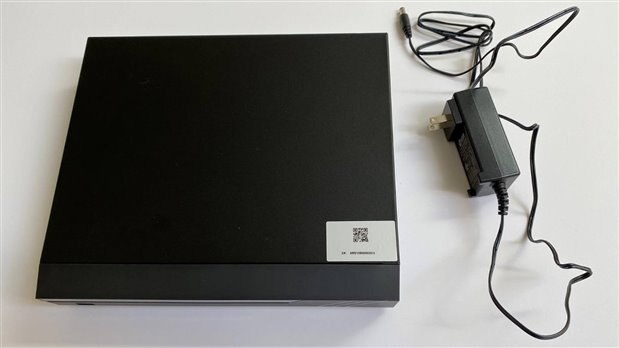
The NVR that I use to store my ip surveillance camera video just died.  it has been running continuously for 14 months.  My experience with electronic equipment that runs 24/7 is that things tend to die in the 3-5 year timeframe.  Usually it's the power supply, especially if it's a wall wart.  Or with NVRs, DVRs, or network storage, it is usually a disk drive.  The unit is an Amcrest NV4108-HS 8-channel HD NVR.


I noticed that the unit was not functioning when I tried to view some recorded video.  When I checked it there was no power indication (no LEDs lit, no fan or disk noise).  I was hoping that it was just the power supply (12V, 2A wall wart) but unfortunately it looks okay with a resistive load.  So, now I'm on to troubleshooting it.
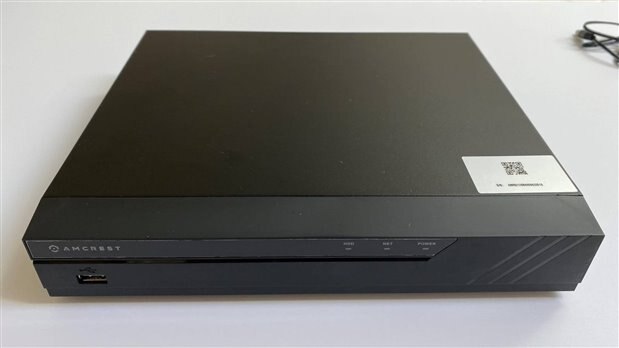
image

image


I had initially tested the power supply with a 25 ohm load, so I tried again with a 5.1 ohm load just to make sure it could handle the 2A rated current.  The voltage dropped a couple of hundred millivolts but that was probably due to the small gauge wire.  So, the power supply looks fine.


I put a DVM across 12V to ground and measured a dead short.  The current limit on the power adapter must be protecting the adapter from damage.


Here's a look at the inside of the NVR:
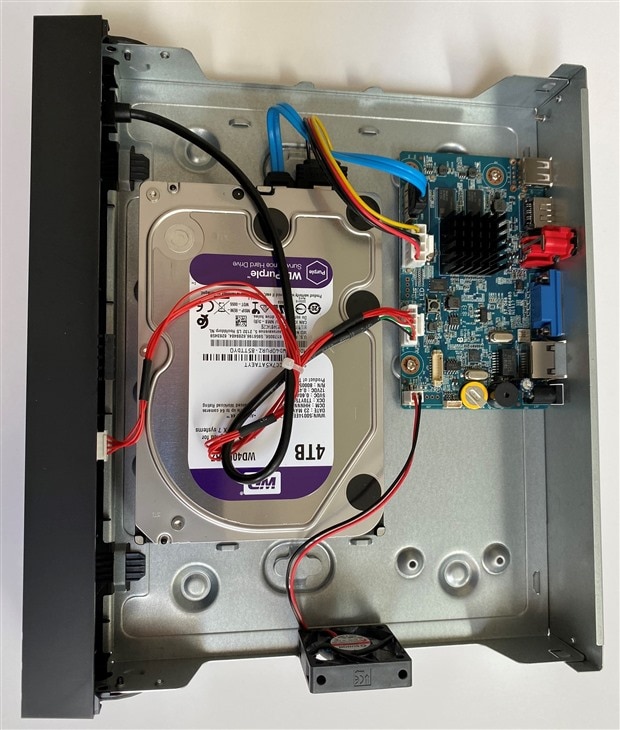
image


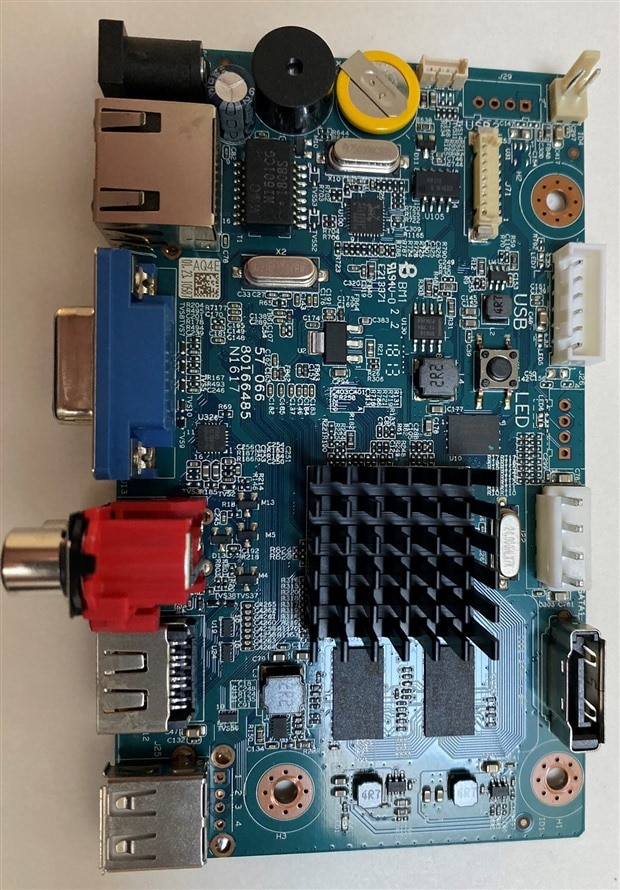
And a closeup of the PCB:

image


A close inspection of both sides of the PCB did not show any obviously damaged or burnt components.  Unfortunately, I haven't been able to find a schematic for this board.  I'm pretty sure that it is manufactured by Dahua who is an OEM supplier for Amcrest and many others.


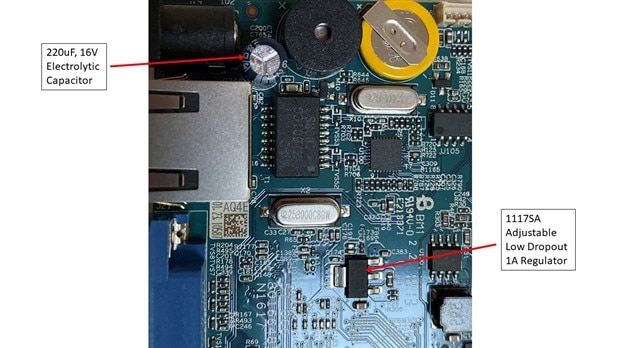
I identified a couple of components that I thought could possibly short the power supply.  The first was obvious - a 220uF electrolytic capacitor that is just behind the power jack.  I removed it but the short was still there and the capacitor checked out okay.  I was hoping to find other electrolytics or voltage regulators (I assume that there is at least a 5V regulator).  I did find an adjustable regulator but its input is not attached to 12V.  Wish I had a schematic......
image


I did not pull the heatsink off what I assume is the primary ASIC mainly because I doubt that it would be directly tied to 12V.  At this point I think that I may just give up unless someone has any good ideas.  Normally, if I had a schematic I would try to push some current into the rail and try to determine where the short is.  Without a schematic it would be hard to figure out where to measure.  If I felt lucky I could just crank up the current and watch for the smoke but I'm not in the mood to try that.


Unfortunately, I was hoping to use the NVR as a video source for my Path II Programmable project so I need to think about a replacement.  The Amcrest unit functioned very well but it is quite disappointing that it had an early death.


At least I should be able to repurpose the case and I'm pretty sure the hard drive is still good - I guess I should verify that next.

  • Sign in to reply

Top Comments

  • jw0752
    jw0752 over 6 years ago +5
    Hi Ralph, The chances of finding the problem when it is a shorted power in line are usually pretty good. I would begin with an ohm meter probe on one of the power input wires and then I would look at all…
  • Gough Lui
    Gough Lui over 6 years ago +5
    I would suggest you try isolating as much as you can. I'm not sure if you have tried, but see what happens if you try to apply 12V power without the fan and hard drive attached. If the board is still shorted…
  • shabaz
    shabaz over 6 years ago +4
    Hi Ralph, I too think the excellent techniques mention by John will help. Were you looking for a composite (RCA connector) video output? A source could be camera modules from ebay, they are around $10…
  • Gough Lui
    Gough Lui over 6 years ago in reply to ralphjy

    Hmm. I wonder if your power brick might have an intermittent feedback winding or optoisolator connection. Transient overvoltage would be the only thing I can think of that would harm most ICs. Problem is if it was truly shorted, there's a slim chance the output of the converters may have been unregulated/up to full input voltage as well, causing collateral damage.


    Things like TVSS diodes on most hard drives may fail shorted in response to overvoltage, removing them may allow the drive to function if they are damaged.


    Not sure whether this patient can be saved ...


    - Gough

    • Cancel
    • Vote Up +1 Vote Down
    • Sign in to reply
    • More
    • Cancel
  • ralphjy
    ralphjy over 6 years ago in reply to shabaz

    Hi Shabaz,


    My reason for using the NVR for the PIIP project is just to get stored video to analyze (I'm also going to use live camera feeds but I don't store video on the camera or in the cloud).  The IP cameras and the NVR have internal webservers that will provide an RTSP video stream over the network.


    As you suggest, it probably will be worthwhile removing those capacitors and then the DC-DC converters if the caps are okay.  I can't determine what the specific converter is.  All three of the 6 pin ones are labelled the same.

    image


    But it seems that for the few buck converters that I've looked at that there is a standard 6 pin SOT footprint.

    image


    And all 3 of them show shorts between Vin and Gnd (pins 5 and 2).  So, a good place to start.


    Unfortunately, I probably need to get another soldering iron to do this efficiently.  It seems that they are using lead-free solder (probably a good thing) as I'm having a difficult time getting the solder off the board.  And as I mentioned to John, I'm quite busy so this will need to be a background task.


    Ralph

    • Cancel
    • Vote Up +2 Vote Down
    • Sign in to reply
    • More
    • Cancel
  • ralphjy
    ralphjy over 6 years ago in reply to Gough Lui

    Hi Gough,


    I always look for electrolytics and tantalums first.  Interesting that the only one electrolytic that I see is the one that I removed at the input.  Good suggestion to take a closer look at the output of the power brick.  I'll take a look at it with an oscilloscope.  I should make it a habit to do that for all my stuff.  I started to do that with other wall warts that I use.  I've had bad experiences with a lot of the 5V 2.5A supplies that are sold for/with the Raspberry Pi.  There's a particular brand - Rhino that Fry's Electronics sells that are consistently bad in terms of output ripple.  I've noticed that they are selling them for $1 now. 


    Ralph

    • Cancel
    • Vote Up +2 Vote Down
    • Sign in to reply
    • More
    • Cancel
  • ralphjy
    ralphjy over 6 years ago in reply to jw0752

    Hi John,


    Thanks for your suggestions.  I don't currently have access to a thermal camera but that's a good idea.  I do have a power supply with variable current limiting that I could use.  I have to admit that in the old days I did my share of trace cutting to isolate faults.  But like you said nowadays with multi-layer boards and power and ground planes it's quite a bit more difficult.  Probably removing components is going to be the best approach.  I'll need to ponder this a bit.  I've got a few irons in the fire and I wasn't looking for another project but I guess curiosity always get the best of an engineer image.


    Ralph

    • Cancel
    • Vote Up +2 Vote Down
    • Sign in to reply
    • More
    • Cancel
  • jw0752
    jw0752 over 6 years ago

    Hi Ralph,

    When checking the circuit with your meter be aware that the color of the probes may not accurately indicate their polarity. It's best to use a second volt meter to verify which ohmmeter probe has the positive potential.

    John

    • Cancel
    • Vote Up +2 Vote Down
    • Sign in to reply
    • More
    • Cancel
>
element14 Community

element14 is the first online community specifically for engineers. Connect with your peers and get expert answers to your questions.

  • Members
  • Learn
  • Technologies
  • Challenges & Projects
  • Products
  • Store
  • About Us
  • Feedback & Support
  • FAQs
  • Terms of Use
  • Privacy Policy
  • Legal and Copyright Notices
  • Sitemap
  • Cookies

An Avnet Company © 2026 Premier Farnell Limited. All Rights Reserved.

Premier Farnell Ltd, registered in England and Wales (no 00876412), registered office: Farnell House, Forge Lane, Leeds LS12 2NE.

ICP 备案号 10220084.

Follow element14

  • X
  • Facebook
  • linkedin
  • YouTube