element14 Community
element14 Community
    Register Log In
  • Site
  • Search
  • Log In Register
  • Community Hub
    Community Hub
    • What's New on element14
    • Feedback and Support
    • Benefits of Membership
    • Personal Blogs
    • Members Area
    • Achievement Levels
  • Learn
    Learn
    • Ask an Expert
    • eBooks
    • element14 presents
    • Learning Center
    • Tech Spotlight
    • STEM Academy
    • Webinars, Training and Events
    • Learning Groups
  • Technologies
    Technologies
    • 3D Printing
    • FPGA
    • Industrial Automation
    • Internet of Things
    • Power & Energy
    • Sensors
    • Technology Groups
  • Challenges & Projects
    Challenges & Projects
    • Design Challenges
    • element14 presents Projects
    • Project14
    • Arduino Projects
    • Raspberry Pi Projects
    • Project Groups
  • Products
    Products
    • Arduino
    • Avnet & Tria Boards Community
    • Dev Tools
    • Manufacturers
    • Multicomp Pro
    • Product Groups
    • Raspberry Pi
    • RoadTests & Reviews
  • About Us
  • Store
    Store
    • Visit Your Store
    • Choose another store...
      • Europe
      •  Austria (German)
      •  Belgium (Dutch, French)
      •  Bulgaria (Bulgarian)
      •  Czech Republic (Czech)
      •  Denmark (Danish)
      •  Estonia (Estonian)
      •  Finland (Finnish)
      •  France (French)
      •  Germany (German)
      •  Hungary (Hungarian)
      •  Ireland
      •  Israel
      •  Italy (Italian)
      •  Latvia (Latvian)
      •  
      •  Lithuania (Lithuanian)
      •  Netherlands (Dutch)
      •  Norway (Norwegian)
      •  Poland (Polish)
      •  Portugal (Portuguese)
      •  Romania (Romanian)
      •  Russia (Russian)
      •  Slovakia (Slovak)
      •  Slovenia (Slovenian)
      •  Spain (Spanish)
      •  Sweden (Swedish)
      •  Switzerland(German, French)
      •  Turkey (Turkish)
      •  United Kingdom
      • Asia Pacific
      •  Australia
      •  China
      •  Hong Kong
      •  India
      •  Korea (Korean)
      •  Malaysia
      •  New Zealand
      •  Philippines
      •  Singapore
      •  Taiwan
      •  Thailand (Thai)
      • Americas
      •  Brazil (Portuguese)
      •  Canada
      •  Mexico (Spanish)
      •  United States
      Can't find the country/region you're looking for? Visit our export site or find a local distributor.
  • Translate
  • Profile
  • Settings
Arduino
  • Products
  • More
Arduino
Blog ASTROPHOTO mount. (Considerations)
  • Blog
  • Forum
  • Documents
  • Quiz
  • Events
  • Polls
  • Files
  • Members
  • Mentions
  • Sub-Groups
  • Tags
  • More
  • Cancel
  • New
Join Arduino to participate - click to join for free!
  • Share
  • More
  • Cancel
Group Actions
  • Group RSS
  • More
  • Cancel
Engagement
  • Author Author: lokkytron
  • Date Created: 19 Apr 2015 9:44 PM Date Created
  • Views 2211 views
  • Likes 1 like
  • Comments 11 comments
  • photo
  • camera
  • astronomy
  • mount
  • arduino
Related
Recommended

ASTROPHOTO mount. (Considerations)

lokkytron
lokkytron
19 Apr 2015

Hello mates.


Here I come again...I really continue figuring out how to reach a very mall and continous speed of rotation, with a very high precission.

What I want to make is a mount to put on a camera and shoot photos of the night skies. My original idea was in the line of control the movement of my telescope, but I think this is unreacheable in my monetary conditions.


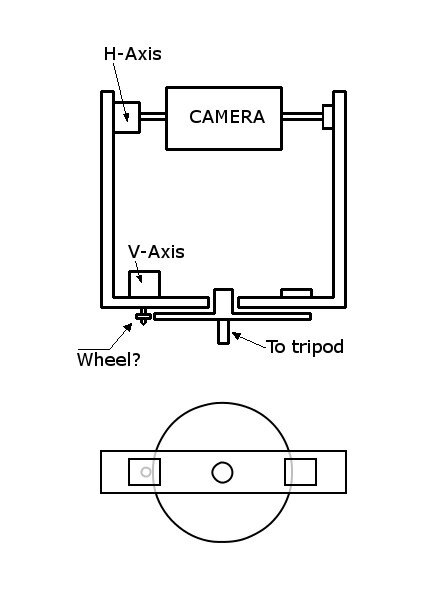
So I am here with this paint schema image

image


The mechanism has aproximatelly 30 cm width and 30 cm height.

The structure will be made with plates of alluminium of 1,5 mm wide

You can think the camera is a small reflex camera (like Nikon D3200)


I had thought that I could reach this with an Arduino UNO board and a pair of sttepers. But when I have started to play with the Arduino board that I bought, some thoughts have come to me. I dont know how to choice the better options.

  1. Will I be able to make this mecha move with a pair of small sttepers 28BYJ-48 with ULN2003 driver?? I have not got the structure pieces yet, so I have not been able to probe this yet.
  2. What do you think will be the better way to control the movement of motors? Bluetooth, IR, RF?
  3. If I would wish to know the angle where the camera to be pointing, ¿what would be the better way? Would I need any optical sensor? or it would be enough with some variables in the code with which I control the sttepers to know this data?
  4. Whatever the choice of motor type, I need to know how to provide movement in the vertical axis. I mean: it would be better a small gear in motor axis and a big gear in the basis? or a wheel in the axis of the motor and a simple circle as basis?


Thank you in advance.

And please, escuse me if I explained it bad

  • Sign in to reply

Top Comments

  • balearicdynamics
    balearicdynamics over 10 years ago in reply to Workshopshed +2
    Andy, frankly I don't consider this a "problem", at least not in terms of an issue. This aspect is well managed by the mill machines and the self-zero point in the steppers is a common practice. Take a…
  • Workshopshed
    Workshopshed over 10 years ago in reply to clem57 +2
    Clem Martins wrote: True Workshopshed But I can see a solution using this: Imagine a circle with a point sticking out. When the point turns around and breaks the laser beam you have hit the zero…
  • balearicdynamics
    balearicdynamics over 10 years ago +2
    Hello, take a look to these two links. This is a smaller structure but if you need we can study something that will work for the DSLR camera, that is the next step of the project. https://www.tindie.com…
  • lokkytron
    lokkytron over 10 years ago

    Thank you Andy Clark, Enrico Miglino and Clem Martins for your comments and contributions.


    I apologize for have been away from element14 for about a week. I've been in bed with a wild migraines.

    I'm still not recovered, so I can not use too much time the computer.


    But I have read the comments and my idea need to be revised... With only two axis I cannot get the rotation of sky so i need al teast one more motor. And the entire device need to be positioned manually pointing to Polaris and then make the move to point and follow an object. As i said, the whole idea need to be revised.


    Thanks again for your time and contributions.

    • Cancel
    • Vote Up +2 Vote Down
    • Sign in to reply
    • More
    • Cancel
  • balearicdynamics
    balearicdynamics over 10 years ago

    Hello,


    take a look to these two links. This is a smaller structure but if you need we can study something that will work for the DSLR camera, that is the next step of the project.


    https://www.tindie.com/products/alicemirror/tiltpan-micro-camera-kit/

    and

    https://www.tindie.com/products/alicemirror/tiltpan-arduino-shield/


    This version is for the stop-motion photography but it doesn't matter because the applied principle is the same. In this case I have used servos and - despite that I appreciate the steppers - I saw two important things developing and testing this proejct; The first is that cheap servos has a considerable torsion and the second is that until now I was able to avoid the dual gear transmission because with microimpulses servos can move very short.


    Now the product you see in the videos works with two common servos but the base can be also work fine with a 360 deg servo (not a modified one, a real full rotation servo).


    With the GoPro and - more - with a heavier DSLR camera there is the problem that the direct traction (coaxial) base servo has serious difficulties to maintain a correct horizon. So, as you can see in the two attached images (done with the mobile of the piece on my desk, no-quality at all, sorry) I have designed a base with recirculating ball bearing included that fits perfectly stable. As you can see in the images of the links on Tindie above with the GoPro (about 100 gr weight) I have also used a small bronze with iron balls bearing (less than 1$ cost) to keep the camera stable when following the azimuth.


    image

    image

    • Cancel
    • Vote Up +2 Vote Down
    • Sign in to reply
    • More
    • Cancel
  • Workshopshed
    Workshopshed over 10 years ago in reply to balearicdynamics

    Yes, it's a problem that's been solved in many different ways before.

    • Cancel
    • Vote Up +1 Vote Down
    • Sign in to reply
    • More
    • Cancel
  • Workshopshed
    Workshopshed over 10 years ago in reply to clem57

    Clem Martins wrote:


    True Workshopshed

         But I can see a solution using this:

    Imagine a circle with a point sticking out. When the point turns around and  breaks the laser beam you have hit the zero point!

    Clem

    Like this?


    You don't have permission to edit metadata of this video.
    Edit media
    x
    image
    Upload Preview
    image

    • Cancel
    • Vote Up +2 Vote Down
    • Sign in to reply
    • More
    • Cancel
  • balearicdynamics
    balearicdynamics over 10 years ago in reply to Workshopshed

    Andy, frankly I don't consider this a "problem", at least not in terms of an issue. This aspect is well managed by the mill machines and the self-zero point in the steppers is a common practice. Take a look to a video of the first mill machine I have done with three-axis steppers controlled by an arduino. With a single input pin and three microswitches (you can save one direction per axis) the problems is solved with a very high repeat precision.


    You don't have permission to edit metadata of this video.
    Edit media
    x
    image
    Upload Preview
    image

    • Cancel
    • Vote Up +2 Vote Down
    • Sign in to reply
    • More
    • Cancel
>
element14 Community

element14 is the first online community specifically for engineers. Connect with your peers and get expert answers to your questions.

  • Members
  • Learn
  • Technologies
  • Challenges & Projects
  • Products
  • Store
  • About Us
  • Feedback & Support
  • FAQs
  • Terms of Use
  • Privacy Policy
  • Legal and Copyright Notices
  • Sitemap
  • Cookies

An Avnet Company © 2025 Premier Farnell Limited. All Rights Reserved.

Premier Farnell Ltd, registered in England and Wales (no 00876412), registered office: Farnell House, Forge Lane, Leeds LS12 2NE.

ICP 备案号 10220084.

Follow element14

  • X
  • Facebook
  • linkedin
  • YouTube