element14 Community
element14 Community
    Register Log In
  • Site
  • Search
  • Log In Register
  • Community Hub
    Community Hub
    • What's New on element14
    • Feedback and Support
    • Benefits of Membership
    • Personal Blogs
    • Members Area
    • Achievement Levels
  • Learn
    Learn
    • Ask an Expert
    • eBooks
    • element14 presents
    • Learning Center
    • Tech Spotlight
    • STEM Academy
    • Webinars, Training and Events
    • Learning Groups
  • Technologies
    Technologies
    • 3D Printing
    • FPGA
    • Industrial Automation
    • Internet of Things
    • Power & Energy
    • Sensors
    • Technology Groups
  • Challenges & Projects
    Challenges & Projects
    • Design Challenges
    • element14 presents Projects
    • Project14
    • Arduino Projects
    • Raspberry Pi Projects
    • Project Groups
  • Products
    Products
    • Arduino
    • Avnet & Tria Boards Community
    • Dev Tools
    • Manufacturers
    • Multicomp Pro
    • Product Groups
    • Raspberry Pi
    • RoadTests & Reviews
  • About Us
    About the element14 Community
  • Store
    Store
    • Visit Your Store
    • Choose another store...
      • Europe
      •  Austria (German)
      •  Belgium (Dutch, French)
      •  Bulgaria (Bulgarian)
      •  Czech Republic (Czech)
      •  Denmark (Danish)
      •  Estonia (Estonian)
      •  Finland (Finnish)
      •  France (French)
      •  Germany (German)
      •  Hungary (Hungarian)
      •  Ireland
      •  Israel
      •  Italy (Italian)
      •  Latvia (Latvian)
      •  
      •  Lithuania (Lithuanian)
      •  Netherlands (Dutch)
      •  Norway (Norwegian)
      •  Poland (Polish)
      •  Portugal (Portuguese)
      •  Romania (Romanian)
      •  Russia (Russian)
      •  Slovakia (Slovak)
      •  Slovenia (Slovenian)
      •  Spain (Spanish)
      •  Sweden (Swedish)
      •  Switzerland(German, French)
      •  Turkey (Turkish)
      •  United Kingdom
      • Asia Pacific
      •  Australia
      •  China
      •  Hong Kong
      •  India
      •  Japan
      •  Korea (Korean)
      •  Malaysia
      •  New Zealand
      •  Philippines
      •  Singapore
      •  Taiwan
      •  Thailand (Thai)
      •  Vietnam
      • Americas
      •  Brazil (Portuguese)
      •  Canada
      •  Mexico (Spanish)
      •  United States
      Can't find the country/region you're looking for? Visit our export site or find a local distributor.
  • Translate
  • Profile
  • Settings
Arduino
  • Products
  • More
Arduino
Blog Internet of Holiday Lights - We meet at Last
  • Blog
  • Forum
  • Documents
  • Quiz
  • Events
  • Polls
  • Files
  • Members
  • Mentions
  • Sub-Groups
  • Tags
  • More
  • Cancel
  • New
Join Arduino to participate - click to join for free!
  • Share
  • More
  • Cancel
Group Actions
  • Group RSS
  • More
  • Cancel
Engagement
  • Author Author: e14 Contributor
  • Date Created: 7 Jan 2015 8:22 PM Date Created
  • Views 1350 views
  • Likes 1 like
  • Comments 9 comments
  • interactive_tree
  • iot_holidaylights
Related
Recommended

Internet of Holiday Lights - We meet at Last

e14 Contributor
e14 Contributor
7 Jan 2015

Ladies and gentlemen, engineers and hobbyists, welcome one and all to my first ever IoT project!


As you can probably guess, I am one of the lucky roadtesters for the Infineon RGB shield. Now this blog has been a long time coming, and I sincerely apologize for this delay, however unlike some other roadtesters this is my first ever electronics project(from home anyway) and so I was slightly unprepared. So I decided that it would be best to wait until I had pretty much everything that I needed for this project before blogging about it so that the blogs could be consistent and evenly spaced out but hey, better late than never as they say!


Now enough of the boring stuff, let's get down to business! So as you can probably see from my tag, I am going to create an interactive Christmas tree, which will be able to change it's lighting according to the mood of the room."How on earth will you find the 'mood' of a room?" I hear you cry! Well to be honest I'm not entirely sure however the plan is to use a small microphone(which will be hung from the Christmas tree itself) to listen to the sound in the room. The arduino yun will then change the colour, intensity and possibly even mode of the RGB strip according to what it hears. For example, if there is little noise the LEDs may be a dim red which will fade in and out, however if there is a lot of loud, high pitched noises the LEDs may be a bright flashing blue.


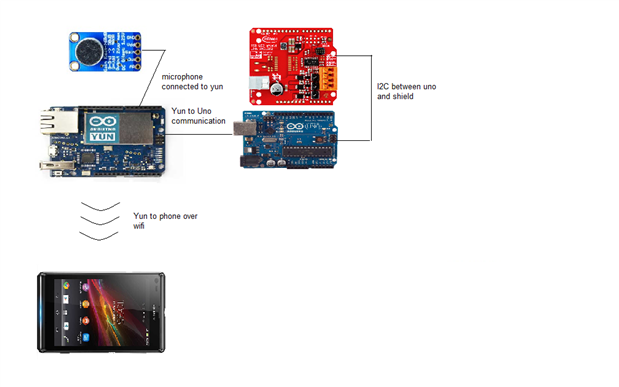
In terms of layout and setup etc., I will have the yun attached to the microphone, deciding on the mood of the room and then telling that to the uno which will control the Infineon board. Although i could possibly have this the other way round, I decided to use the yun to process the data as I also plan to possibly create an app for my phone using the android sdk which will allow me to change things like modes or intensity over wifi. My original thoughts were to connect the yun and arduino via usb, however this can produce some problems, such as the uno drawing power from the yun, and the fact that it looks extremely complicated! I will update you all on my final decision in my next blog.


Below is a picture showing all of the connections between the devices I will be using. It isn't too detailed, but it helps to show what on earth I'm rambling on about.
 

image

Join me again this time next week(hopefully) for my second blog, where i will working with the yun to turn the microphones outputs into moods and then send that to the uno.

  • Sign in to reply
  • Jan Cumps
    Jan Cumps over 11 years ago in reply to e14 Contributor

    I believe pins A4 and A5 are free:

    image


    The Infineon shield uses D14 (SDA) and D15(SCL) for i2c.

    • Cancel
    • Vote Up 0 Vote Down
    • Sign in to reply
    • More
    • Cancel
  • e14 Contributor
    e14 Contributor over 11 years ago in reply to Jan Cumps

    Thank you for the speedy reply Jan. I was looking at using I2C however from what I've seen about the shield it uses pins 4 and 5 so I'll have to look for a workaround for that.

    • Cancel
    • Vote Up 0 Vote Down
    • Sign in to reply
    • More
    • Cancel
  • fvan
    fvan over 11 years ago

    Are you offloading the shield to the UNO for a specific reason ? Why not have both shield and mic on YUN ?

    • Cancel
    • Vote Up 0 Vote Down
    • Sign in to reply
    • More
    • Cancel
  • Jan Cumps
    Jan Cumps over 11 years ago

    I find this the simplest way to connect two Arduinos: via the i2c protocol and wire library:

    http://arduino.cc/en/Tutorial/MasterWriter

    • Cancel
    • Vote Up 0 Vote Down
    • Sign in to reply
    • More
    • Cancel
<
element14 Community

element14 is the first online community specifically for engineers. Connect with your peers and get expert answers to your questions.

  • Members
  • Learn
  • Technologies
  • Challenges & Projects
  • Products
  • Store
  • About Us
  • Feedback & Support
  • FAQs
  • Terms of Use
  • Privacy Policy
  • Legal and Copyright Notices
  • Sitemap
  • Cookies

An Avnet Company © 2026 Premier Farnell Limited. All Rights Reserved.

Premier Farnell Ltd, registered in England and Wales (no 00876412), registered office: Farnell House, Forge Lane, Leeds LS12 2NE.

Follow element14

  • X
  • Facebook
  • linkedin
  • YouTube