element14 Community
element14 Community
    Register Log In
  • Site
  • Search
  • Log In Register
  • Community Hub
    Community Hub
    • What's New on element14
    • Feedback and Support
    • Benefits of Membership
    • Personal Blogs
    • Members Area
    • Achievement Levels
  • Learn
    Learn
    • Ask an Expert
    • eBooks
    • element14 presents
    • Learning Center
    • Tech Spotlight
    • STEM Academy
    • Webinars, Training and Events
    • Learning Groups
  • Technologies
    Technologies
    • 3D Printing
    • FPGA
    • Industrial Automation
    • Internet of Things
    • Power & Energy
    • Sensors
    • Technology Groups
  • Challenges & Projects
    Challenges & Projects
    • Design Challenges
    • element14 presents Projects
    • Project14
    • Arduino Projects
    • Raspberry Pi Projects
    • Project Groups
  • Products
    Products
    • Arduino
    • Avnet & Tria Boards Community
    • Dev Tools
    • Manufacturers
    • Multicomp Pro
    • Product Groups
    • Raspberry Pi
    • RoadTests & Reviews
  • About Us
  • Store
    Store
    • Visit Your Store
    • Choose another store...
      • Europe
      •  Austria (German)
      •  Belgium (Dutch, French)
      •  Bulgaria (Bulgarian)
      •  Czech Republic (Czech)
      •  Denmark (Danish)
      •  Estonia (Estonian)
      •  Finland (Finnish)
      •  France (French)
      •  Germany (German)
      •  Hungary (Hungarian)
      •  Ireland
      •  Israel
      •  Italy (Italian)
      •  Latvia (Latvian)
      •  
      •  Lithuania (Lithuanian)
      •  Netherlands (Dutch)
      •  Norway (Norwegian)
      •  Poland (Polish)
      •  Portugal (Portuguese)
      •  Romania (Romanian)
      •  Russia (Russian)
      •  Slovakia (Slovak)
      •  Slovenia (Slovenian)
      •  Spain (Spanish)
      •  Sweden (Swedish)
      •  Switzerland(German, French)
      •  Turkey (Turkish)
      •  United Kingdom
      • Asia Pacific
      •  Australia
      •  China
      •  Hong Kong
      •  India
      • Japan
      •  Korea (Korean)
      •  Malaysia
      •  New Zealand
      •  Philippines
      •  Singapore
      •  Taiwan
      •  Thailand (Thai)
      • Vietnam
      • Americas
      •  Brazil (Portuguese)
      •  Canada
      •  Mexico (Spanish)
      •  United States
      Can't find the country/region you're looking for? Visit our export site or find a local distributor.
  • Translate
  • Profile
  • Settings
Arduino
  • Products
  • More
Arduino
Arduino Forum Transistor as an analog input
  • Blog
  • Forum
  • Documents
  • Quiz
  • Events
  • Polls
  • Files
  • Members
  • Mentions
  • Sub-Groups
  • Tags
  • More
  • Cancel
  • New
Join Arduino to participate - click to join for free!
Actions
  • Share
  • More
  • Cancel
Forum Thread Details
  • State Verified Answer
  • Replies 19 replies
  • Answers 2 answers
  • Subscribers 404 subscribers
  • Views 2920 views
  • Users 0 members are here
  • transistor
  • input
  • arduino
  • analog
Related

Transistor as an analog input

dirtdiver
dirtdiver over 13 years ago

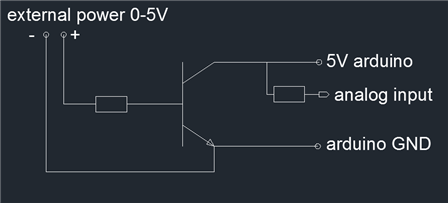
If i were to use a transtor as an analog input device is that the proper way to connect it to the arduino?image

Thanks!

  • Sign in to reply
  • Cancel
Parents
  • Former Member
    0 Former Member over 13 years ago

    Your first drawing will work if you swap the Analog in and Arduino 5V labels.

    • Cancel
    • Vote Up 0 Vote Down
    • Sign in to reply
    • Verify Answer
    • Cancel
  • billabott
    0 billabott over 13 years ago in reply to Former Member

    image

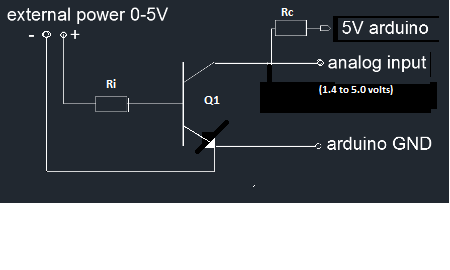
    I positively agree. 


    N.B.  Signal will be distorted due to the fact that the emitter base junction will be OFF whenever the input signal is below 0.7 volts.

    • Cancel
    • Vote Up 0 Vote Down
    • Sign in to reply
    • Verify Answer
    • Reject Answer
    • Cancel
  • dirtdiver
    0 dirtdiver over 13 years ago in reply to billabott

    OK , so i use an NPN (or a pnp im not sure if the edition you made is an arrow pointing in)

    then i have the collector to Ain and what is that resistor before the 5v (regulating current or something?)

    The emitter is connected to GND


    Thanks for the help!

    and sorry for the delay in my reply!

    • Cancel
    • Vote Up 0 Vote Down
    • Sign in to reply
    • Verify Answer
    • Cancel
Reply
  • dirtdiver
    0 dirtdiver over 13 years ago in reply to billabott

    OK , so i use an NPN (or a pnp im not sure if the edition you made is an arrow pointing in)

    then i have the collector to Ain and what is that resistor before the 5v (regulating current or something?)

    The emitter is connected to GND


    Thanks for the help!

    and sorry for the delay in my reply!

    • Cancel
    • Vote Up 0 Vote Down
    • Sign in to reply
    • Verify Answer
    • Cancel
Children
  • billabott
    0 billabott over 13 years ago in reply to dirtdiver

    "... what is that resistor before the 5v ... ?"    Good question.


    As the input signal increases and current, I(b), begins to flow out of the base; a much larger current, I(c), flows out of the collector and that current, my friends, creates a voltage drop across R(c) which the 'Duino will sense on its analog input pin, Ain.  Just to make it clear, yes, the output signal is amplified but also inverted.  


    Oh, and by the way, taydaelectronics.com has some very attractive prices on PNP and NPN transistors.  See their facebook page for  frequenct coupons to help pay part of your S&H charges.

    • Cancel
    • Vote Up 0 Vote Down
    • Sign in to reply
    • Reject Answer
    • Cancel
  • dirtdiver
    0 dirtdiver over 13 years ago in reply to billabott

    Thanks for the explanation!What value should i use for Rc?

    Oh and 0.01$ for a transistor is nice..

    • Cancel
    • Vote Up 0 Vote Down
    • Sign in to reply
    • Verify Answer
    • Cancel
  • billabott
    0 billabott over 13 years ago in reply to dirtdiver

    The data sheet for the transistor will have a max. I(c) value.  Reduce by one half and you have R(c) = 2* [V / I(c)].  Via the Application of  Ohm's Law : V=I*R.  The R(b) will be about 100*R(c). 

    Say, dirtdriver, where do you go to school anyway?

    • Cancel
    • Vote Up 0 Vote Down
    • Sign in to reply
    • Verify Answer
    • Reject Answer
    • Cancel
  • dirtdiver
    0 dirtdiver over 13 years ago in reply to billabott

    well its a "high school of electronics and electrical engineering" or it should be something like that in english

    But im 10th grade (now to be 11th) and so far the stuff i have learned are 5% related to "electricity", image and what i know i know from the enterner or books...but the real education starts next year(not that im waiting for it, i try to learn as much as possible, couse its when i see the chinese dudes making A.I. robots that i realise how little i know... image )

    • Cancel
    • Vote Up 0 Vote Down
    • Sign in to reply
    • Verify Answer
    • Cancel
element14 Community

element14 is the first online community specifically for engineers. Connect with your peers and get expert answers to your questions.

  • Members
  • Learn
  • Technologies
  • Challenges & Projects
  • Products
  • Store
  • About Us
  • Feedback & Support
  • FAQs
  • Terms of Use
  • Privacy Policy
  • Legal and Copyright Notices
  • Sitemap
  • Cookies

An Avnet Company © 2025 Premier Farnell Limited. All Rights Reserved.

Premier Farnell Ltd, registered in England and Wales (no 00876412), registered office: Farnell House, Forge Lane, Leeds LS12 2NE.

ICP 备案号 10220084.

Follow element14

  • X
  • Facebook
  • linkedin
  • YouTube