element14 Community
element14 Community
    Register Log In
  • Site
  • Search
  • Log In Register
  • Community Hub
    Community Hub
    • What's New on element14
    • Feedback and Support
    • Benefits of Membership
    • Personal Blogs
    • Members Area
    • Achievement Levels
  • Learn
    Learn
    • Ask an Expert
    • eBooks
    • element14 presents
    • Learning Center
    • Tech Spotlight
    • STEM Academy
    • Webinars, Training and Events
    • Learning Groups
  • Technologies
    Technologies
    • 3D Printing
    • FPGA
    • Industrial Automation
    • Internet of Things
    • Power & Energy
    • Sensors
    • Technology Groups
  • Challenges & Projects
    Challenges & Projects
    • Design Challenges
    • element14 presents Projects
    • Project14
    • Arduino Projects
    • Raspberry Pi Projects
    • Project Groups
  • Products
    Products
    • Arduino
    • Avnet & Tria Boards Community
    • Dev Tools
    • Manufacturers
    • Multicomp Pro
    • Product Groups
    • Raspberry Pi
    • RoadTests & Reviews
  • About Us
  • Store
    Store
    • Visit Your Store
    • Choose another store...
      • Europe
      •  Austria (German)
      •  Belgium (Dutch, French)
      •  Bulgaria (Bulgarian)
      •  Czech Republic (Czech)
      •  Denmark (Danish)
      •  Estonia (Estonian)
      •  Finland (Finnish)
      •  France (French)
      •  Germany (German)
      •  Hungary (Hungarian)
      •  Ireland
      •  Israel
      •  Italy (Italian)
      •  Latvia (Latvian)
      •  
      •  Lithuania (Lithuanian)
      •  Netherlands (Dutch)
      •  Norway (Norwegian)
      •  Poland (Polish)
      •  Portugal (Portuguese)
      •  Romania (Romanian)
      •  Russia (Russian)
      •  Slovakia (Slovak)
      •  Slovenia (Slovenian)
      •  Spain (Spanish)
      •  Sweden (Swedish)
      •  Switzerland(German, French)
      •  Turkey (Turkish)
      •  United Kingdom
      • Asia Pacific
      •  Australia
      •  China
      •  Hong Kong
      •  India
      • Japan
      •  Korea (Korean)
      •  Malaysia
      •  New Zealand
      •  Philippines
      •  Singapore
      •  Taiwan
      •  Thailand (Thai)
      • Vietnam
      • Americas
      •  Brazil (Portuguese)
      •  Canada
      •  Mexico (Spanish)
      •  United States
      Can't find the country/region you're looking for? Visit our export site or find a local distributor.
  • Translate
  • Profile
  • Settings
Arduino
  • Products
  • More
Arduino
Arduino Forum Switch anode current on with HIGH
  • Blog
  • Forum
  • Documents
  • Quiz
  • Events
  • Polls
  • Files
  • Members
  • Mentions
  • Sub-Groups
  • Tags
  • More
  • Cancel
  • New
Join Arduino to participate - click to join for free!
Actions
  • Share
  • More
  • Cancel
Forum Thread Details
  • State Verified Answer
  • Replies 4 replies
  • Answers 2 answers
  • Subscribers 402 subscribers
  • Views 480 views
  • Users 0 members are here
  • current
  • transistors
  • anode
Related

Switch anode current on with HIGH

Former Member
Former Member over 12 years ago

Hello. I hope the topic makes sense. I would like to add that this is for educational purposes, and that a dedicated driver IC would probably be better.


What I basically want to do is drive a multiplexed 4 digit common anode 7 segment, using some sort of current switching on the anode side and a shift register on the cathode side.


I have this circuit working with pnp transistors on the anode side (right on the schematic below). A low signal on pins 2,3,4 or 5 makes the current flow from the emitter to the collector, and the LED light up in the chosen digit (in a pattern controlled by the shift register).


Is there any way I can replace the PNP transistors with something that reacts the same way to a low signal? First thought was of course NPN transistors, but they have to go on the cathode side, which is not practical with this display. My plan is to try driving the anodes with a counter such as the CD4022 using the latch signal from the shift register, thus potentially saving 4 pins on my arduino.
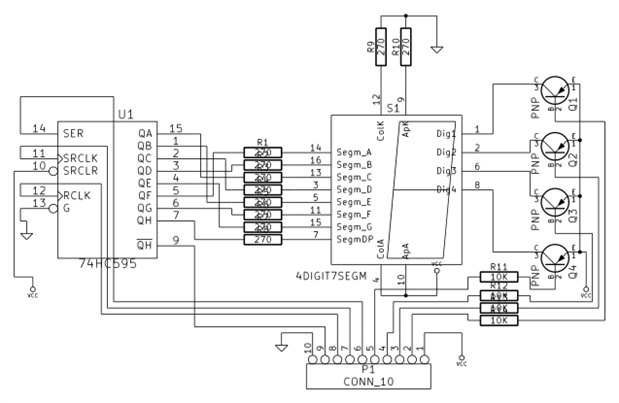
image

(sorry about the messy schematic, it is a quick drawing for learning to work with the PCB-layouting tool in KiCAD)

Attachments:
image
  • Sign in to reply
  • Cancel
Parents
  • dougw
    0 dougw over 12 years ago

    Hi Niels,

    Another thought....

    Could you extend the shift register by 4 bits by cascading a second chip and use these to drive your PNP transistors? - no need for a Johnson counter, signal inversion or more Arduino pins - just make sure only one of the 4 "digit bits" is low.

    Doug

    • Cancel
    • Vote Up 0 Vote Down
    • Sign in to reply
    • Verify Answer
    • Reject Answer
    • Cancel
Reply
  • dougw
    0 dougw over 12 years ago

    Hi Niels,

    Another thought....

    Could you extend the shift register by 4 bits by cascading a second chip and use these to drive your PNP transistors? - no need for a Johnson counter, signal inversion or more Arduino pins - just make sure only one of the 4 "digit bits" is low.

    Doug

    • Cancel
    • Vote Up 0 Vote Down
    • Sign in to reply
    • Verify Answer
    • Reject Answer
    • Cancel
Children
No Data
element14 Community

element14 is the first online community specifically for engineers. Connect with your peers and get expert answers to your questions.

  • Members
  • Learn
  • Technologies
  • Challenges & Projects
  • Products
  • Store
  • About Us
  • Feedback & Support
  • FAQs
  • Terms of Use
  • Privacy Policy
  • Legal and Copyright Notices
  • Sitemap
  • Cookies

An Avnet Company © 2025 Premier Farnell Limited. All Rights Reserved.

Premier Farnell Ltd, registered in England and Wales (no 00876412), registered office: Farnell House, Forge Lane, Leeds LS12 2NE.

ICP 备案号 10220084.

Follow element14

  • X
  • Facebook
  • linkedin
  • YouTube