element14 Community
element14 Community
    Register Log In
  • Site
  • Search
  • Log In Register
  • Community Hub
    Community Hub
    • What's New on element14
    • Feedback and Support
    • Benefits of Membership
    • Personal Blogs
    • Members Area
    • Achievement Levels
  • Learn
    Learn
    • Ask an Expert
    • eBooks
    • element14 presents
    • Learning Center
    • Tech Spotlight
    • STEM Academy
    • Webinars, Training and Events
    • Learning Groups
  • Technologies
    Technologies
    • 3D Printing
    • FPGA
    • Industrial Automation
    • Internet of Things
    • Power & Energy
    • Sensors
    • Technology Groups
  • Challenges & Projects
    Challenges & Projects
    • Design Challenges
    • element14 presents Projects
    • Project14
    • Arduino Projects
    • Raspberry Pi Projects
    • Project Groups
  • Products
    Products
    • Arduino
    • Avnet & Tria Boards Community
    • Dev Tools
    • Manufacturers
    • Multicomp Pro
    • Product Groups
    • Raspberry Pi
    • RoadTests & Reviews
  • About Us
  • Store
    Store
    • Visit Your Store
    • Choose another store...
      • Europe
      •  Austria (German)
      •  Belgium (Dutch, French)
      •  Bulgaria (Bulgarian)
      •  Czech Republic (Czech)
      •  Denmark (Danish)
      •  Estonia (Estonian)
      •  Finland (Finnish)
      •  France (French)
      •  Germany (German)
      •  Hungary (Hungarian)
      •  Ireland
      •  Israel
      •  Italy (Italian)
      •  Latvia (Latvian)
      •  
      •  Lithuania (Lithuanian)
      •  Netherlands (Dutch)
      •  Norway (Norwegian)
      •  Poland (Polish)
      •  Portugal (Portuguese)
      •  Romania (Romanian)
      •  Russia (Russian)
      •  Slovakia (Slovak)
      •  Slovenia (Slovenian)
      •  Spain (Spanish)
      •  Sweden (Swedish)
      •  Switzerland(German, French)
      •  Turkey (Turkish)
      •  United Kingdom
      • Asia Pacific
      •  Australia
      •  China
      •  Hong Kong
      •  India
      • Japan
      •  Korea (Korean)
      •  Malaysia
      •  New Zealand
      •  Philippines
      •  Singapore
      •  Taiwan
      •  Thailand (Thai)
      • Vietnam
      • Americas
      •  Brazil (Portuguese)
      •  Canada
      •  Mexico (Spanish)
      •  United States
      Can't find the country/region you're looking for? Visit our export site or find a local distributor.
  • Translate
  • Profile
  • Settings
Arduino
  • Products
  • More
Arduino
Arduino Forum Seems odd can I get an explation?
  • Blog
  • Forum
  • Documents
  • Quiz
  • Events
  • Polls
  • Files
  • Members
  • Mentions
  • Sub-Groups
  • Tags
  • More
  • Cancel
  • New
Join Arduino to participate - click to join for free!
Actions
  • Share
  • More
  • Cancel
Forum Thread Details
  • State Not Answered
  • Replies 5 replies
  • Subscribers 402 subscribers
  • Views 494 views
  • Users 0 members are here
  • transistor
  • behavior
  • basic
  • odd
Related

Seems odd can I get an explation?

Former Member
Former Member over 11 years ago

Hallo Element 4 I am rather new here, in fact its my first post. I've been playing around with Arduino and various components for it. I was trying to understand transistors and looked up a few tutorials on it. Thus in all examples the transistors I bought behaved rather odd. I've made a schematic of my build on a breadboard where I use the Arduino as a power source and a NPN transistor and I am unsure of the part number so please ignore it on the first picture.

Fullscreen contentimage_76498.html Download
<html><head><title>Jive SBS</title></head>
<body><font face="arial,helvetica,sans-serif">
<b>Error</b><br><font size="-1">
An general error occurred while processing your request.
</font></font></body></html>

At the picture most at the right thats how I understand a button switch to a transistor works. I know the transistor is rather pointless in this, but it was a good way to experiment with the transistor without changing code all the time image


However the odd behavior I was talking about just now is shown on the picture on the right. It yields the same resualt as picture on. As far as I understand an NPN transistor means the Collector have to be negative base should be possitive and the emitter should be negative to get an output. So in the drawing on the left it should nullify all cause its "PPN" and shouldn't light up the LED but it does.


I decided to try to make an AND gate to test some theory. The build looks like this:

Fullscreen contentimage_76499.html Download
<html><head><title>Jive SBS</title></head>
<body><font face="arial,helvetica,sans-serif">
<b>Error</b><br><font size="-1">
An general error occurred while processing your request.
</font></font></body></html>


Whats happening here is this:

when I press A nothing happens. When I press  B it lights up. If I press A and B it still lights up. Which is wrong for an AND gate. Can anyone please explain why it behaves like this? Did I buy the wrong set of transistors?

  • Sign in to reply
  • Cancel
Parents
  • shabaz
    0 shabaz over 11 years ago

    Hi,


    You're starting at a point where it will be hard to follow how a transistor works. The best you could hope for without starting at an earlier point is to just see some example typical circuits and make a note of them.

    That won't get you far if you wish to make changes and have a deeper understanding.


    So, if you wish to start at an earlier point, then it's probably  best to start off with voltage, current, resistance, Ohm's law and then understand how a PN junction works, before looking at a transistor (And, some people assume two diodes make a transistor; this is not the case).


    Considering a transistor leg to be just positive or negative is too simplistic to understand a transistor circuit, so the theory is essential.

    It would be about the minimum information before you could begin to interpret behavior of a circuit containing transistors.


    It's good you're doing practical stuff but you need some minimum theory and then a way to make measurements (multimeter) as you try to experiment.


    To speed up your understanding a quick way to experiment would be to use a simulator such as the one on this university website - there is a pre-built switch simulation using a transistor in there (click on circuit->transistors->switch). Hovering over any wire or device will provide you with measurements. There are also some PDF tutorials at the same site. They look quite good but I think you'll still need a textbook too (and I don't know of any easy book sadly - maybe others do. There are some Forrest M. Mims books that are easy to read and not bad if you want a less-math and more-practical type of book. Also, google 'transistor man' - it provides a simple drawing that is surprisingly good to explain a transistor - but still first requires an understanding of voltage, curent, resistance and Ohm's law.

    image

    • Cancel
    • Vote Up 0 Vote Down
    • Sign in to reply
    • Verify Answer
    • Cancel
Reply
  • shabaz
    0 shabaz over 11 years ago

    Hi,


    You're starting at a point where it will be hard to follow how a transistor works. The best you could hope for without starting at an earlier point is to just see some example typical circuits and make a note of them.

    That won't get you far if you wish to make changes and have a deeper understanding.


    So, if you wish to start at an earlier point, then it's probably  best to start off with voltage, current, resistance, Ohm's law and then understand how a PN junction works, before looking at a transistor (And, some people assume two diodes make a transistor; this is not the case).


    Considering a transistor leg to be just positive or negative is too simplistic to understand a transistor circuit, so the theory is essential.

    It would be about the minimum information before you could begin to interpret behavior of a circuit containing transistors.


    It's good you're doing practical stuff but you need some minimum theory and then a way to make measurements (multimeter) as you try to experiment.


    To speed up your understanding a quick way to experiment would be to use a simulator such as the one on this university website - there is a pre-built switch simulation using a transistor in there (click on circuit->transistors->switch). Hovering over any wire or device will provide you with measurements. There are also some PDF tutorials at the same site. They look quite good but I think you'll still need a textbook too (and I don't know of any easy book sadly - maybe others do. There are some Forrest M. Mims books that are easy to read and not bad if you want a less-math and more-practical type of book. Also, google 'transistor man' - it provides a simple drawing that is surprisingly good to explain a transistor - but still first requires an understanding of voltage, curent, resistance and Ohm's law.

    image

    • Cancel
    • Vote Up 0 Vote Down
    • Sign in to reply
    • Verify Answer
    • Cancel
Children
  • Former Member
    0 Former Member over 11 years ago in reply to shabaz

    I said I was new to Element 14 not to electronics image We have it on school but unfortunally my teacher have been sick for a long time :C. I do know Ohms law and so on to be fair I devolp a pong game and stuff. So I am experinced in the way of electronics with current and voltages and ressitance how it theortically work. What just puzzles me is why the circut I show doesn't work is it really something that basic I missed o: ?


    As I understand transistors of the NPN type

    The collector have to be negative meaning no power

    The base positive meaning it needs to have power

    and the emitor Negative

    if its something else the transistor wont work as intented


    So the drawing to the right makes sense cause the current on the collector is negative theres no current going through so thats good. However at the left the collector is possitive. Meaning it work? O:

    • Cancel
    • Vote Up 0 Vote Down
    • Sign in to reply
    • Verify Answer
    • Cancel
  • shabaz
    0 shabaz over 11 years ago in reply to Former Member

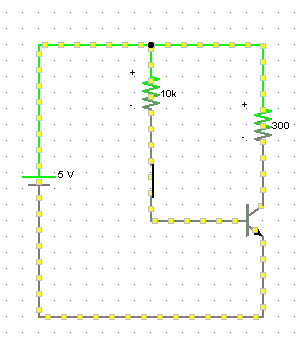
    Resistors R2,4,5 and 6 are currently doing nothing (can you guess why? - clue - parallel circuits).

    You can use Ohm's law to see that, by writing what voltages are on each side of the resistor - and noticing

    what effect will occur to the voltages if you flick the switch on or off.


    You'll find the circuit behaves very differently if you insert resistors in series with the base.

    For example, in your top-left circuit, if you insert the resistor (perhaps 10k), you'll find the LED doesn't light (or is dim).

    The transistor works like a diode if you don't use that junction (as an interesting question to aid learning, what voltages

    would you approximately expect between the Base and 0V, and the Emitter and 0V, and what value do you get when

    you subtract one from the other)?


    If you did the same thing in your lower circuit (i.e. insert base resistors), the AND circuit behavior that you want will occur.

    This will demonstrate the switching action.

    I strongly recommend experimenting with the simulator and observing the voltages and currents at different junctions.


    EDIT: sorry, crossed with John's post too.

    • Cancel
    • Vote Up 0 Vote Down
    • Sign in to reply
    • Verify Answer
    • Cancel
element14 Community

element14 is the first online community specifically for engineers. Connect with your peers and get expert answers to your questions.

  • Members
  • Learn
  • Technologies
  • Challenges & Projects
  • Products
  • Store
  • About Us
  • Feedback & Support
  • FAQs
  • Terms of Use
  • Privacy Policy
  • Legal and Copyright Notices
  • Sitemap
  • Cookies

An Avnet Company © 2025 Premier Farnell Limited. All Rights Reserved.

Premier Farnell Ltd, registered in England and Wales (no 00876412), registered office: Farnell House, Forge Lane, Leeds LS12 2NE.

ICP 备案号 10220084.

Follow element14

  • X
  • Facebook
  • linkedin
  • YouTube