element14 Community
element14 Community
    Register Log In
  • Site
  • Search
  • Log In Register
  • Community Hub
    Community Hub
    • What's New on element14
    • Feedback and Support
    • Benefits of Membership
    • Personal Blogs
    • Members Area
    • Achievement Levels
  • Learn
    Learn
    • Ask an Expert
    • eBooks
    • element14 presents
    • Learning Center
    • Tech Spotlight
    • STEM Academy
    • Webinars, Training and Events
    • Learning Groups
  • Technologies
    Technologies
    • 3D Printing
    • FPGA
    • Industrial Automation
    • Internet of Things
    • Power & Energy
    • Sensors
    • Technology Groups
  • Challenges & Projects
    Challenges & Projects
    • Design Challenges
    • element14 presents Projects
    • Project14
    • Arduino Projects
    • Raspberry Pi Projects
    • Project Groups
  • Products
    Products
    • Arduino
    • Avnet & Tria Boards Community
    • Dev Tools
    • Manufacturers
    • Multicomp Pro
    • Product Groups
    • Raspberry Pi
    • RoadTests & Reviews
  • About Us
  • Store
    Store
    • Visit Your Store
    • Choose another store...
      • Europe
      •  Austria (German)
      •  Belgium (Dutch, French)
      •  Bulgaria (Bulgarian)
      •  Czech Republic (Czech)
      •  Denmark (Danish)
      •  Estonia (Estonian)
      •  Finland (Finnish)
      •  France (French)
      •  Germany (German)
      •  Hungary (Hungarian)
      •  Ireland
      •  Israel
      •  Italy (Italian)
      •  Latvia (Latvian)
      •  
      •  Lithuania (Lithuanian)
      •  Netherlands (Dutch)
      •  Norway (Norwegian)
      •  Poland (Polish)
      •  Portugal (Portuguese)
      •  Romania (Romanian)
      •  Russia (Russian)
      •  Slovakia (Slovak)
      •  Slovenia (Slovenian)
      •  Spain (Spanish)
      •  Sweden (Swedish)
      •  Switzerland(German, French)
      •  Turkey (Turkish)
      •  United Kingdom
      • Asia Pacific
      •  Australia
      •  China
      •  Hong Kong
      •  India
      • Japan
      •  Korea (Korean)
      •  Malaysia
      •  New Zealand
      •  Philippines
      •  Singapore
      •  Taiwan
      •  Thailand (Thai)
      • Vietnam
      • Americas
      •  Brazil (Portuguese)
      •  Canada
      •  Mexico (Spanish)
      •  United States
      Can't find the country/region you're looking for? Visit our export site or find a local distributor.
  • Translate
  • Profile
  • Settings
Avnet Boards Forums
  • Products
  • Dev Tools
  • Avnet & Tria Boards Community
  • Avnet Boards Forums
  • More
  • Cancel
Avnet Boards Forums
ZedBoard Hardware Design OCM vs DDR vs BRAM read/write speed
  • Forum
  • Documents
  • Members
  • Mentions
  • Sub-Groups
  • Tags
  • More
  • Cancel
  • New
Join Avnet Boards Forums to participate - click to join for free!
Actions
  • Share
  • More
  • Cancel
Forum Thread Details
  • State Not Answered
  • Replies 7 replies
  • Subscribers 340 subscribers
  • Views 2957 views
  • Users 0 members are here
Related

OCM vs DDR vs BRAM read/write speed

Former Member
Former Member over 10 years ago

Hi,

I executed an application that writes 8KB of data on OCM, DDR and BRAM for 2 Mega times (for each memory I wrote 16GB totally). I expected different memory speeds for OCM, DDR and BRAM but to my surprise all of these actions were done at the same time. I am using the memset() function for writing 8KB buffers. Anybody can explain it?

-Mohammad

  • Sign in to reply
  • Cancel
  • zedhed
    0 zedhed over 10 years ago

    Hi Mohammad,

    Are you writing over the same 8KB buffer space successively?

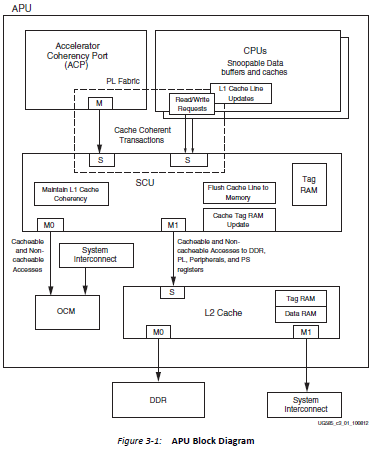
    According to UG585, Zynq has "32KB instruction and 32KB data L1 caches with parity per MPCore" and according to the APU block diagram, the cache coherent trascations with OCM, DDR, and the System Interconnect have to go through the Snoop Control Unit.  If you expand the buffer size beyond 8KB, do you see a difference in performance between these different memories?

    image

    Source:  http://www.xilinx.com/support/documentation/user_guides/ug585-Zynq-7000-TRM.pdf

    Regards,

    -Kevin

    • Cancel
    • Vote Up 0 Vote Down
    • Sign in to reply
    • Verify Answer
    • Cancel
  • Former Member
    0 Former Member over 10 years ago in reply to zedhed

    Hi Kevin,

    I checked my code and found a mistake there then correct it.

    Now it is demonstrated that writing on the BRAM is much slower than writing on the DDR or OCM but writing on these two are performing with the same speed. Although I expected higher speed for OCM (Do you agree?!). I can not understand why!

    Mohammad

    • Cancel
    • Vote Up 0 Vote Down
    • Sign in to reply
    • Verify Answer
    • Cancel
  • Former Member
    0 Former Member over 10 years ago in reply to Former Member

    Hi Mohammad,

    Could you please show the code about testing the speed for OCM and DDR? Thanks very much!

    Regards,
    linesonly

    • Cancel
    • Vote Up 0 Vote Down
    • Sign in to reply
    • Verify Answer
    • Cancel
  • Former Member
    0 Former Member over 10 years ago in reply to Former Member

    Hi, there is my bare metal code for OCM and DDR Read/Write speed testing on zedboard.

    (0)We need some timer functions to record time
    int timer_read() {
    tint base, a;
    tbase = 0xf8002000;
    ta = REG_READ(base+0x18);
    treturn a;
    }
    double timer_value(int t, double fpclk) {
    t// t in timer units, fpclk in mhz
    t// returns timer value in seconds
    tdouble x;
    tx = ((double) t) * 65536.0 / (fpclk * 1000000.0);
    treturn x;
    }

    (1)Register set
    taddr_value(0xf8000910); // tttttttt slcr.OCM_CFG[RAM_HI] = 1000
    taddr_value(0xf8f00000); //mpcore.SCU_CONTROL_REGISTER[Address_filtering_enable] = 1
    taddr_value(0xf8f00040); //tt      mpcore.Filtering_Start_Address_Register = 0x0010_0000
    taddr_value(0xf8f00044); //ttt    mpcore.Filtering_End_Address_Register = 0xffe0_0000

    (2) prepare a random address offset data (stored in OCM) and write/read function
    tint random_offset[100] = {0x4700, 0x4300, 0x7300, 0x8600, 0x3600, 0x9600, 0x4700, 0x3600, 0x6100, 0x4600, 0x9900, 0x6900, 0x8100, 0x6200, 0x9700, 0x7400, 0x2400, 0x6700, 0x6200, 0x4200, 0x8100, 0x1400, 0x5700, 0x2000, 0x4200, 0x5300, 0x3200, 0x3700, 0x3200, 0x1600, 0x7600, 0x0200, 0x2700, 0x6600, 0x5600, 0x5000, 0x2600, 0x7100, 0x0700, 0x3200, 0x9000, 0x7900, 0x7800, 0x5300, 0x1200, 0x5600, 0x8500, 0x9900, 0x2600, 0x9600, 0x9600, 0x6800, 0x2700, 0x3100, 0x0500, 0x0300, 0x7200, 0x9300, 0x1500, 0x5500, 0x5900, 0x5600, 0x3500, 0x6400, 0x3800, 0x5400, 0x8200, 0x4600, 0x2200, 0x3100, 0x6200, 0x4300, 0x0900, 0x9000, 0x1600, 0x2200, 0x7700, 0x9400, 0x3900, 0x4900, 0x5400, 0x4300, 0x5400, 0x8200, 0x1700, 0x3700, 0x9300, 0x2300, 0x7800, 0x8400, 0x4200, 0x1700, 0x5300, 0x3100, 0x5700, 0x2400, 0x5500, 0x0600, 0x8800, 0x7700};

    Write/read function:
    #define REG_READ(addr)
    tt({int val;int a=addr; asm volatile ("ldr   %0,[%1]
    " : "=r"(val) : "r"(a)); val;})

    #define REG_WRITE(addr,val)
    tt({int v = val; int a = addr; __asm volatile ("str  %1,[%0]
    " :: "r"(a),"r"(v)); v;})


    (3) Test OCM, first prepare address:
    t//store random offset data in OCM block 2
    tint *ocm_data_int = 0x00010000;
    tfor(i = 0; i < 100 ; i++){
    ttocm_data_int[i] = OCM_BASE + random_offset[i];
    ttprint_addr_value(&ocm_data_int[i]);
    t}


    (3-1) Test OCM random write speed
            //random write 1.2GB data
    ttimer_init();
    tfor(j = 0; j<3145728; j++){ //2^20 = 1048576; 2^20 * 3 = 3145728
    ttfor(i=0; i<100; i++){
    tttREG_WRITE( ocm_data_int[i], 0xF0F00F0F);
    ttt//REG_WRITE( &ocm_data_int[i]+4, 0xF0F0000F);
    tt}
    t}
    ti = timer_read();
    ttest_time = timer_value(i, pclk);
    tprintf("     random write speed = %g MB/sr
    ", 1200.0/test_time);

    (3-2) Test OCM random read speed
    t// random read 1.2 GB data
    tint data_int=0;
    ttimer_init();
    tfor(j = 0; j<3145728; j++){ //2^20 = 1048576 (*3 = 3145728)
    ttfor(i=0; i<100; i++){
    tttdata_int = REG_READ(ocm_data_int[i]);
    tt}
    t}
    ti = timer_read();
    ttest_time = timer_value(i, pclk);
    tprintf("     random read speed = %g MB/sr
    ", 1200.0/test_time);


    (4) Test DDR, first we should prepare address as follows:
    tint DDR_BASE = 0x10020000;
    t//store random offset data in OCM block 2
    tfor(i = 0; i < 100 ; i++){
    ttocm_data_int[i] = DDR_BASE + random_offset[i];
    tt//print_addr_value(ocm_data_int[i]);
    t}

    (4-1) Test DDR random write speed
    ttimer_init();
    tfor(j = 0; j<3145728; j++){ //2^20 = 1048576 (*3 = 3145728)
    ttfor(i=0; i<100; i++){
    tttREG_WRITE( ocm_data_int[i], 0xF0F00F0F);
    tt}
    t}
    ti = timer_read();
    ttest_time = timer_value(i, pclk);
    tprintf("     random write speed = %g MB/sr
    ", 1200.0/test_time);

    (4-2) Test DDR random read speed
    ttimer_init();
    tfor(j = 0; j<3145728; j++){ //2^20 = 1048576 (*3 = 3145728)
    ttfor(i=0; i<100; i++){
    tttdata_int = REG_READ(ocm_data_int[i]);
    tt}
    t}
    ti = timer_read();
    tprintf("     random read time counter = %dr
    ", i);
    ttest_time = timer_value(i, pclk);
    tprintf("     random read 1.2GB time = %g secr
    ",  test_time);
    tprintf("     random read speed = %g MB/sr
    ", 1200.0/test_time);


    (5)Then I got the result:

         OCM random write speed = 498.653 MB/s
         OCM random read speed = 497.069 MB/s

         DDR  random write speed = 500.616 MB/s
         DDR  random read speed = 497.799 MB/s

    It seems like that there is not much difference between OCM and DDR for random WRITE/READ speed.

    Or, could you figure out that if there is any other problems?

    Thanks,
    Zeepen

    • Cancel
    • Vote Up 0 Vote Down
    • Sign in to reply
    • Verify Answer
    • Cancel
  • Former Member
    0 Former Member over 10 years ago in reply to Former Member

    Hi, there is my bare metal code for OCM and DDR Read/Write speed testing on zedboard.

    (0)We need some timer functions to record time
    int timer_read() {
    tint base, a;
    tbase = 0xf8002000;
    ta = REG_READ(base+0x18);
    treturn a;
    }
    double timer_value(int t, double fpclk) {
    t// t in timer units, fpclk in mhz
    t// returns timer value in seconds
    tdouble x;
    tx = ((double) t) * 65536.0 / (fpclk * 1000000.0);
    treturn x;
    }

    (1)Register set
    taddr_value(0xf8000910); // tttttttt slcr.OCM_CFG[RAM_HI] = 1000
    taddr_value(0xf8f00000); //mpcore.SCU_CONTROL_REGISTER[Address_filtering_enable] = 1
    taddr_value(0xf8f00040); //tt      mpcore.Filtering_Start_Address_Register = 0x0010_0000
    taddr_value(0xf8f00044); //ttt    mpcore.Filtering_End_Address_Register = 0xffe0_0000

    (2) prepare a random address offset data (stored in OCM) and write/read function
    tint random_offset[100] = {0x4700, 0x4300, 0x7300, 0x8600, 0x3600, 0x9600, 0x4700, 0x3600, 0x6100, 0x4600, 0x9900, 0x6900, 0x8100, 0x6200, 0x9700, 0x7400, 0x2400, 0x6700, 0x6200, 0x4200, 0x8100, 0x1400, 0x5700, 0x2000, 0x4200, 0x5300, 0x3200, 0x3700, 0x3200, 0x1600, 0x7600, 0x0200, 0x2700, 0x6600, 0x5600, 0x5000, 0x2600, 0x7100, 0x0700, 0x3200, 0x9000, 0x7900, 0x7800, 0x5300, 0x1200, 0x5600, 0x8500, 0x9900, 0x2600, 0x9600, 0x9600, 0x6800, 0x2700, 0x3100, 0x0500, 0x0300, 0x7200, 0x9300, 0x1500, 0x5500, 0x5900, 0x5600, 0x3500, 0x6400, 0x3800, 0x5400, 0x8200, 0x4600, 0x2200, 0x3100, 0x6200, 0x4300, 0x0900, 0x9000, 0x1600, 0x2200, 0x7700, 0x9400, 0x3900, 0x4900, 0x5400, 0x4300, 0x5400, 0x8200, 0x1700, 0x3700, 0x9300, 0x2300, 0x7800, 0x8400, 0x4200, 0x1700, 0x5300, 0x3100, 0x5700, 0x2400, 0x5500, 0x0600, 0x8800, 0x7700};

    Write/read function:
    #define REG_READ(addr)
    tt({int val;int a=addr; asm volatile ("ldr   %0,[%1]
    " : "=r"(val) : "r"(a)); val;})

    #define REG_WRITE(addr,val)
    tt({int v = val; int a = addr; __asm volatile ("str  %1,[%0]
    " :: "r"(a),"r"(v)); v;})


    (3) Test OCM, first prepare address:
    t//store random offset data in OCM block 2
    tint *ocm_data_int = 0x00010000;
    tfor(i = 0; i < 100 ; i++){
    ttocm_data_int[i] = OCM_BASE + random_offset[i];
    ttprint_addr_value(&ocm_data_int[i]);
    t}


    (3-1) Test OCM random write speed
            //random write 1.2GB data
    ttimer_init();
    tfor(j = 0; j<3145728; j++){ //2^20 = 1048576; 2^20 * 3 = 3145728
    ttfor(i=0; i<100; i++){
    tttREG_WRITE( ocm_data_int[i], 0xF0F00F0F);
    ttt//REG_WRITE( &ocm_data_int[i]+4, 0xF0F0000F);
    tt}
    t}
    ti = timer_read();
    ttest_time = timer_value(i, pclk);
    tprintf("     random write speed = %g MB/sr
    ", 1200.0/test_time);

    (3-2) Test OCM random read speed
    t// random read 1.2 GB data
    tint data_int=0;
    ttimer_init();
    tfor(j = 0; j<3145728; j++){ //2^20 = 1048576 (*3 = 3145728)
    ttfor(i=0; i<100; i++){
    tttdata_int = REG_READ(ocm_data_int[i]);
    tt}
    t}
    ti = timer_read();
    ttest_time = timer_value(i, pclk);
    tprintf("     random read speed = %g MB/sr
    ", 1200.0/test_time);


    (4) Test DDR, first we should prepare address as follows:
    tint DDR_BASE = 0x10020000;
    t//store random offset data in OCM block 2
    tfor(i = 0; i < 100 ; i++){
    ttocm_data_int[i] = DDR_BASE + random_offset[i];
    tt//print_addr_value(ocm_data_int[i]);
    t}

    (4-1) Test DDR random write speed
    ttimer_init();
    tfor(j = 0; j<3145728; j++){ //2^20 = 1048576 (*3 = 3145728)
    ttfor(i=0; i<100; i++){
    tttREG_WRITE( ocm_data_int[i], 0xF0F00F0F);
    tt}
    t}
    ti = timer_read();
    ttest_time = timer_value(i, pclk);
    tprintf("     random write speed = %g MB/sr
    ", 1200.0/test_time);

    (4-2) Test DDR random read speed
    ttimer_init();
    tfor(j = 0; j<3145728; j++){ //2^20 = 1048576 (*3 = 3145728)
    ttfor(i=0; i<100; i++){
    tttdata_int = REG_READ(ocm_data_int[i]);
    tt}
    t}
    ti = timer_read();
    tprintf("     random read time counter = %dr
    ", i);
    ttest_time = timer_value(i, pclk);
    tprintf("     random read 1.2GB time = %g secr
    ",  test_time);
    tprintf("     random read speed = %g MB/sr
    ", 1200.0/test_time);


    (5)Then I got the result:

         OCM random write speed = 498.653 MB/s
         OCM random read speed = 497.069 MB/s

         DDR  random write speed = 500.616 MB/s
         DDR  random read speed = 497.799 MB/s

    It seems like that there is not much difference between OCM and DDR for random WRITE/READ speed.

    Or, could you figure out that if there is any other problems?

    Thanks,
    Zeepen

    • Cancel
    • Vote Up 0 Vote Down
    • Sign in to reply
    • Verify Answer
    • Cancel
  • Former Member
    0 Former Member over 10 years ago

    Hi, there is my bare metal code for OCM and DDR Read/Write speed testing on zedboard.

    (0)We need some timer functions to record time
    int timer_read() {
    tint base, a;
    tbase = 0xf8002000;
    ta = REG_READ(base+0x18);
    treturn a;
    }
    double timer_value(int t, double fpclk) {
    t// t in timer units, fpclk in mhz
    t// returns timer value in seconds
    tdouble x;
    tx = ((double) t) * 65536.0 / (fpclk * 1000000.0);
    treturn x;
    }

    (1)Register set
    taddr_value(0xf8000910); // tttttttt slcr.OCM_CFG[RAM_HI] = 1000
    taddr_value(0xf8f00000); //mpcore.SCU_CONTROL_REGISTER[Address_filtering_enable] = 1
    taddr_value(0xf8f00040); //tt      mpcore.Filtering_Start_Address_Register = 0x0010_0000
    taddr_value(0xf8f00044); //ttt    mpcore.Filtering_End_Address_Register = 0xffe0_0000

    (2) prepare a random address offset data (stored in OCM) and write/read function
    tint random_offset[100] = {0x4700, 0x4300, 0x7300, 0x8600, 0x3600, 0x9600, 0x4700, 0x3600, 0x6100, 0x4600, 0x9900, 0x6900, 0x8100, 0x6200, 0x9700, 0x7400, 0x2400, 0x6700, 0x6200, 0x4200, 0x8100, 0x1400, 0x5700, 0x2000, 0x4200, 0x5300, 0x3200, 0x3700, 0x3200, 0x1600, 0x7600, 0x0200, 0x2700, 0x6600, 0x5600, 0x5000, 0x2600, 0x7100, 0x0700, 0x3200, 0x9000, 0x7900, 0x7800, 0x5300, 0x1200, 0x5600, 0x8500, 0x9900, 0x2600, 0x9600, 0x9600, 0x6800, 0x2700, 0x3100, 0x0500, 0x0300, 0x7200, 0x9300, 0x1500, 0x5500, 0x5900, 0x5600, 0x3500, 0x6400, 0x3800, 0x5400, 0x8200, 0x4600, 0x2200, 0x3100, 0x6200, 0x4300, 0x0900, 0x9000, 0x1600, 0x2200, 0x7700, 0x9400, 0x3900, 0x4900, 0x5400, 0x4300, 0x5400, 0x8200, 0x1700, 0x3700, 0x9300, 0x2300, 0x7800, 0x8400, 0x4200, 0x1700, 0x5300, 0x3100, 0x5700, 0x2400, 0x5500, 0x0600, 0x8800, 0x7700};

    Write/read function:
    #define REG_READ(addr)
    tt({int val;int a=addr; asm volatile ("ldr   %0,[%1]
    " : "=r"(val) : "r"(a)); val;})

    #define REG_WRITE(addr,val)
    tt({int v = val; int a = addr; __asm volatile ("str  %1,[%0]
    " :: "r"(a),"r"(v)); v;})


    (3) Test OCM, first prepare address:
    t//store random offset data in OCM block 2
    tint *ocm_data_int = 0x00010000;
    tfor(i = 0; i < 100 ; i++){
    ttocm_data_int[i] = OCM_BASE + random_offset[i];
    ttprint_addr_value(&ocm_data_int[i]);
    t}


    (3-1) Test OCM random write speed
            //random write 1.2GB data
    ttimer_init();
    tfor(j = 0; j<3145728; j++){ //2^20 = 1048576; 2^20 * 3 = 3145728
    ttfor(i=0; i<100; i++){
    tttREG_WRITE( ocm_data_int[i], 0xF0F00F0F);
    ttt//REG_WRITE( &ocm_data_int[i]+4, 0xF0F0000F);
    tt}
    t}
    ti = timer_read();
    ttest_time = timer_value(i, pclk);
    tprintf("     random write speed = %g MB/sr
    ", 1200.0/test_time);

    (3-2) Test OCM random read speed
    t// random read 1.2 GB data
    tint data_int=0;
    ttimer_init();
    tfor(j = 0; j<3145728; j++){ //2^20 = 1048576 (*3 = 3145728)
    ttfor(i=0; i<100; i++){
    tttdata_int = REG_READ(ocm_data_int[i]);
    tt}
    t}
    ti = timer_read();
    ttest_time = timer_value(i, pclk);
    tprintf("     random read speed = %g MB/sr
    ", 1200.0/test_time);


    (4) Test DDR, first we should prepare address as follows:
    tint DDR_BASE = 0x10020000;
    t//store random offset data in OCM block 2
    tfor(i = 0; i < 100 ; i++){
    ttocm_data_int[i] = DDR_BASE + random_offset[i];
    tt//print_addr_value(ocm_data_int[i]);
    t}

    (4-1) Test DDR random write speed
    ttimer_init();
    tfor(j = 0; j<3145728; j++){ //2^20 = 1048576 (*3 = 3145728)
    ttfor(i=0; i<100; i++){
    tttREG_WRITE( ocm_data_int[i], 0xF0F00F0F);
    tt}
    t}
    ti = timer_read();
    ttest_time = timer_value(i, pclk);
    tprintf("     random write speed = %g MB/sr
    ", 1200.0/test_time);

    (4-2) Test DDR random read speed
    ttimer_init();
    tfor(j = 0; j<3145728; j++){ //2^20 = 1048576 (*3 = 3145728)
    ttfor(i=0; i<100; i++){
    tttdata_int = REG_READ(ocm_data_int[i]);
    tt}
    t}
    ti = timer_read();
    tprintf("     random read time counter = %dr
    ", i);
    ttest_time = timer_value(i, pclk);
    tprintf("     random read 1.2GB time = %g secr
    ",  test_time);
    tprintf("     random read speed = %g MB/sr
    ", 1200.0/test_time);


    (5)Then I got the result:

         OCM random write speed = 498.653 MB/s
         OCM random read speed = 497.069 MB/s

         DDR  random write speed = 500.616 MB/s
         DDR  random read speed = 497.799 MB/s

    It seems like that there is not much difference between OCM and DDR for random WRITE/READ speed.

    Or, could you figure out that if there is any other problems?

    Thanks,
    Zeepen

    • Cancel
    • Vote Up 0 Vote Down
    • Sign in to reply
    • Verify Answer
    • Cancel
  • Former Member
    0 Former Member over 10 years ago

    Hi, there is my bare metal code for OCM and DDR Read/Write speed testing on zedboard.

    (0)We need some timer functions to record time
    int timer_read() {
    tint base, a;
    tbase = 0xf8002000;
    ta = REG_READ(base+0x18);
    treturn a;
    }
    double timer_value(int t, double fpclk) {
    t// t in timer units, fpclk in mhz
    t// returns timer value in seconds
    tdouble x;
    tx = ((double) t) * 65536.0 / (fpclk * 1000000.0);
    treturn x;
    }

    (1)Register set
    taddr_value(0xf8000910); // tttttttt slcr.OCM_CFG[RAM_HI] = 1000
    taddr_value(0xf8f00000); //mpcore.SCU_CONTROL_REGISTER[Address_filtering_enable] = 1
    taddr_value(0xf8f00040); //tt      mpcore.Filtering_Start_Address_Register = 0x0010_0000
    taddr_value(0xf8f00044); //ttt    mpcore.Filtering_End_Address_Register = 0xffe0_0000

    (2) prepare a random address offset data (stored in OCM) and write/read function
    tint random_offset[100] = {0x4700, 0x4300, 0x7300, 0x8600, 0x3600, 0x9600, 0x4700, 0x3600, 0x6100, 0x4600, 0x9900, 0x6900, 0x8100, 0x6200, 0x9700, 0x7400, 0x2400, 0x6700, 0x6200, 0x4200, 0x8100, 0x1400, 0x5700, 0x2000, 0x4200, 0x5300, 0x3200, 0x3700, 0x3200, 0x1600, 0x7600, 0x0200, 0x2700, 0x6600, 0x5600, 0x5000, 0x2600, 0x7100, 0x0700, 0x3200, 0x9000, 0x7900, 0x7800, 0x5300, 0x1200, 0x5600, 0x8500, 0x9900, 0x2600, 0x9600, 0x9600, 0x6800, 0x2700, 0x3100, 0x0500, 0x0300, 0x7200, 0x9300, 0x1500, 0x5500, 0x5900, 0x5600, 0x3500, 0x6400, 0x3800, 0x5400, 0x8200, 0x4600, 0x2200, 0x3100, 0x6200, 0x4300, 0x0900, 0x9000, 0x1600, 0x2200, 0x7700, 0x9400, 0x3900, 0x4900, 0x5400, 0x4300, 0x5400, 0x8200, 0x1700, 0x3700, 0x9300, 0x2300, 0x7800, 0x8400, 0x4200, 0x1700, 0x5300, 0x3100, 0x5700, 0x2400, 0x5500, 0x0600, 0x8800, 0x7700};

    Write/read function:
    #define REG_READ(addr)
    tt({int val;int a=addr; asm volatile ("ldr   %0,[%1]
    " : "=r"(val) : "r"(a)); val;})

    #define REG_WRITE(addr,val)
    tt({int v = val; int a = addr; __asm volatile ("str  %1,[%0]
    " :: "r"(a),"r"(v)); v;})


    (3) Test OCM, first prepare address:
    t//store random offset data in OCM block 2
    tint *ocm_data_int = 0x00010000;
    tfor(i = 0; i < 100 ; i++){
    ttocm_data_int[i] = OCM_BASE + random_offset[i];
    ttprint_addr_value(&ocm_data_int[i]);
    t}


    (3-1) Test OCM random write speed
            //random write 1.2GB data
    ttimer_init();
    tfor(j = 0; j<3145728; j++){ //2^20 = 1048576; 2^20 * 3 = 3145728
    ttfor(i=0; i<100; i++){
    tttREG_WRITE( ocm_data_int[i], 0xF0F00F0F);
    ttt//REG_WRITE( &ocm_data_int[i]+4, 0xF0F0000F);
    tt}
    t}
    ti = timer_read();
    ttest_time = timer_value(i, pclk);
    tprintf("     random write speed = %g MB/sr
    ", 1200.0/test_time);

    (3-2) Test OCM random read speed
    t// random read 1.2 GB data
    tint data_int=0;
    ttimer_init();
    tfor(j = 0; j<3145728; j++){ //2^20 = 1048576 (*3 = 3145728)
    ttfor(i=0; i<100; i++){
    tttdata_int = REG_READ(ocm_data_int[i]);
    tt}
    t}
    ti = timer_read();
    ttest_time = timer_value(i, pclk);
    tprintf("     random read speed = %g MB/sr
    ", 1200.0/test_time);


    (4) Test DDR, first we should prepare address as follows:
    tint DDR_BASE = 0x10020000;
    t//store random offset data in OCM block 2
    tfor(i = 0; i < 100 ; i++){
    ttocm_data_int[i] = DDR_BASE + random_offset[i];
    tt//print_addr_value(ocm_data_int[i]);
    t}

    (4-1) Test DDR random write speed
    ttimer_init();
    tfor(j = 0; j<3145728; j++){ //2^20 = 1048576 (*3 = 3145728)
    ttfor(i=0; i<100; i++){
    tttREG_WRITE( ocm_data_int[i], 0xF0F00F0F);
    tt}
    t}
    ti = timer_read();
    ttest_time = timer_value(i, pclk);
    tprintf("     random write speed = %g MB/sr
    ", 1200.0/test_time);

    (4-2) Test DDR random read speed
    ttimer_init();
    tfor(j = 0; j<3145728; j++){ //2^20 = 1048576 (*3 = 3145728)
    ttfor(i=0; i<100; i++){
    tttdata_int = REG_READ(ocm_data_int[i]);
    tt}
    t}
    ti = timer_read();
    tprintf("     random read time counter = %dr
    ", i);
    ttest_time = timer_value(i, pclk);
    tprintf("     random read 1.2GB time = %g secr
    ",  test_time);
    tprintf("     random read speed = %g MB/sr
    ", 1200.0/test_time);


    (5)Then I got the result:

         OCM random write speed = 498.653 MB/s
         OCM random read speed = 497.069 MB/s

         DDR  random write speed = 500.616 MB/s
         DDR  random read speed = 497.799 MB/s

    It seems like that there is not much difference between OCM and DDR for random WRITE/READ speed.

    Or, could you figure out that if there is any other problems?

    Thanks,
    Zeepen

    • Cancel
    • Vote Up 0 Vote Down
    • Sign in to reply
    • Verify Answer
    • Cancel
element14 Community

element14 is the first online community specifically for engineers. Connect with your peers and get expert answers to your questions.

  • Members
  • Learn
  • Technologies
  • Challenges & Projects
  • Products
  • Store
  • About Us
  • Feedback & Support
  • FAQs
  • Terms of Use
  • Privacy Policy
  • Legal and Copyright Notices
  • Sitemap
  • Cookies

An Avnet Company © 2025 Premier Farnell Limited. All Rights Reserved.

Premier Farnell Ltd, registered in England and Wales (no 00876412), registered office: Farnell House, Forge Lane, Leeds LS12 2NE.

ICP 备案号 10220084.

Follow element14

  • X
  • Facebook
  • linkedin
  • YouTube