


Artificial Intelligence is transforming the modern data center. From training large language models to supporting real-time inference applications, AI workloads require unprecedented amounts of data to move between processors, accelerators, storage systems, and network equipment.
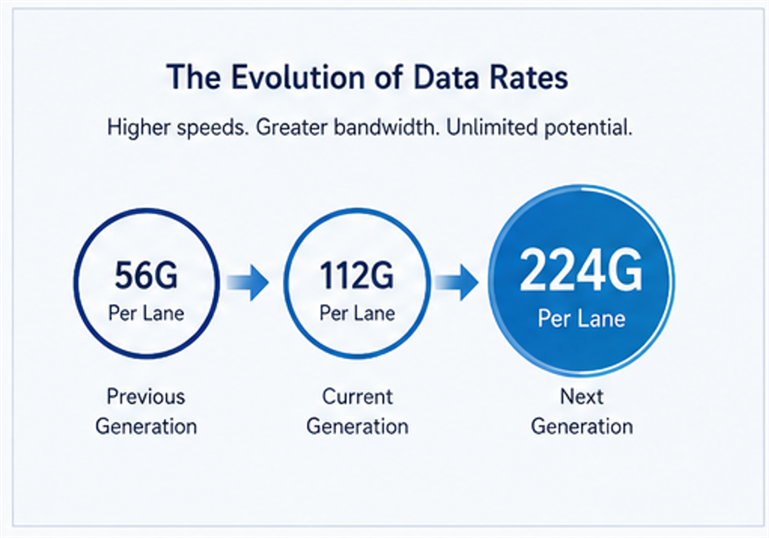
As bandwidth requirements continue to grow, engineers are being challenged to design systems that can support higher speeds without sacrificing signal integrity, reliability, or power efficiency. This is driving industry adoption of next-generation connectivity technologies, including 224G signaling and advanced high-speed interconnect architectures.
Why AI is Pushing Connectivity to Its Limits
Traditional data center architecture was not designed for the massive data movement required by today's AI applications. Modern AI clusters may contain thousands of GPUs and accelerators that must communicate continuously across the network.
To keep pace with these demands, infrastructure designers are increasing network speeds while reducing latency and power consumption. As the industry transitions toward 224G signaling and beyond, connectivity solutions must support significantly higher data rates than previous generations.
Engineering Challenges at Higher Speeds
While faster signaling delivers greater bandwidth, it also introduces new design challenges:
- Signal integrity degradation
- Increased insertion loss
- Thermal management concerns
- Electromagnetic interference (EMI)
- Mechanical reliability requirements
As data rates increase, every connection point in the signal path becomes increasingly critical to overall system performance.
The Role of High-Speed Interconnect Solutions
Supporting next-generation AI infrastructure requires connectivity solutions specifically engineered for high-speed applications.
ACS offers a broad portfolio of interconnect solutions designed to help engineers address these challenges, including:
Mini Cool Edge® IO
Mini Cool Edge® IO provide compact, high-density connectivity for AI and data center applications. Their design helps enables high-speed signal transmission while supporting the signal integrity requirements of next-generation systems.
PCIe® Gen 7 Mini Cool Edge IO®
Advantages:
- Supports PCIe® Gen 7 architecture
- Up to 128G PAM4
- Supports both cable and card edge connection
- Designed for high-end computing systems
- Enables high-speed signal transmission while maintaining signal integrity
OSFP 224G Cable Assemblies
AI clusters require enormous data movement between switches, accelerators, and compute nodes.
ACS OSFP 224G cable assemblies help address these requirements through:
- 224G PAM4 signaling
- Aggregate bandwidths up to 1.6T
- Thermal management features
- SKEWCLEAR® twin-ax cable technology
- Designed for high-speed data center and high performance computing applications
PCIe® and High-Speed I/O Connectivity
Modern AI platforms rely on PCIe-based architectures to connect processors, accelerators, and storage. ACS offers connectivity solutions designed to support evolving PCIe generations and growing bandwidth requirements.
Backplane and Board-to-Board Connectivity
Reliable board-level interconnects are essential for high-performance servers and networking equipment. ACS backplane and board-to-board solutions help optimize signal integrity while supporting high-density designs.
ACS EXAMAX2® Backplane connectors support next-generation networking and compute platforms through:
- 112Gb/s PAM4 support
- Meets industry specifications PCIe® 6.0 and 7.0
- Beam-on-beam mating interface
- Industry-leading signal integrity performance
- 100% backward mating compatibility to previous ExaMAX® products
Specifically for AI system architecture, the ExaMax2 High-Speed Backplane Connector

Preparing for the Future
The transition to 224G signaling represents more than a speed upgrade, but rather, it reflects the industry's continued push toward higher-performance computing and AI-driven infrastructure.
As organizations build larger and more sophisticated AI environments, connectivity will remain a foundational technology enabling system scalability, reliability, and efficiency.
By combining advanced connector technologies, high-speed cable assemblies, and robust interconnect architectures, engineers can better prepare their systems for the bandwidth demands of tomorrow's AI applications.
What connectivity challenges are you encountering as bandwidth requirements continue to increase in your designs? Share your experiences in the comments below!