


Consumer drones have become the go-to tool for areal videography, from wedding footage to adventure vlogs. Meanwhile, Commercial UAVs are quietly transforming how we farm, inspect infrastructure, and even deliver goods. What both have in common is an engineering challenge that rarely makes the headlines: fitting reliable, high-performance electronics into a frame that weighs less than a bag of rice.
Every gram count when battery capacity determines how long you stay airborne. And every connection counts when a loose wire over a field — or a construction site — means losing a mission-critical asset. That's where connector design becomes less of a spec-sheet concern and more of a flight-safety one.
Amphenol's interconnects are engineered specifically for these constraints, addressing the power, data and sensing demands of modern drone platforms across every major subsystem.
The hard design of drone design
Before getting into the hardware, it's worth understanding what makes drone connectivity so demanding. Engineers working on these platforms are fighting on several fronts simultaneously:
SWaP constraints (Size, Weight, and Power) mean every connector must earn its place. Ultra-miniature interfaces that fit dense boards aren't a nice-to-have — they're a prerequisite for competitive flight time and payload capacity.
Vibration and shock are constant. Propellers generate continuous high-frequency vibration, and drones routinely experience hard landings, sudden gusts, and aggressive maneuvers. Connectors need floating contacts and secure latching to stay reliable across thousands of flight cycles.
Environmental exposure ranges from humid coastal air to dusty agricultural fields to sub-zero survey missions. IP67-rated sealing against rain, dust, and temperature swings is a baseline requirement for anything beyond recreational use.
Signal integrity under EMI is a particular challenge. High-current motor drive lines run in close proximity to sensitive camera and data interfaces. MIPI, USB, and PCIe signals must coexist with motor drive lines without crosstalk — a problem that gets harder as platforms become more capable and more densely packed.
Battery and Power Distribution: The Foundation of Flight
Flight time ultimately comes down to how efficiently energy moves from the battery to the motors. But real-world endurance depends on more than raw capacity — it depends on the integrity of every connection in that power chain.
The power distribution board sits at the center of this system, routing current from the battery to the electronic speed controllers (ESCs) and flight controller. Any resistance, looseness, or voltage drop here translates directly into reduced performance and, in the worst case, an in-flight shutdown.
For consumer drones, this means convenient recharging and predictable battery behavior. For commercial UAVs, it often means hot-swappable packs to support rapid field turnaround between missions — a capability that requires connectors rated for repeated high-current insertion cycles without degradation.

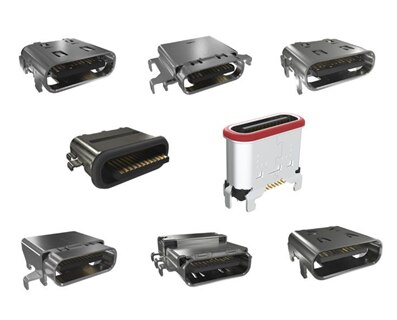
DuraSwap and DURASWAP Concentric Connectors are purpose built for this use case, supporting hot swappable, high current battery packs with the cycle life commercial operations demands. For sealed charging ports, Waterproof USB Type C provides a weather-resistant interface, while the HVLock® High Voltage Platform and PwrBlade Mini Cable to Board connectors handle safe, compact power distribution to ESCs and downstream modules. The FlexFast Mini Flex-to-Board rounds out the power subsystem with space efficient flex-to-board interface suited to the right layouts of modern drone platforms.
Battery Management Systems: Safety Before Everything Else
The BMS is the safety layer between the battery and the drone. It monitors cell voltages and temperatures, balances charge across cells, and tracks cycle history to flag degradation before it becomes a hazard. During high-demand flight — particularly in agricultural drones carrying chemical payloads, or UAVs delivering medical cargo — the BMS is the last line of defense against thermal runaway.
The challenge for connector design here is twofold. First, BMS boards live in tight battery compartments with minimal room for connectors with large footprints. Second, the health data they transmit to the flight controller must be reliable even during hard landings and aggressive maneuvering — a false alarm that triggers an emergency landing mid-mission is nearly as costly as a real one.
The MicroSpace Crimp-to-Wire Connectors and MicroSpaceXS 1.27mm Waterproof Crimp-to-Wire/Wire-to-Wire Connector address this with vibration-resistant wiring in a compact form factor. The FloatCombo 0.50mm Floating Board-to-Board Connectors absorb board misalignment caused by mechanical stress, while the Minitek127® 1.27mm Cable-to-Board Connector System, Conan® 1.00mm Connector, and FlexFast Mini provide low-profile, tolerance-friendly links suited to the confined geometry of battery compartments.
Flight Control and Communication: The Nervous System
The flight controller is where everything comes together. It continuously processes inputs from GPS/GLONASS, gyroscopes, compass, barometer, and pilot commands, then instructs each ESC on exactly how much power to deliver to its motor. This feedback loop — running hundreds of times per second — is what allows a drone to hold a perfectly stable hover in a 20-mph crosswind or fly a precise survey grid indoors where GPS is unavailable.
Beyond control, the flight controller manages communication with the ground. Consumer platforms prioritize low-latency video streaming and smooth piloting for footage work. Commercial platforms increasingly focus on onboard data capture — PCIe-connected storage for the large datasets generated by LiDAR surveys, multispectral imaging, or 4K inspection video.
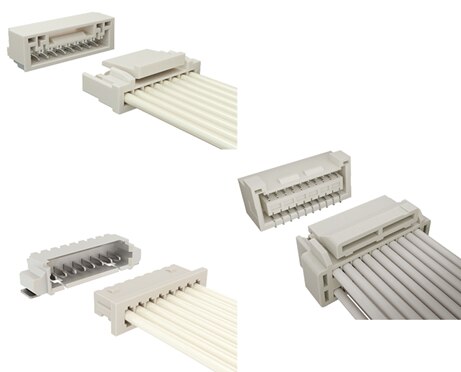
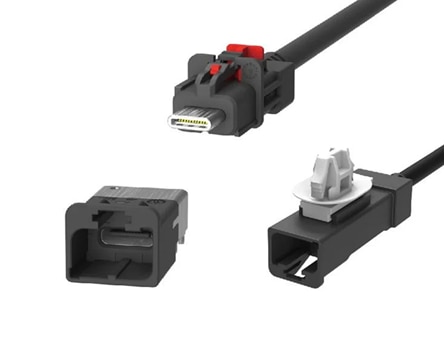
Tightly stacked boards in the central electronics hub need connectors that maintain clean high-speed signals despite the constant vibration and EMI environment generated by nearby motors. The FitMate 0.80mm Wire-to-Board and Mini HSBridge+ Automotive USB handle control and communication links, while PCIe® M.2 Gen 5 Card Edge Connectors and Micro SD and SD Card Sockets support onboard storage. The 0.35mm Micro Board-to-Board 101 Series and BergStak® 0.40mm Self-Alignment Board-to-Board Connectors provide the dense, precise board-to-board interconnects the compute stack requires.
Motor Drives and ESC: Delivering the Thrust Without Compromise
The motors are simple in concept - spin fast, generate lift - but the electronics managing them are not. ESCs convert DC battery power into PWM-controlled three-phase drive signals, continuously adjusting motor speed to keep the drone stable. In a quadcopter, two motors spin clockwise and two counterclockwise, so their torques cancel out and the frame stays level. When a gust hits, the flight controller compensates by adjusting all four ESCs simultaneously, in milliseconds.
ESC lives close to motors, out on the arms, where they're subject to the worst of the vibration and heat load. Signal and power interconnects in this area need to be short, flexible, and mechanically robust. A connector that works loose here doesn't cause a glitch - it causes a sudden yaw, uncontrolled spin, or crash.
0.50mm FFC/FPC Connectors and 0.50mm Pitch Autolock Connectors provide flexible routing suited to the confined geometry of arm-mounted electronics. FFC Jumper cables handle short, vibration-exposed signal runs, while Spring Contacts maintain reliable electrical contact through mechanical deflection. The Minitek® 0.80mm Wire-to-Board Connector System rounds out the motor drive subsystem with a compact, secure wire-to-board interface designed for high-vibration environments.
Vision and Sensing: What Separates a Camera from a Platform
A modern commercial drone is less like a flying camera than a flying sensor suite. Stereo vision systems estimate depth by comparing offset images from two cameras. Downward-facing ultrasonic, optical flow, and time-of-flight sensors provide precise altitude hold and stable control during takeoff and landing. Forward-facing obstacle detection systems can identify hazards dozens of meters ahead and reroute autonomously.
For specialized applications, thermal cameras detect crop stress and water-use inefficiency across fields. LiDAR payloads build millimeter-accurate 3D models of terrain, structures, or tree canopies. All of this sensor data converges on a central processor for fusion and analysis, routed through a gimbal that isolates the payload from aircraft motion, so the data stays clean.
The data rates involved are substantial - multi gigabit video and LiDAR streams, running continuously, across connections that must survive the same vibration environment as everything else on the aircraft. Ve-NET Automotive Multi-Gigabit Differential Connectors and Mini HSBridge+ Automotive USB support the high-bandwidth links between sensors, gimbals, and processors. For fine-pitch board and wire connections within sensor modules, the 0.35mm Micro Board-to-Board 101 Series, MicroSpace, and MicroSpaceXS deliver reliable interconnects in the tightest available footprint.
The Bigger Picture
Drone platforms are getting more capable, more autonomous and more commercially critical with every product generation. That trajectory puts increasing pressure on the interconnects that hold them together, not just to fit smaller spaces and carry more data, but to do it reliably across years of field operation in demanding conditions. Getting the connector right doesn't make the headline when a drone completes a precision agricultural survey or delivers a medical package on time. But getting it wrong is exactly the kind of failure that grounds a platform, and the mission with it.