element14 Community
element14 Community
    Register Log In
  • Site
  • Search
  • Log In Register
  • Community Hub
    Community Hub
    • What's New on element14
    • Feedback and Support
    • Benefits of Membership
    • Personal Blogs
    • Members Area
    • Achievement Levels
  • Learn
    Learn
    • Ask an Expert
    • eBooks
    • element14 presents
    • Learning Center
    • Tech Spotlight
    • STEM Academy
    • Webinars, Training and Events
    • Learning Groups
  • Technologies
    Technologies
    • 3D Printing
    • FPGA
    • Industrial Automation
    • Internet of Things
    • Power & Energy
    • Sensors
    • Technology Groups
  • Challenges & Projects
    Challenges & Projects
    • Design Challenges
    • element14 presents Projects
    • Project14
    • Arduino Projects
    • Raspberry Pi Projects
    • Project Groups
  • Products
    Products
    • Arduino
    • Avnet & Tria Boards Community
    • Dev Tools
    • Manufacturers
    • Multicomp Pro
    • Product Groups
    • Raspberry Pi
    • RoadTests & Reviews
  • About Us
  • Store
    Store
    • Visit Your Store
    • Choose another store...
      • Europe
      •  Austria (German)
      •  Belgium (Dutch, French)
      •  Bulgaria (Bulgarian)
      •  Czech Republic (Czech)
      •  Denmark (Danish)
      •  Estonia (Estonian)
      •  Finland (Finnish)
      •  France (French)
      •  Germany (German)
      •  Hungary (Hungarian)
      •  Ireland
      •  Israel
      •  Italy (Italian)
      •  Latvia (Latvian)
      •  
      •  Lithuania (Lithuanian)
      •  Netherlands (Dutch)
      •  Norway (Norwegian)
      •  Poland (Polish)
      •  Portugal (Portuguese)
      •  Romania (Romanian)
      •  Russia (Russian)
      •  Slovakia (Slovak)
      •  Slovenia (Slovenian)
      •  Spain (Spanish)
      •  Sweden (Swedish)
      •  Switzerland(German, French)
      •  Turkey (Turkish)
      •  United Kingdom
      • Asia Pacific
      •  Australia
      •  China
      •  Hong Kong
      •  India
      • Japan
      •  Korea (Korean)
      •  Malaysia
      •  New Zealand
      •  Philippines
      •  Singapore
      •  Taiwan
      •  Thailand (Thai)
      • Vietnam
      • Americas
      •  Brazil (Portuguese)
      •  Canada
      •  Mexico (Spanish)
      •  United States
      Can't find the country/region you're looking for? Visit our export site or find a local distributor.
  • Translate
  • Profile
  • Settings
Amphenol
  • Products
  • Manufacturers
  • Amphenol
  • More
  • Cancel
Amphenol
Amphenol Communication Solutions Blog What is inertial navigation for ADAS? – Murata accelerometers
  • Blog
  • Forum
  • Documents
  • Events
  • Leaderboard
  • Polls
  • Members
  • Mentions
  • Sub-Groups
  • Tags
  • More
  • Cancel
  • New
Join Amphenol to participate - click to join for free!
  • Share
  • More
  • Cancel
Group Actions
  • Group RSS
  • More
  • Cancel
Engagement
  • Author Author: murata
  • Date Created: 8 Aug 2018 1:18 PM Date Created
  • Views 725 views
  • Likes 3 likes
  • Comments 0 comments
  • adas
  • accelerometre
  • murata
Related
Recommended

What is inertial navigation for ADAS? – Murata accelerometers

murata
murata
8 Aug 2018

image

Inertial navigation is navigation based on inertial components providing the information on the six degrees of freedom; yaw, pitch, roll, and three axis acceleration.

This data is independent of the environment and not susceptible to image recognition or other similar technologies.

There are many forms of inertial navigation system (INS), but one commonality between them all is their use of multiple inertial sensors and some form of central processing unit to keep track of the measurements coming from those sensors. The sensors used in an INS are typically gyros and accelerometers – and there are normally several of each inside. Automotive applications are typically used to handling GPS-based systems, but INS represents a departure from this approach.

The measurement that an INS generates is relative to their last known position, so even after an inertial navigation system has been turned on for several minutes, it cannot specify where it is, but it can ascertain that it hasn’t moved. If the INS knows where it started, it can easily work out where it is, based on its own measurements. That is how spaceships and aircraft successfully navigate using an INS – because they know where they started from.

The big benefit for inertial navigation for the development of ADAS is that it goes above and beyond the technologies that are typically used in cars. In autonomous driving, the demands on exact location information rise significantly, compared with that of traditional driven vehicles. The cars need to know not just which road but which lane they are in, and the margin for error is small.

Murata has already started to realize the sensors for INS.

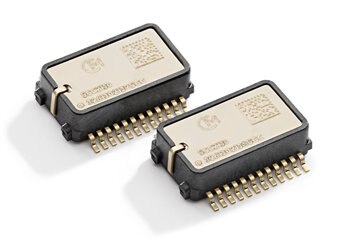
The Murata SCC2000 series of combined high-performance angular rate and accelerometer sensor components based on Murata’s proven capacitive 3D-MEMS technology.
image

Key features of SCC2000 series

  • Fully integrated gyro accelerometer combo with:
    • Single axis gyro: X or Z axis (horizontal or vertical)
    • 3-axis accelerometer (X, Y, Z)
    • Gyro only version available also
  • Excellent bias stability, low noise level
  • Robust MEMS designs and high performance in harsh environment
    • Good performance under mechanical vibrations
    •        Good mechanical shock endurance
  • Digital Output (SPI-interface)
  • Bandwidth for both accelerometer and gyro:
    • –10/60 Hz (user selectable via SPI interface)
  • Several advanced self-diagnostic features
  • Temperature range: -40°C … +125°C
  • 24-pin pre-molded SOIC package:
    • –8.5 x 15.0 x 4.3 mm
  • Supply voltage range (analog + digital): 3.0V-3.6V
    • Current consumption: Z-rate type 23 mA, X-rate type 25 mA

Key benefits of SCC2000 series

  • Cost savings
    • Z axis gyro is a major benefit for INS manufacturers, vertical PCB not needed and system level cost savings
    •        Lower component cost
  • Smaller housing, lower power consumption, single power supply
  • Improved accelerometer performance:
    • Better linearity
    •        Lower noise level
    •        Better temperature stability due to 2nd order internal compensation


The SCC2000 series is targeted at applications demanding high stability with tough environmental requirements.

If you would like to see more details about SCC2000 series, please feel free to visit our website or contact with us.

Check RS stocks of SCC2000 series

Attachments:
imageSCC2000_flyer.pdf
  • Sign in to reply
element14 Community

element14 is the first online community specifically for engineers. Connect with your peers and get expert answers to your questions.

  • Members
  • Learn
  • Technologies
  • Challenges & Projects
  • Products
  • Store
  • About Us
  • Feedback & Support
  • FAQs
  • Terms of Use
  • Privacy Policy
  • Legal and Copyright Notices
  • Sitemap
  • Cookies

An Avnet Company © 2026 Premier Farnell Limited. All Rights Reserved.

Premier Farnell Ltd, registered in England and Wales (no 00876412), registered office: Farnell House, Forge Lane, Leeds LS12 2NE.

ICP 备案号 10220084.

Follow element14

  • X
  • Facebook
  • linkedin
  • YouTube