


As robotic systems become more intelligent and capable, engineers are under increasing pressure to deliver more functionality within smaller footprints. From collaborative robots (cobots) and autonomous mobile robots (AMRs) to advanced machine vision systems, modern automation platforms require compact, reliable, and high-performance connectivity solutions.
Meeting these demands requires more than processing power and software, it requires connectivity solutions capable of supporting increasingly dense electronic architectures.
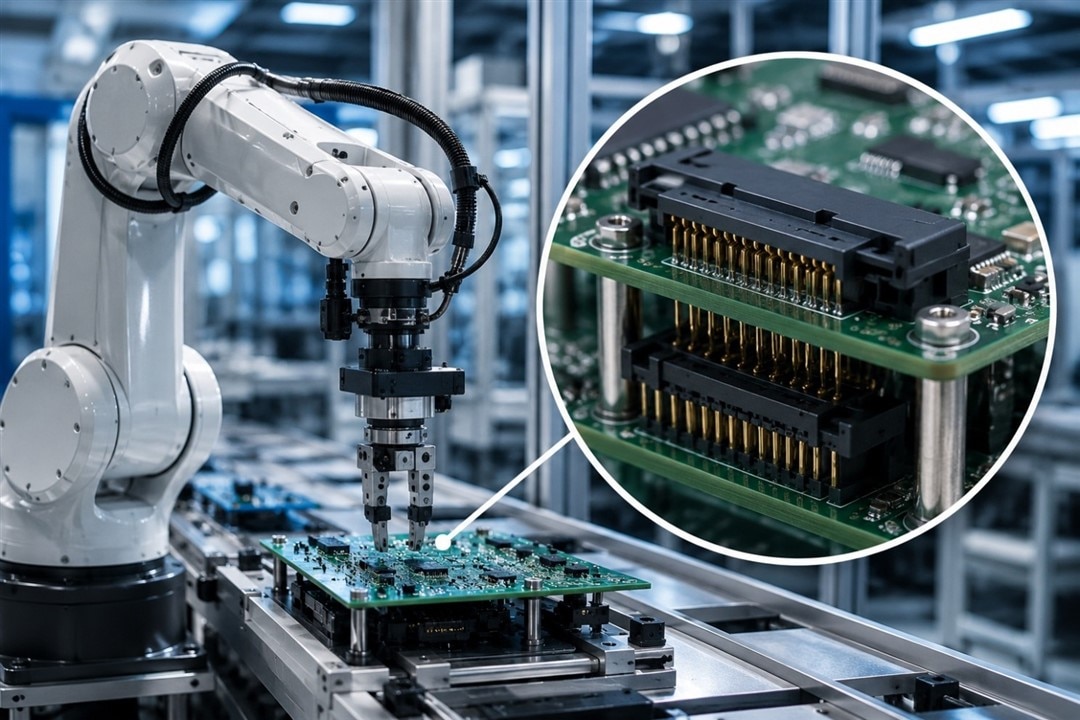
The Push Toward Smaller, Smarter Robotics
Today's robotic systems integrate a growing number of components, including sensors, cameras, processors, communication modules, and power management systems.
As these capabilities expand, there are several challenges:
- Limited PCB space
- Increasing component density
- Higher data transmission requirements
- Reliability in industrial environments
The ability to maximize board space while maintaining reliable electrical connections has become a critical design consideration.
Why Board-to-Board Connectivity Matters
Many robotic systems rely on multiple printed circuit boards working together within a compact enclosure. Reliable board-to-board connections help ensure communication between critical subsystems while supporting increasingly sophisticated functionality.
Poor connector selection can lead to signal integrity issues, design constraints, and maintenance challenges that impact overall system performance.
As robotics continue to evolve, compact and reliable board-to-board connectivity becomes increasingly important.
BergStak® Connectors for Space-Constrained Designs
ACS BergStak® connectors are designed to help engineers maximize PCB real estate without sacrificing performance.
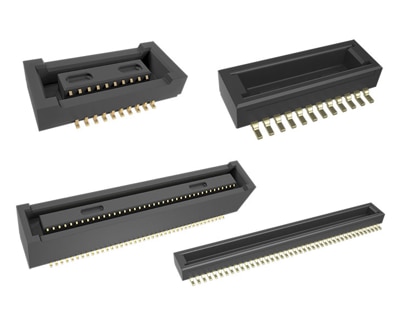
The BergStak® family offers a range of fine-pitch, high-density solutions that help engineers maximize board space while maintaining reliable electrical performance.
BergStak® 0.40 mm Connector:
For highly compact robotic systems, the BergStak® 0.40 mm connector series is one of the most space-efficient options within the portfolio.
Key Features
- Ultra-fine 0.40 mm pitch
- High-density board-to-board architecture
- Multiple stack height options
- Various pin count configurations
- High-Speed performance of 16Gb/s
Advantages
- Supports high-density board-to-board interconnection
- Supports applications need transfer HS signals
- Supports different application requirements with multiple stack heights
- Provides higher retention force with the optional metal hold-down
Since robotics designs continue shrinking while adding more functionality, the 0.40 mm series is particularly valuable for highly integrated control systems.
BergStak® 0.50 mm Connector:
For applications requiring a balance between density and design flexibility, the BergStak® 0.50 mm series offers a 0.50mm pitch, high-density, low-profile design with multiple stack heights and a wide range of positions.
Key Features
- 0.50 mm pitch
- Board-to-board connectivity
- Flexible stack heights
- Reliable signal transmission
- Compact design
Advantages
- High density connector, suitable for applications with space constraints
- Offers higher retention force with the optional metal hold-down.
- Wide range of sizes and stack heights supports different applications
BergStak® 0.80 mm Connector:
For robotic systems requiring additional mechanical robustness and higher pin-count board connections, the BergStak® 0.80 mm series may be a better fit.
Key Features
- 0.80 mm pitch
- High-density board-to-board connectivity
- Multiple pin-count options
- Flexible stack heights
- Supports data rates up to 12 Gb/s
Advantages
- Comprehensive range of sizes and stack heights to satisfy all need
- High-density for all electrical applications needs
- Satisfies different application requirements

Supporting the Future of Automation
As factories continue to adopt Industry 4.0 technologies, robotic systems are becoming more connected and data driven. This shift requires compact electronics capable of processing and transmitting increasing amounts of information.
By enabling high-density board-to-board connections, BergStak® connectors help engineers develop smaller, more capable systems that can support the growing demands of modern automation.
Looking Ahead
The next generation of robotics will continue to push the limits of system density, intelligence, and performance. Connectivity solutions that maximize available space while maintaining reliability will play an increasingly important role in enabling these advancements.
For engineers designing compact automation systems, board-to-board connectivity is no longer simply a component selection, but rather, it is a critical design decision.
What do you see as the biggest challenge in designing next-generation robotic systems? Share your experience in the comments below!