element14 Community
element14 Community
    Register Log In
  • Site
  • Search
  • Log In Register
  • Community Hub
    Community Hub
    • What's New on element14
    • Feedback and Support
    • Benefits of Membership
    • Personal Blogs
    • Members Area
    • Achievement Levels
  • Learn
    Learn
    • Ask an Expert
    • eBooks
    • element14 presents
    • Learning Center
    • Tech Spotlight
    • STEM Academy
    • Webinars, Training and Events
    • Learning Groups
  • Technologies
    Technologies
    • 3D Printing
    • FPGA
    • Industrial Automation
    • Internet of Things
    • Power & Energy
    • Sensors
    • Technology Groups
  • Challenges & Projects
    Challenges & Projects
    • Design Challenges
    • element14 presents Projects
    • Project14
    • Arduino Projects
    • Raspberry Pi Projects
    • Project Groups
  • Products
    Products
    • Arduino
    • Avnet & Tria Boards Community
    • Dev Tools
    • Manufacturers
    • Multicomp Pro
    • Product Groups
    • Raspberry Pi
    • RoadTests & Reviews
  • About Us
    About the element14 Community
  • Store
    Store
    • Visit Your Store
    • Choose another store...
      • Europe
      •  Austria (German)
      •  Belgium (Dutch, French)
      •  Bulgaria (Bulgarian)
      •  Czech Republic (Czech)
      •  Denmark (Danish)
      •  Estonia (Estonian)
      •  Finland (Finnish)
      •  France (French)
      •  Germany (German)
      •  Hungary (Hungarian)
      •  Ireland
      •  Israel
      •  Italy (Italian)
      •  Latvia (Latvian)
      •  
      •  Lithuania (Lithuanian)
      •  Netherlands (Dutch)
      •  Norway (Norwegian)
      •  Poland (Polish)
      •  Portugal (Portuguese)
      •  Romania (Romanian)
      •  Russia (Russian)
      •  Slovakia (Slovak)
      •  Slovenia (Slovenian)
      •  Spain (Spanish)
      •  Sweden (Swedish)
      •  Switzerland(German, French)
      •  Turkey (Turkish)
      •  United Kingdom
      • Asia Pacific
      •  Australia
      •  China
      •  Hong Kong
      •  India
      •  Japan
      •  Korea (Korean)
      •  Malaysia
      •  New Zealand
      •  Philippines
      •  Singapore
      •  Taiwan
      •  Thailand (Thai)
      •  Vietnam
      • Americas
      •  Brazil (Portuguese)
      •  Canada
      •  Mexico (Spanish)
      •  United States
      Can't find the country/region you're looking for? Visit our export site or find a local distributor.
  • Translate
  • Profile
  • Settings
Analog Devices
  • Products
  • Manufacturers
  • Analog Devices
  • More
  • Cancel
Analog Devices
Forum Support required for HMC356LP3ETR Low-Noise Amplifier
  • Blog
  • Forum
  • Documents
  • Events
  • Polls
  • Members
  • Mentions
  • Sub-Groups
  • Tags
  • More
  • Cancel
  • New
Join Analog Devices to participate - click to join for free!
Actions
  • Share
  • More
  • Cancel
Forum Thread Details
  • State Not Answered
  • Replies 5 replies
  • Subscribers 46 subscribers
  • Views 100 views
  • Users 0 members are here
Related

Support required for HMC356LP3ETR Low-Noise Amplifier

alphaise
alphaise 17 days ago
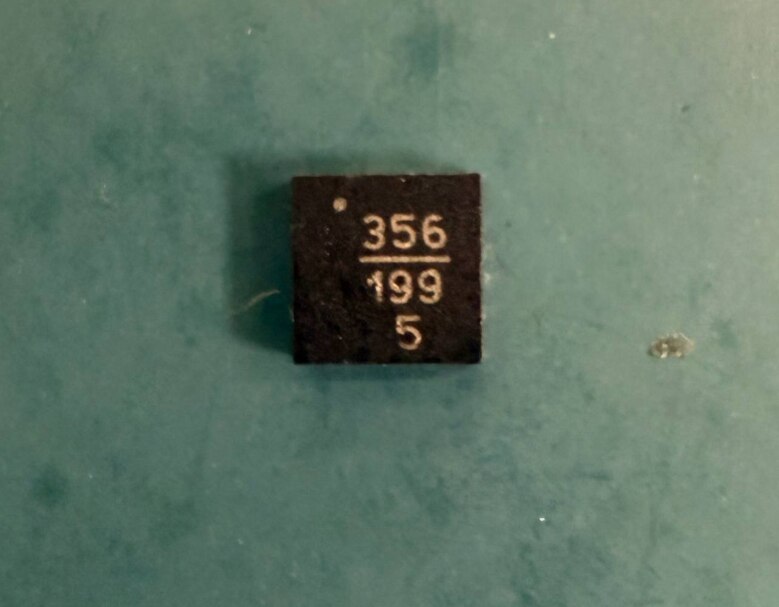
During probing of the IC, we observed that pins 6 (GND) and 7 (ACG) are shorted together, and are also shorted to pin 15 (Vdd). However, the other GND pins (ground paddle, pins 2, 4, and 16) do not appear to be shorted together.
This issue was observed consistently in 2 units that were tested. For reference, I have attached the pinout diagram and a top-view image of the IC.
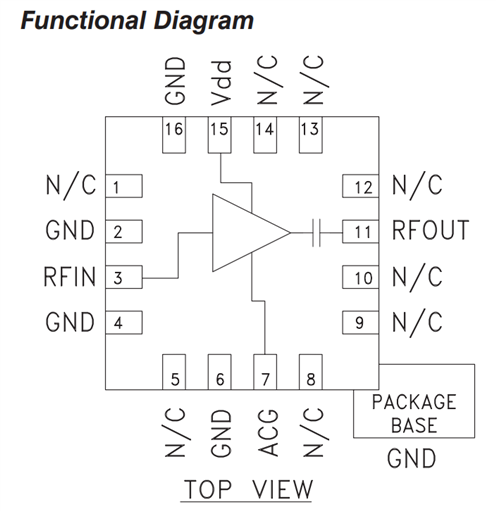
image     image
  • Sign in to reply
  • Cancel

Top Replies

  • jc2048
    jc2048 16 days ago in reply to alphaise +2
    What is the "issue"? The datasheet says the pins labelled as GND should be connected to RF/DC ground. It doesn't say they're all connected inside the device. The resistance you measure between 6 and…
  • alphaise
    alphaise 16 days ago in reply to Jan Cumps +1
    Yes, I checked against the chamfered edge on the ground paddle as well.
  • michaelkellett
    0 michaelkellett 17 days ago

    Is this before or after you had applied power ?

    Where did you buy the parts ?

    How are you measuring them - when you say "shorted" what do you mean - is it the same resistance in either polarity, what is that resistance.

    MK

    • Cancel
    • Vote Up 0 Vote Down
    • Sign in to reply
    • Verify Answer
    • Cancel
  • Jan Cumps
    0 Jan Cumps 16 days ago

    Did you use the dot as pin1 indicator? 

    • Cancel
    • Vote Up 0 Vote Down
    • Sign in to reply
    • Verify Answer
    • Cancel
  • alphaise
    0 alphaise 16 days ago in reply to Jan Cumps

    Yes, I checked against the chamfered edge on the ground paddle as well.

    • Cancel
    • Vote Up +1 Vote Down
    • Sign in to reply
    • Verify Answer
    • Cancel
  • alphaise
    0 alphaise 16 days ago in reply to michaelkellett

    The issue is consistent both before and after applying power.

    The parts were purchased from Element14 (Singapore), and they had sent over replacement units after I alerted them of the issue - but the shorting is still present (i.e., no change). 

    I used the continuity test on various multimeters for measurements. The resistance between pin 15 (Vdd) and 6 (GND) is about 8.1 Ω, and 2.9 Ω between pin 15 and 7 (ACG).

    • Cancel
    • Vote Up 0 Vote Down
    • Sign in to reply
    • Verify Answer
    • Cancel
  • jc2048
    0 jc2048 16 days ago in reply to alphaise

    What is the "issue"?

    The datasheet says the pins labelled as GND should be connected to RF/DC ground. It doesn't say they're all connected inside the device.

    The resistance you measure between 6 and 7 is the bias for the FET. You'd expect to see it there. Presumably you've connected a decoupling capacitor to 7 and not a GND in your circuit. If you've connected a ground to 7, you'll get whatever the FET current is with the gate at 0V, instead of the 100mA or so at their dc bias point (don't leave it running like that - I doubt the package can manage the dissipation: it probably gets fairly warm even at the 100mA).

    2, 4, and 16 are dummies that you can use to run the surface ground into the paddle area - 2 and 4 allow you to bring the transmission line all the way in without a discontinuity. 16 is to run a ground in alongside the vdd to improve the decoupling performance (the return current has to get across to 6). The designer is just steering you as to how they thought the layout would work.

    The paddle will be the substrate connection, which you'll probably want to heatsink with vias down to the plane. I would guess the input termination goes down to the paddle, that would seem to make most sense, but I'm not very familiar with this kind of stuff - it might go to GND at 6.

    The chip designer seems to have intended the copper under the paddle to be the common point between input and output.

    What's interesting is that the 3rd party who designed the evaluation board have done the layout in a different way, isolating the paddle on the surface layer and using the plane for everything. I would assume they know what they're doing, so it would be interesting to know the pros and cons of the two approaches.

    Disclaimer: I've never done any RF, so decide for yourself if this makes any sense. I do have vague memories of how a FET works, though (retired engineer!).

    • Cancel
    • Vote Up +2 Vote Down
    • Sign in to reply
    • Verify Answer
    • Cancel
element14 Community

element14 is the first online community specifically for engineers. Connect with your peers and get expert answers to your questions.

  • Members
  • Learn
  • Technologies
  • Challenges & Projects
  • Products
  • Store
  • About Us
  • Feedback & Support
  • FAQs
  • Terms of Use
  • Privacy Policy
  • Legal and Copyright Notices
  • Sitemap
  • Cookies

An Avnet Company © 2026 Premier Farnell Limited. All Rights Reserved.

Premier Farnell Ltd, registered in England and Wales (no 00876412), registered office: Farnell House, Forge Lane, Leeds LS12 2NE.

ICP 备案号 10220084.

Follow element14

  • X
  • Facebook
  • linkedin
  • YouTube