element14 Community
element14 Community
    Register Log In
  • Site
  • Search
  • Log In Register
  • Community Hub
    Community Hub
    • What's New on element14
    • Feedback and Support
    • Benefits of Membership
    • Personal Blogs
    • Members Area
    • Achievement Levels
  • Learn
    Learn
    • Ask an Expert
    • eBooks
    • element14 presents
    • Learning Center
    • Tech Spotlight
    • STEM Academy
    • Webinars, Training and Events
    • Learning Groups
  • Technologies
    Technologies
    • 3D Printing
    • FPGA
    • Industrial Automation
    • Internet of Things
    • Power & Energy
    • Sensors
    • Technology Groups
  • Challenges & Projects
    Challenges & Projects
    • Design Challenges
    • element14 presents Projects
    • Project14
    • Arduino Projects
    • Raspberry Pi Projects
    • Project Groups
  • Products
    Products
    • Arduino
    • Avnet & Tria Boards Community
    • Dev Tools
    • Manufacturers
    • Multicomp Pro
    • Product Groups
    • Raspberry Pi
    • RoadTests & Reviews
  • About Us
    About the element14 Community
  • Store
    Store
    • Visit Your Store
    • Choose another store...
      • Europe
      •  Austria (German)
      •  Belgium (Dutch, French)
      •  Bulgaria (Bulgarian)
      •  Czech Republic (Czech)
      •  Denmark (Danish)
      •  Estonia (Estonian)
      •  Finland (Finnish)
      •  France (French)
      •  Germany (German)
      •  Hungary (Hungarian)
      •  Ireland
      •  Israel
      •  Italy (Italian)
      •  Latvia (Latvian)
      •  
      •  Lithuania (Lithuanian)
      •  Netherlands (Dutch)
      •  Norway (Norwegian)
      •  Poland (Polish)
      •  Portugal (Portuguese)
      •  Romania (Romanian)
      •  Russia (Russian)
      •  Slovakia (Slovak)
      •  Slovenia (Slovenian)
      •  Spain (Spanish)
      •  Sweden (Swedish)
      •  Switzerland(German, French)
      •  Turkey (Turkish)
      •  United Kingdom
      • Asia Pacific
      •  Australia
      •  China
      •  Hong Kong
      •  India
      •  Japan
      •  Korea (Korean)
      •  Malaysia
      •  New Zealand
      •  Philippines
      •  Singapore
      •  Taiwan
      •  Thailand (Thai)
      •  Vietnam
      • Americas
      •  Brazil (Portuguese)
      •  Canada
      •  Mexico (Spanish)
      •  United States
      Can't find the country/region you're looking for? Visit our export site or find a local distributor.
  • Translate
  • Profile
  • Settings
Microchip
  • Products
  • Manufacturers
  • Microchip
  • More
  • Cancel

Microchip

  • Blog
  • Forum
  • Documents
  • Events
  • Polls
  • Members
  • Mentions
  • Sub-Groups
  • Tags
  • More
  • Cancel
  • New
Join Microchip to participate - click to join for free!

image

Welcome to the Microchip page on element14. Here you can find things such as our latest news, training videos, and product details. Additionally, you can engage with us in our forums.

Have a Question?
Related Products
Microchip Technology Incorporated is a leading provider of smart, connected and secure embedded control solutions. Its easy-to-use development tools and comprehensive product portfolio enable customers to create optimal designs, which reduce risk while lowering total system cost and time to market. The company's solutions serve more than 120,000 customers across the industrial, automotive, consumer, aerospace and defense, communications and computing markets. Headquartered in Chandler, Arizona, Microchip offers outstanding technical support along with dependable delivery and quality.
Recent Discussions & Questions
  • Discussion

    bare metal C on SAMA5D4 Xplained Ultra with Jlink, which IDE?

    656 views
    2 replies
    Latest over 1 year ago
    by Microbit
  • Discussion

    IoT Design Week - March 9-13, 2020

    689 views
    0 replies
    Started over 6 years ago
    by jomoenginer
  • Not Answered

    BZX9C10 0

    946 views
    1 reply
    Latest over 6 years ago
    by michaelkellett
  • Not Answered

    Explorer 16 Development Board CD Image 0

    1406 views
    1 reply
    Latest over 8 years ago
    by koudelad
  • Discussion

    3.3v,5v and 12v  DC outputs SMPS,output power 150w,input AC voltage 220v

    860 views
    1 reply
    Latest over 10 years ago
    by gadget.iom
>
Latest News
  • Introducing the PIC32CM PL10- Low Power, Touch Focused 32-bit Arm®︎ Cortex®︎-M0+ , with a Clear Path from AVR

    Introducing the PIC32CM PL10- Low Power, Touch Focused 32-bit Arm®︎ Cortex®︎-M0+ , with a Clear Path from AVR

    Microchip_MCU
    Microchip_MCU


    Microchip Technology recently launched the PIC32CM PL10, a 32-bit Arm® Cortex®-M0+ MCU making it easier to make the migration from 8-bit AVR feel a lot easier. Pin compatible with our AVR Dx/Ex family, 5V capable, and carrying over the peripherals you already know- MVIO, CCL, EVSYS- it's built so you don't have to redesign your power architecture or relearn your peripheral toolkit to get 32-bit performance. Let's break down what's new and what carries over.

    The AVR Migration Story

    If you're running AVR Dx/Ex today, with a little effort, PIC32CMPL10 will allow your existing board layout to achieve migration. 5V logic has better noise margins than 3.3V. In industrial environments with motors, relays, or long cable runs, that extra headroom means fewer spurious glitches and more robust signal integrity.

    Lots of existing industrial and appliance designs run on 5V buses, sensors, and actuators. If your MCU is 3.3V-only, you're adding level shifters everywhere, which means more BOM cost, more board space, and more failure points. Moving to most 32-bit parts means redesigning around 3.3V. The PL10 removes that barrier. You get 32-bit performance without touching your power architecture.

    The peripherals you already know carry straight over: MVIO for mixed-voltage I/O, CCL (Configurable Custom Logic) for hardware glue logic, and EVSYS (Event System) for peripheral-to-peripheral signaling without CPU involvement. The learning curve is about what's new, not relearning what you already have.

    On-Chip Capacitive Touch- No External Controller Needed

    The integrated Peripheral Touch Controller (PTC) handles buttons, sliders, wheels, and multi-element touch layouts directly on the MCU - up to 29 channels, no external touch IC, nothing extra on the BOM.

    For real-world reliability we built in Driven Shield+, which actively drives adjacent electrodes to stabilize the touch signal under moisture or electrical noise.. Touch surfaces are configured through our touch library - you're defining behavior, not hand-tuning acquisition registers.

    Peripheral-Driven Power Architecture

    Two features here that work together really well:

    Event System- peripherals trigger each other in hardware, no CPU involved. A timer can kick off a periodic ADC conversion with zero firmware overhead. Fully deterministic.

    Sleepwalking- the PTC and ADC stay active while the core is in standby, only waking the CPU when a threshold is crossed or a touch is detected. Routine sensing never has to involve the processor at all.

    The result: low average current even in applications that need to stay responsive

    Wide Voltage Range + MVIO

    The PL10 runs from 1.8V to 5.5V, and Multi-Voltage I/O (MVIO) lets one I/O bank run at a different voltage from the core. Interface with 5V legacy peripherals or 1.8V sensors without adding level shifters. Useful in mixed-voltage systems where you'd otherwise be adding components just to bridge rails.

    The 12-bit ADC (up to 800 ksps) also includes a built-in low-pass filter and internal techniques for cleaner, more consistent measurements- feeding both touch acquisition and general-purpose analog sensing.

    Familiar Peripherals, Modern Dev Environment

    Alongside the touch and power features, you get SERCOM interfaces, timers, and configurable logic- the usual suspects. Existing design patterns carry over without surprises.

    Development is supported in MPLAB X IDE and VS Code with MPLAB extensions. Code examples and app notes are available through MPLAB Discover.

    Get Your Hands On It

    Grab the Curiosity Nano on Farnell

    The PIC32CM PL10 Curiosity Nano (EV10P22A) is the fastest way to start evaluating. It's got:

    • On-board debugger with virtual serial port over USB-C
    • Adjustable target voltage (1.8–5.1V)
    • User LED, mechanical switch, and an on-board touch button ready to go

    Curiosity Nano edge connector- breadboard compatible, castellated edges for surface mounting

    What are your thoughts- what is the most compelling feature on the PIC32CMPL10? Let us know in comments! 


    • 12 Mar 2026
  • Release of Microchip motorBench®︎ Development Suite version 2.50

    dsPIC_Microchip
    dsPIC_Microchip

    image

    For all motor control developers out there…Microchip Technology has released motorBench® Development Suite version 2.50. Automatically generate code and tune your motor to accelerate development of your embedded motor control system.

    New Features in version 2.50:

    • Code generation using your own custom boards
    • Code generation with our development boards
    • Code generation using dsPIC® DSC Integrated Motor Drivers
    • UI Interface improvement to calculate Ld and Lq
    • Manual override of motor self-commissioning
    • Updated Motor Control Application Framework

    https://www.microchip.com/en-us/solutions/technologies/motor-control-and-drive/motorbench-development-suite

    • 1 May 2025
  • Microchip Technology Unveils 32-bit MCU Family with Integrated High-Performance Analog Peripherals

    dsPIC_Microchip
    dsPIC_Microchip

    To address the increasing demand for high-performance, math-intensive applications in a wide range of industries, Microchip Technology (Nasdaq: MCHP) has released the PIC32A family of MCUs. Enhancing the company’s already robust 32-bit MCU portfolio, PIC32A MCUs are designed to be cost-efficient, high-performance solutions for general-purpose applications across automotive, industrial, consumer, Artificial Intelligence/Machine Learning (AI/ML) and medical markets.

    Designed to significantly reduce the need for external components, the 200 MHz 32-bit PIC32A family features integrated high-speed analog peripherals, up to 40 Msps 12-bit ADCs, high-speed 5 ns comparators and 100 MHz Gain Bandwidth Product (GBWP) op amps for intelligent edge sensing. These features and a high-performance CPU allow for multiple functions to be performed on a single MCU, optimizing both system and bill of material costs.

    Link to Press Release: https://www.microchip.com/en-us/about/news-releases/products/microchip-technology-unveils-32-bit-mcu-family-with-integrated

    • 12 Mar 2025
  • Microchip's MASTERs Conference 2019

    14rhb
    14rhb

    Microchip are holding their popular conference again soon and registration has just opened:


    https://secure.microchip.com/usmasters/Home.aspx

    https://secure.microchip.com/usmasters/pricing.aspx


    [ps: I am not linked to Microchip in any way, just a maker who keeps watch on their website for updates and news]


    Rod

    • 15 Apr 2019
  • Microchip SAMA5D27 SOM1: A Ready to Go Linux Solution Simplifies Embedded LINUX MPU Design

    rscasny
    rscasny

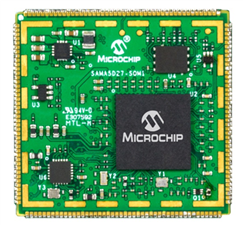
    Microchip has recently launched the System on Module (PN: ATSAMA5D27-SOM1ATSAMA5D27-SOM1) which targets embedded Linux applications. Featuring an ARM-based MPU Microchip have done all the very complex design work leaving users to simply place the module onto their application board.image


    The module is a small-single sided PCB, 40mm x 38mm, industrial temperature grade (-40/+85C) and requires a single 3.3V power supply for operation.


    Designers can consider the SoM (System on Module) to be just one of the components they require to build their product.


    A ready to go Linux solution is supplied with Microchip’s commitment to in-house Linux support. Microchip contributes to the Linux Mainline and offers a Yocto based build manager, allowing developers to build their own Linux distribution.


    The module includes several components from Microchip.   


    Industry standard ARM MPU with DDR Memory, 10/100Mbit Ethernet PHY, (MAC address is programmed into a small serial eeprom), a power-management controller, and non-volatile boot memory.image


    For the more adventurous, the SoM can be used as a reference design: Microchip provides a reference implementation with full access to design files for those who want to consider making modifications or migrate to discrete designs.


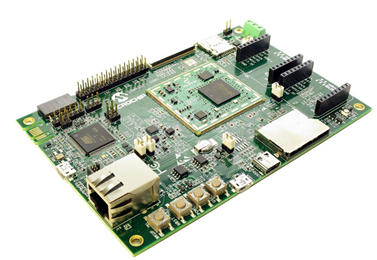
    For fast development, Microchip offers the ATSAMA5D27-SOM1-EK1 ATSAMA5D27-SOM1-EK1 which incorporates the SoM. This board is backed by a Board Support Package (BSP) with Linux kernel and drivers for the SoM’s MPU peripherals and integrated circuits.


    For more information, click here to read the User Manual.

    • 18 Apr 2018
element14 Community

element14 is the first online community specifically for engineers. Connect with your peers and get expert answers to your questions.

  • Members
  • Learn
  • Technologies
  • Challenges & Projects
  • Products
  • Store
  • About Us
  • Feedback & Support
  • FAQs
  • Terms of Use
  • Privacy Policy
  • Legal and Copyright Notices
  • Sitemap
  • Cookies

An Avnet Company © 2026 Premier Farnell Limited. All Rights Reserved.

Premier Farnell Ltd, registered in England and Wales (no 00876412), registered office: Farnell House, Forge Lane, Leeds LS12 2NE.

ICP 备案号 10220084.

Follow element14

  • X
  • Facebook
  • linkedin
  • YouTube