
element14 Community
element14 Community
    Register Log In
  • Site
  • Search
  • Log In Register
  • Community Hub
    Community Hub
    • What's New on element14
    • Feedback and Support
    • Benefits of Membership
    • Personal Blogs
    • Members Area
    • Achievement Levels
  • Learn
    Learn
    • Ask an Expert
    • eBooks
    • element14 presents
    • Learning Center
    • Tech Spotlight
    • STEM Academy
    • Webinars, Training and Events
    • Learning Groups
  • Technologies
    Technologies
    • 3D Printing
    • FPGA
    • Industrial Automation
    • Internet of Things
    • Power & Energy
    • Sensors
    • Technology Groups
  • Challenges & Projects
    Challenges & Projects
    • Design Challenges
    • element14 presents Projects
    • Project14
    • Arduino Projects
    • Raspberry Pi Projects
    • Project Groups
  • Products
    Products
    • Arduino
    • Avnet & Tria Boards Community
    • Dev Tools
    • Manufacturers
    • Multicomp Pro
    • Product Groups
    • Raspberry Pi
    • RoadTests & Reviews
  • About Us
    About the element14 Community
  • Store
    Store
    • Visit Your Store
    • Choose another store...
      • Europe
      •  Austria (German)
      •  Belgium (Dutch, French)
      •  Bulgaria (Bulgarian)
      •  Czech Republic (Czech)
      •  Denmark (Danish)
      •  Estonia (Estonian)
      •  Finland (Finnish)
      •  France (French)
      •  Germany (German)
      •  Hungary (Hungarian)
      •  Ireland
      •  Israel
      •  Italy (Italian)
      •  Latvia (Latvian)
      •  
      •  Lithuania (Lithuanian)
      •  Netherlands (Dutch)
      •  Norway (Norwegian)
      •  Poland (Polish)
      •  Portugal (Portuguese)
      •  Romania (Romanian)
      •  Russia (Russian)
      •  Slovakia (Slovak)
      •  Slovenia (Slovenian)
      •  Spain (Spanish)
      •  Sweden (Swedish)
      •  Switzerland(German, French)
      •  Turkey (Turkish)
      •  United Kingdom
      • Asia Pacific
      •  Australia
      •  China
      •  Hong Kong
      •  India
      •  Japan
      •  Korea (Korean)
      •  Malaysia
      •  New Zealand
      •  Philippines
      •  Singapore
      •  Taiwan
      •  Thailand (Thai)
      •  Vietnam
      • Americas
      •  Brazil (Portuguese)
      •  Canada
      •  Mexico (Spanish)
      •  United States
      Can't find the country/region you're looking for? Visit our export site or find a local distributor.
  • Translate
  • Profile
  • Settings
Microchip
  • Products
  • Manufacturers
  • Microchip
  • More
  • Cancel
Microchip
Blog PIC16F13276 & PIC18-Q35: Programmable Hardware Logic, No CPLD Required- New from Microchip
  • Blog
  • Forum
  • Documents
  • Events
  • Polls
  • Members
  • Mentions
  • Sub-Groups
  • Tags
  • More
  • Cancel
  • New
Join Microchip to participate - click to join for free!
  • Share
  • More
  • Cancel
Group Actions
  • Group RSS
  • More
  • Cancel
Engagement
  • Author Author: Microchip_MCU
  • Date Created: 22 Apr 2026 10:26 PM Date Created
  • Views 317 views
  • Likes 8 likes
  • Comments 4 comments
Related
Recommended

PIC16F13276 & PIC18-Q35: Programmable Hardware Logic, No CPLD Required- New from Microchip

Microchip_MCU
Microchip_MCU
22 Apr 2026

image

What if you didn't need a CPLD or FPGA for programmable logic? What if your MCU could do it all- no external components, smaller BOM, less board space, and still give you everything a CPLD would?

Introducing the PIC16F132 and PIC18-Q35- the latest additions to Microchip's growing Configurable Logic Block (CLB) product portfolio; each with an on-chip CLB peripheral that runs fully independent of the CPU, so response times are deterministic and fixed, no jitter, no variability. For automotive, industrial, and safety-critical designs where timing guarantees are non-negotiable, that matters. And unlike FPGA toolchains, it's fast to work with: MCC's graphical CLB synthesizer lets you configure, simulate, and debug logic in minutes, with no HDL experience required.

Eliminate that external component, shrink your BOM, reclaim that board space, and you haven't given anything up. If you used PIC16F13145 last year, you already know where this is going.

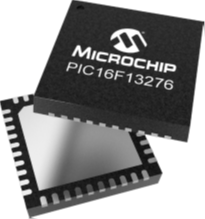
The PIC16F132 product family- Embedded Innovation with Configurable Logic and Enhanced Security
image

The entry point. It's an 8- to 40-pin PIC16 with 32 CLB logic elements- automotive-ready, cost-effective, and low-power. It's built for designs where you need real hardware logic capability without the overhead of a standalone CPLD. Pair it with the

  • 10-bit ADC with computation, 10-bit DAC, hardware CVD touch sensing, dual 16-bit PWMs, 2× comparators
  • SMBus-compatible I²C/SPI and dual EUSARTs
  • Up to 28 KB Flash, 2 KB SRAM, 256 B EEPROM
  • Packages: SOIC, TSSOP, PDIP, SSOP, VQFN, TQFP

and you have a surprisingly capable chip in a small, affordable package.

Security is handled too

  • PDID permanently disables the programming and debug interfaces after deployment, locking down your firmware from the hardware level up.

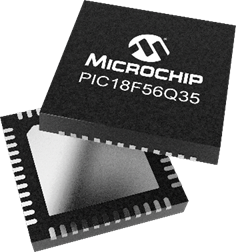
PIC18-Q35- Maximum Flexibility for Custom Embedded Solutions
image

This is where the CLB story gets serious.

  • 128 logic elements. 64 MHz PIC18 core.
  • Multi-Voltage I/O from 1.62V to 5.5V eliminates external level shifters for mixed-voltage designs.
  • 4x DMA controllers handle data movement without touching the CPU. UART with LIN and DMX protocol support, Zero-Cross Detect, and the same PDID security lockdown as the F132- all in 28- to 48-pin packages.

Built for industrial, automotive, and security-sensitive environments that demand both performance and flexibility on a single chip.

Both families are fully supported in MPLAB X IDE and VS Code. MCC's CLB synthesizer gives you a graphical drag-and-drop interface, Verilog for advanced users, built-in simulation, timing analysis, and hardware debug pins. No HDL experience needed -you can have custom logic running in minutes.

image

Resources:
Learn more about- PIC16F13145 / PIC16F132/ PIC18Q35

Check out products on Farnell- 
PIC16F132

Start developing with PIC16F132 Curiosity Nano Development Board

PIC18FQ35

Family  Data sheets- 

PIC16F132 imagePDF

imagePDF PIC18Q35

  • Sign in to reply

Top Comments

  • jc2048
    jc2048 16 days ago in reply to Jan Cumps +1
    The evaluation board for the 18F56Q35 is EV55P36A https://www.microchip.com/en-us/development-tool/EV55P36A Microchip Direct have them in stock, so they're just taking their time to work their way through…
  • Microchip_MCU
    Microchip_MCU 14 days ago in reply to jc2048

    Thank you for catching that. We have replaced the image. 

    • Cancel
    • Vote Up 0 Vote Down
    • Sign in to reply
    • More
    • Cancel
  • jc2048
    jc2048 16 days ago in reply to Jan Cumps

    The evaluation board for the 18F56Q35 is EV55P36A

    https://www.microchip.com/en-us/development-tool/EV55P36A

    Microchip Direct have them in stock, so they're just taking their time to work their way through distribution. They aren't very much money either.

    It's a very easy route to experimenting with logic design. If I'm understanding the datasheet correctly, the CPU-less ones would allow the part to work as just a CPLD. 

    I used 16F parts quite a lot back in the 1990s - assembler, never in C. They're very simple RISC parts. The data memory is separate to the code memory and is in the form of a register file (256 of them, so 8 bits in the instruction as an address), with paging of banks for the devices with more than 256. With multiple banks, there's an area of 16 registers that are common to all banks. Personally, I wouldn't try programming them in C without a good understanding of the architecture (ie learn with assembler, and then use the C as merely a high-level and more efficient way of writing the assembler). Presumably the compiler will hide that from you to a certain extent (bank switching in the background, etc), but there are still going to be complications with things like buffers wrapping round the page, and those sorts of issues, aren't there.

    The 18F parts would be more amenable to high level coding because there's a way of addressing the data memory in a flat form (only very vaguely remembered - I only did one design with 18F before moving on to the 24F parts, though even those I programmed in assembler).

    Somewhere I've got a PicKit3 programmer, but I don't know if it would work with any of these parts.

    • Cancel
    • Vote Up +1 Vote Down
    • Sign in to reply
    • More
    • Cancel
  • Jan Cumps
    Jan Cumps 17 days ago in reply to jc2048

    The EV18Z11A evaluation kit is below 10 £, with on-board debugger...

    (looks like not in stock though with avnet and other distributors)

    • Cancel
    • Vote Up 0 Vote Down
    • Sign in to reply
    • More
    • Cancel
  • jc2048
    jc2048 17 days ago

    Interesting devices. The 18F parts in particular, with 128 BLEs and available in DIP packages.

    Mistake in the selection graphic? BLE = basic logic element.

    image

    • Cancel
    • Vote Up 0 Vote Down
    • Sign in to reply
    • More
    • Cancel
element14 Community

element14 is the first online community specifically for engineers. Connect with your peers and get expert answers to your questions.

  • Members
  • Learn
  • Technologies
  • Challenges & Projects
  • Products
  • Store
  • About Us
  • Feedback & Support
  • FAQs
  • Terms of Use
  • Privacy Policy
  • Legal and Copyright Notices
  • Sitemap
  • Cookies

An Avnet Company © 2026 Premier Farnell Limited. All Rights Reserved.

Premier Farnell Ltd, registered in England and Wales (no 00876412), registered office: Farnell House, Forge Lane, Leeds LS12 2NE.

ICP 备案号 10220084.

Follow element14

  • X
  • Facebook
  • linkedin
  • YouTube