


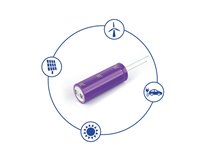
 Electric double layer capacitors (EDLC) - also known as super-capacitors or ultra-capacitors, have moved increasingly into research and development’s focus recently because of their power delivery performance that perfectly fills the gap between dielectric capacitors and traditional batteries. This attention is predominantly coming from applications in portable electronics devices, electric vehicles, bulk electricity storage at power stations and “load levelling” of renewable sources such as solar energy and wind power. The complex challenges of future decentralized energy supply can only be met on the basis of novel hybrid electrical storage technologies. EDLCs have high power density, faster charge/discharge capability, and wide operating temperature compared to batteries. Since they store energy electrostatically, they can pass through hundreds of thousands of charge-/discharge cycles without losing capacitance. Despite all their advantages, their low voltage level and relatively low capacity stand as a bottleneck for capacitors compared to batteries or redox-flow systems.
HL Series – Gold Capacitor with Outstanding Specs
The Capacitance is mainly dependent on the surface area of the electrical double layer. Activated carbon is used to form a big surface area for the electrodes which leads to a capacitance up to 100F. Together with the HL Series, Panasonic introduced a high performance, acetonitrile free electrolyte which is highly anti-alkaline and non-hazardous. Therefore Panasonic's Gold-Capacitors are RoHs compliant and are not liable to severe recycling regulations.
The superiors behaviour of the internal resistance over lifetime and the stability of the capacity over the whole usage time allows better performance with lower capacitance than before. This brings the electrochemical capacitors closer to batteries and enables superior charge and discharge performance compared with secondary batteries; consequently, you can build your power supply circuit with fewer capacitors.
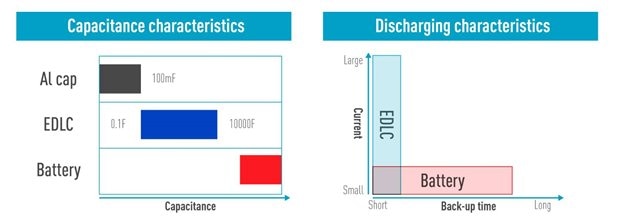
To round it up: Panasonic’s new HL Series Electric Double Layer Capacitors provides you with all the necessary qualities you are looking for in order to complete your many rapid charge/discharge cycles demanding application.
- Long operation life: realization of long operation life without requiring replacement provided by the industry’s first 2000- hour guarantee
- High current output(Low resistance): realization of the high current output by reducing the internal resistance, 10mΩ or less
- Wide temperature range: realization of the low temperature guarantee down to -40 deg. C for the use under severe environment as well as automotive application
Application:
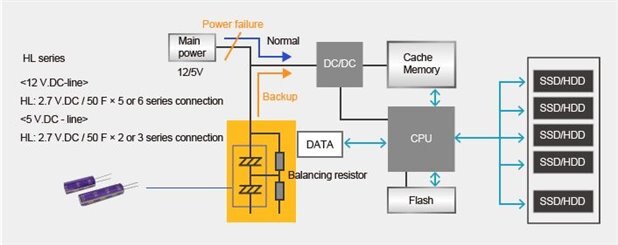
Super-capacitors that are both high capacitance and high output can leverage energy storage solutions that are mountable in a small space. When the super-capacitor is used as an auxiliary power supply during peak output, it can reduce the size of the supply units, add a higher output function, and improve overall performance. Ultra-capacitors are now having both energy and power density high, and so new applications for EDLCs are being developed at an increasing rate. Some possible applications of ultra-capacitors are: Storage/Data backup of cache memory in case of power failure.
Storage/ Data backup of cache memory in case of power failure
Of more interest to the typical design engineer are consumer electronics, computer, and communications applications. Super-capacitors are frequently designed into these products for memory protection. Internal back-up power is another common application. The super-capacitor can be used either as a battery replacement or as a short-term redundant back-up supply. Here, the capacitor can act as a supply for a short period. Batteries are the alternative of the capacitors in these applications. Batteries do not generally have a long product lifetime, and therefore need to be replaced regularly. Today’s consumer appliances are also cheap to the extent that a battery could cost up to 20% of the price of the appliance. EDLCs are therefore a good choice as back-up power supply due to their long lifetime. The fig. below shows the scheme for memory back-up of clock memory via super-capacitor.
Automotive
Battery power electric vehicles have the limitations of low power density, limited charge/discharge cycles, high temperature dependence and long charging time. Ultra-capacitors, by virtue of their technolo, are not having such limitations, although they are faced with other limitations such as low energy density and high costs. The combination of the storage devices can be a good alternative. Peak load requirements that result from accelerating or climbing up hills can be met by the high-power device such as a super capacitor bank. The utilisation of super capacitors also makes regenerative braking possible. The figure below shows backup power supply of the electronic brake in case of battery power failure:

Renewable energy applications
In solar PV applications, batteries have to be replaced every 3– 7 years because of continuous cycling that has a detrimental effect on batteries. But super-capacitors are able to be charged and discharged quickly and also for larger life cycles than that of batteries, and thus only need to be replaced every 20 years, which is the lifetime of the PV panels. Life-cycle costs are therefore reduced through the elimination of frequent maintenance requirements. Energy efficiency is always of primary concern in renewable power generation and super capacitors demonstrate a higher charging efficiency than batteries. A lead-acid battery, for example, can lose up to 30% of the energy during charging, whereas EDLCs may only lose 10%. Additionally, the ability to operate efficiently of a wider range of temperatures is another advantage of using super-capacitors. Some remote stations may be located in cold climates and if batteries are used for energy storage, the temperature will have to be maintained at close to room temperature by auxiliary systems, representing additional cost and energy consumption.
For further reference please compare: Panasonic
Please also compare: Farnell
Top Comments