


Introduction - The technology behind Grid-EYE
Panasonic has kick-started its IR array sensor business with an innovative 8x8 matrix-format thermopile array called "Grid-EYE". Grid-EYE is an infrared array sensor with a compact and complete SMD package featuring a revolutionary 64-pixel infrared camera. Based on Panasonic's MEMS (micro-electro-mechanical systems) technology, Grid-EYE combines a MEMS sensor chip, a digital ASIC (I2C interface) and a silicon lens. It features 64 thermopile elements in an 8x8 grid format, which can capture absolute surface temperatures without the need for any contact. Unlike conventional sensors, Grid-EYE uses a patented 60° silicon lens, which has been etched out of a silicon wafer and, with a height measuring less than 0.3 mm, is the smallest lens available on the market. By combining these different types of technology, Panasonic has managed to reduce the size of the sensor's housing to a compact 11.6 mm x 8 mm x 4.3 mm, which is approximately 70% smaller than all other comparable products currently on the market.
Figure 1

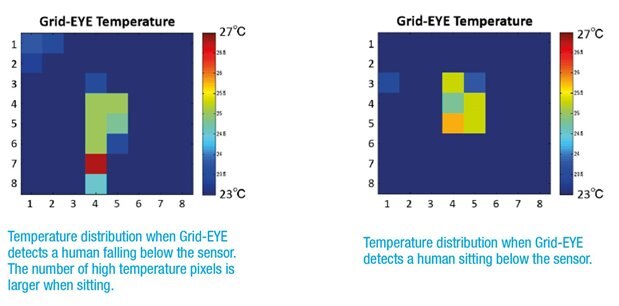
In stark contrast to single-element thermopile sensors and pyroelectric sensors, Grid-EYE is able to identify the direction of movement of people and objects. Grid-EYE can also detect position and presence as well as actual surface temperatures from -20°C to +100°C. This wide range of temperature measurements enables Panasonic to achieve a noise equivalent temperature difference (NETD) of +/-0.08°C at 1 Hz and ambient temperature. The complementary array of measurement elements can even detect multiple people or objects moving in different directions. At close proximity, Grid-EYE can even detect hand movements for simple gesture control.
Figure 2

Case Study - Grid-EYE within the field of assisted living
According to the German Federal institute for Population Research (BiB), the number of people who need care could be set to rise by 35% in the next 15 years in Germany alone. In 2013, around 2.6 million people depended on the provision of care, which means that number is predicted to reach around 3.5 million in 2030. The latest statistics on accidents suffered by elderly people at home show that accidents are most likely to be caused by an elderly person falling over in the living room or down the stairs in their own home. In conjunction with the general monitoring of activities and vital signs, being able to reliably identify if someone has suffered a fall is considered to be extremely important as part of efforts to safeguard and promote senior citizens' health and safety. The technology used should be contactless, discreet and as cost-effective as possible. The ability to integrate hardware components into existing living environments must also be an option. What's more, the technology needs to be easy to use as its acceptance amongst users will depend on it. The final requirement is for the broadest range of emergency situations within a living environment to be recognized whilst minimizing false alarms and preventing erroneous emergency calls.
Figure 3
"Professional, electronic assistance systems are definitely the future," says Lothar Feige. The Managing Director of the relatively recently founded company pikkerton says the company is set to shake up the AAL market with an in-house development of its own. AAL stands for "active assisted living", whereby elderly people get to live in their own homes for as long as possible with the help of technology. pikkerton chose to use Grid-EYE when developing its own InstaMon (a light switch design which recognizes and reports falls) because Grid-EYE's sensor data is sufficient for serving subsequent image processing algorithms yet protects the individual's privacy as the sensor does not reproduce images. "We were impressed with Grid-EYE's dimensions and power spectrum," Lothar Feige explains. "And because our sensor needs to fit discreetly into people's living rooms and our aim was to reduce the installation depth to 32 mm, the decision was a no-brainer. Thanks to the dimensions, InstaMon can be built as the form factor of a light switch and can be used in conventional flush-mounted boxes or even surface-mounted frames."
First of all, the infrared array sensor sends the relevant temperature distribution to a micro-controller. This then extracts an extremely wide variety of characteristics from the temperature distribution sent by the sensor. These characteristics are then fed into evaluation algorithms working and learning in parallel. The device is designed as a GSM device (2G) and therefore has a SIM card slot. The integrated dual-band antenna means that the device can be registered on all cellphone networks available across Europe. Depending on the configuration, SMS messages can be sent and even voice calls can be made to any telephone or smartphone. As a result, direct contact with the person who has fallen down can be made immediately using the integrated hands-free speakerphone.
Alarm-triggered services can also increase the cost transparency of homecare services as the billing for the service time is as accurate as for a phone bill. The benefits for assisted-living care providers are that there are fewer false alarms and greater customer satisfaction and therefore also increased customer loyalty. Finally, the system represents a win-win situation for everyone involved, both for insurance companies and care providers as well as senior citizens and their relatives as it allows them to feel safe and secure in their own homes, which is a basic necessity.
For further reference please compare: Panasonic
Please also compare: Farnell
Top Comments