element14 Community
element14 Community
    Register Log In
  • Site
  • Search
  • Log In Register
  • Community Hub
    Community Hub
    • What's New on element14
    • Feedback and Support
    • Benefits of Membership
    • Personal Blogs
    • Members Area
    • Achievement Levels
  • Learn
    Learn
    • Ask an Expert
    • eBooks
    • element14 presents
    • Learning Center
    • Tech Spotlight
    • STEM Academy
    • Webinars, Training and Events
    • Learning Groups
  • Technologies
    Technologies
    • 3D Printing
    • FPGA
    • Industrial Automation
    • Internet of Things
    • Power & Energy
    • Sensors
    • Technology Groups
  • Challenges & Projects
    Challenges & Projects
    • Design Challenges
    • element14 presents Projects
    • Project14
    • Arduino Projects
    • Raspberry Pi Projects
    • Project Groups
  • Products
    Products
    • Arduino
    • Avnet & Tria Boards Community
    • Dev Tools
    • Manufacturers
    • Multicomp Pro
    • Product Groups
    • Raspberry Pi
    • RoadTests & Reviews
  • About Us
  • Store
    Store
    • Visit Your Store
    • Choose another store...
      • Europe
      •  Austria (German)
      •  Belgium (Dutch, French)
      •  Bulgaria (Bulgarian)
      •  Czech Republic (Czech)
      •  Denmark (Danish)
      •  Estonia (Estonian)
      •  Finland (Finnish)
      •  France (French)
      •  Germany (German)
      •  Hungary (Hungarian)
      •  Ireland
      •  Israel
      •  Italy (Italian)
      •  Latvia (Latvian)
      •  
      •  Lithuania (Lithuanian)
      •  Netherlands (Dutch)
      •  Norway (Norwegian)
      •  Poland (Polish)
      •  Portugal (Portuguese)
      •  Romania (Romanian)
      •  Russia (Russian)
      •  Slovakia (Slovak)
      •  Slovenia (Slovenian)
      •  Spain (Spanish)
      •  Sweden (Swedish)
      •  Switzerland(German, French)
      •  Turkey (Turkish)
      •  United Kingdom
      • Asia Pacific
      •  Australia
      •  China
      •  Hong Kong
      •  India
      • Japan
      •  Korea (Korean)
      •  Malaysia
      •  New Zealand
      •  Philippines
      •  Singapore
      •  Taiwan
      •  Thailand (Thai)
      • Vietnam
      • Americas
      •  Brazil (Portuguese)
      •  Canada
      •  Mexico (Spanish)
      •  United States
      Can't find the country/region you're looking for? Visit our export site or find a local distributor.
  • Translate
  • Profile
  • Settings
Panasonic
  • Products
  • Manufacturers
  • Panasonic
  • More
  • Cancel
Panasonic
Blog LiDAR Technology in Autonomous Driving: A Practical Guide to Key Components
  • Blog
  • Forum
  • Documents
  • Polls
  • Members
  • Mentions
  • Sub-Groups
  • Tags
  • More
  • Cancel
  • New
Join Panasonic to participate - click to join for free!
  • Share
  • More
  • Cancel
Group Actions
  • Group RSS
  • More
  • Cancel
Engagement
  • Author Author: riyo@panasonic
  • Date Created: 3 Feb 2026 1:47 AM Date Created
  • Views 152 views
  • Likes 4 likes
  • Comments 3 comments
  • DDR memory
  • GaN FET
  • EV / HEV Components
  • autonomous driving
  • automotive inductors
  • EMC / ESD Protection
  • High-Temperature Components
  • High-Speed Communication
  • ESD Suppressors
  • Automotive Reliability
  • automotive electronics
  • Vehicle Sensors
  • lidar
  • high precision resistors
  • Point Cloud
  • DC/DC Converter
  • Laser Diode (LD)
  • flash memory
  • adas
  • hybrid capacitors
  • Sensor Technology
  • mcu
  • varistors
  • power management
  • signal processing
  • Photodiode (PD)
  • 3D Sensing
  • thermistors
  • Analog Front-End
Related
Recommended

LiDAR Technology in Autonomous Driving: A Practical Guide to Key Components

riyo@panasonic
riyo@panasonic
3 Feb 2026
LiDAR Technology in Autonomous Driving: A Practical Guide to Key Components

1. What Is LiDAR?

LiDAR (Light Detection and Ranging) is a sensing technology that measures the distance to objects by emitting laser pulses and capturing the reflected light. The combination of emission direction and time‑of‑flight enables the generation of a high‑resolution 3D point cloud, which is widely used in ADAS and autonomous driving systems. As vehicle automation advances, the adoption of LiDAR is expected to grow steadily. 

Optical element Optical axis varying method Type Scanning
LD, PD Mechanical method Rotation by a motor A number of LDs and PDs are rotated by a motor to scan the whole area.
Polygon mirror Respective optical axes of a single LD and a single PD are varied by a polygon mirror in scanning.
Non-mechanical method (solid-state) MEMS mirror Respective optical axes of a single LD and a single PD are varied by a MEMS mirror in scanning.
Phased array Respective optical axes of a single LD and a single PD are varied by a waveguide in scanning.
Flash Light from a light source, such as an LED, is emitted over a wide area, and reflected light is collectively scanned by an array of PDs.

2. How LiDAR Measures Distance and Recognizes Objects

Distance Measurement

  • A laser diode emits a pulse toward an object.
  • A photodiode receives the reflected light.
  • The distance is determined from the time between emission and reception.

Object Recognition

By repeatedly scanning in multiple directions, LiDAR creates a point cloud.
This data is used to:

  • Identify obstacles
  • Build dynamic 3D maps
  • Estimate and correct the vehicle’s position in real time 

3. Market Trends and Technical Requirements

As autonomous driving levels increase, LiDAR systems must meet three key requirements:

Requirement Reason
Higher power Higher‑resolution sensing increases CPU load and power demands.
Faster communication High‑frequency and high‑speed data transfer is essential to process large point clouds.
Smaller size & lighter weight Vehicles incorporate more sensors, requiring miniaturized components.

4. LiDAR System Overview

A LiDAR unit typically consists of:

  • Laser Diode (LD): Emits high‑speed laser pulses
  • Photodiode (PD): Converts received light into electrical signals
  • Amplifier for the PD output
  • FPGA: Handles high‑speed data processing
  • MCU: Controls system operation
  • Transceiver: CAN/Ethernet communication
  • DDR & Flash Memory
  • DC/DC Converters: Provide necessary voltage rails
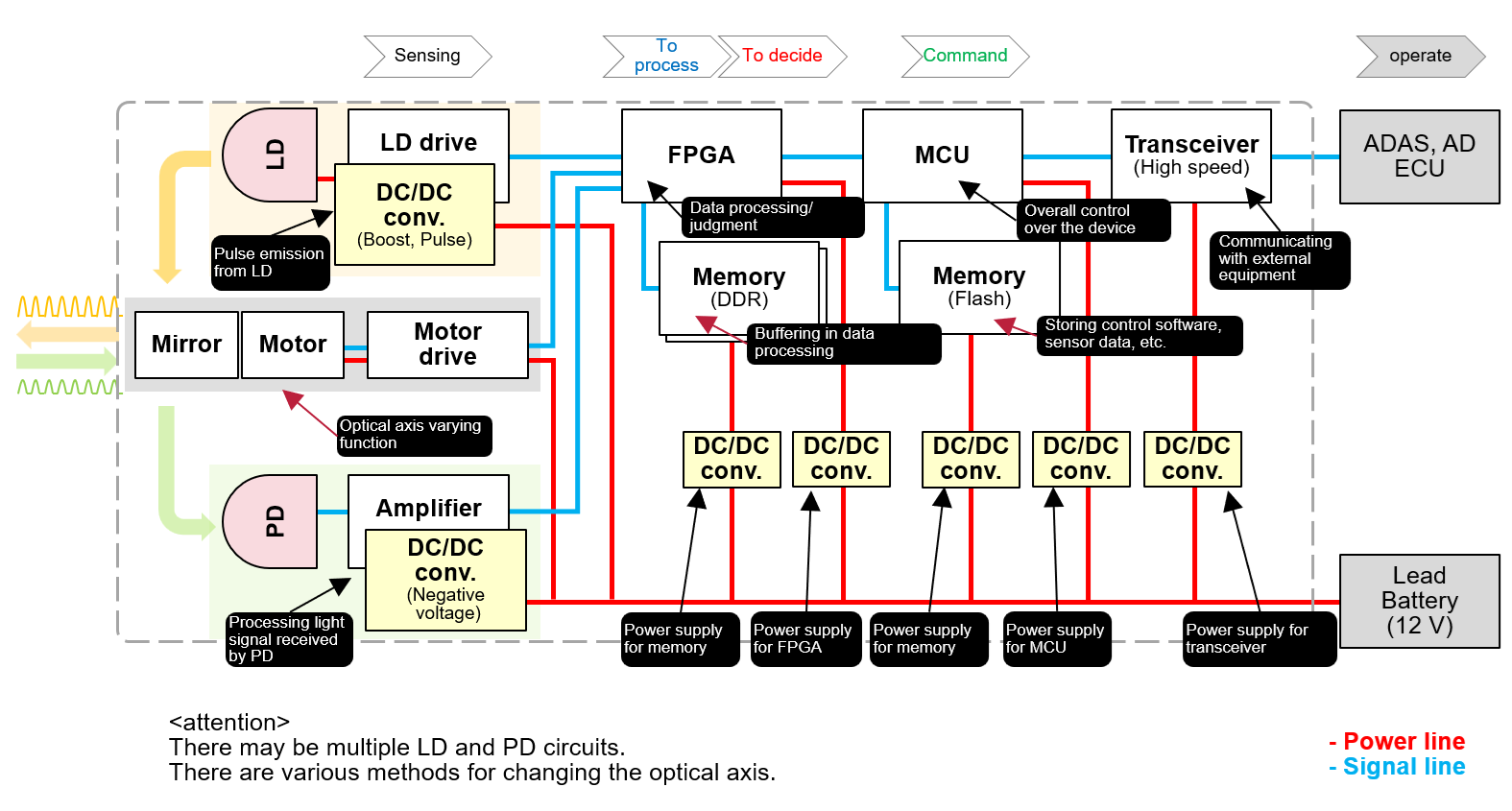
Overall configuration of the LiDAR system

5. Key Circuits and Recommended Components 


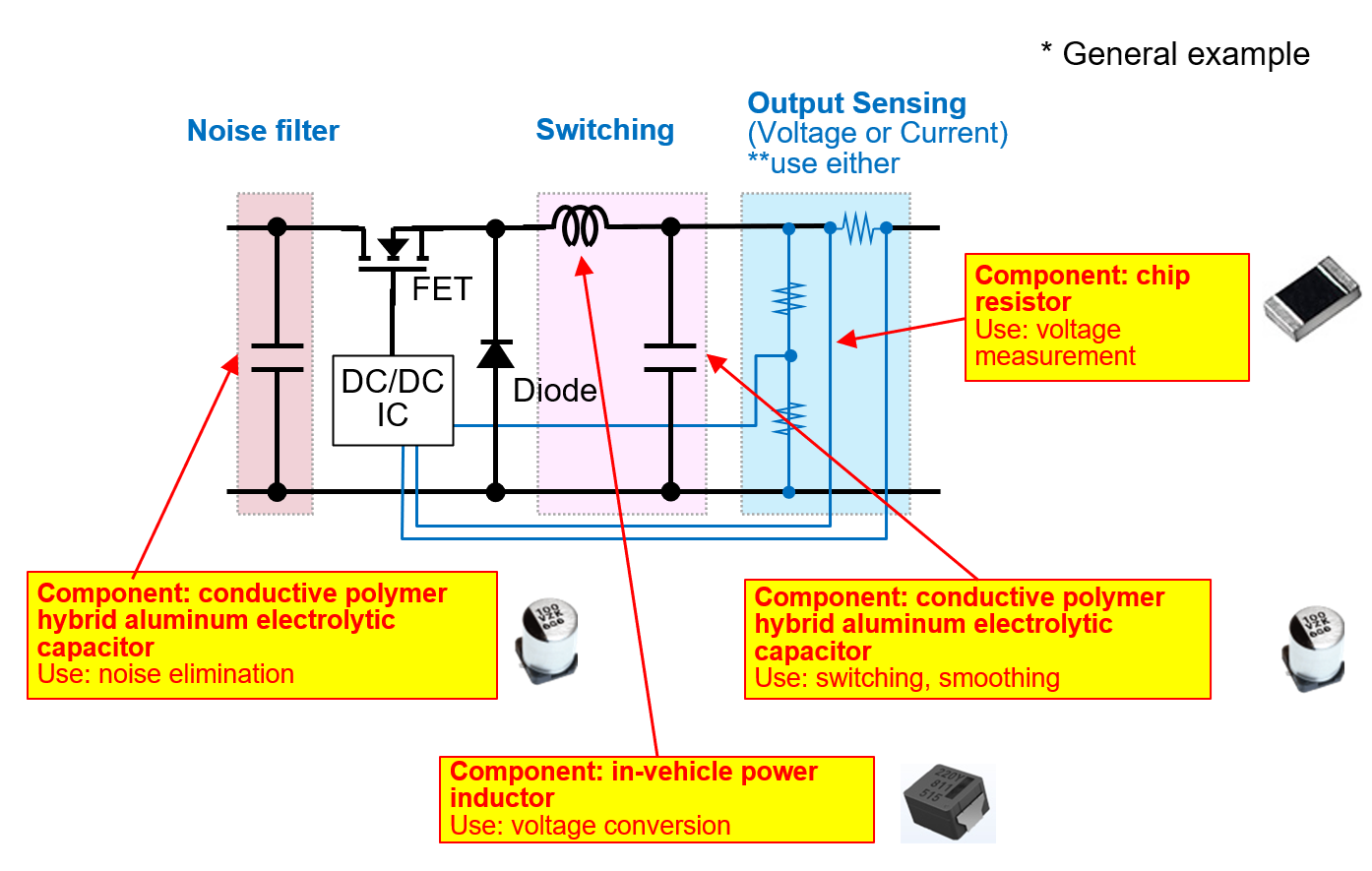
5‑1. DC/DC Converter Circuit

High‑performance LiDAR requires stable, low‑noise power.

Recommended Components

Function Component Key Features
Noise filtering & smoothing Conductive polymer hybrid aluminum electrolytic capacitor Low ESR, high ripple tolerance, excellent high‑frequency behavior
Voltage conversion Automotive power inductor High current capability, low loss, low ACR
Voltage measurement High‑precision chip resistor Low resistance tolerance, low TCR for accurate control

Components used in the DC/DC converter


5‑2. Transceiver Interface (CAN / Ethernet)

Because communication lines are exposed to ESD, protection devices are critical.

Recommended Components

  • Chip varistor
  • ESD suppressor (ultra‑low capacitance)

Key points:

  • Chip varistors cover a wide capacitance range (8–250 pF) for low → high‑speed communication
  • ESD suppressors (0.1 pF) are optimal for high‑speed interfaces
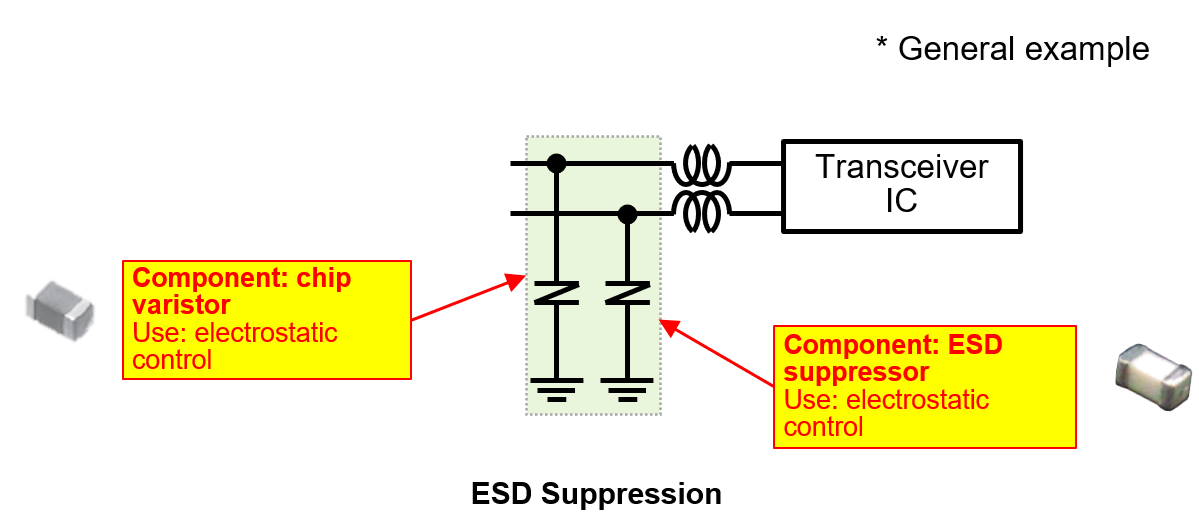
Components used in the transceiver IF


5‑3. Photodiode Light‑Receiving Circuit

Reflected laser light is weak and must be amplified with high precision.

Recommended Components

  • High‑precision chip resistor → Sets amplifier gain
  • NTC thermistor → Temperature compensation

Why they matter:

  • Low‑TCR thin‑film resistors ensure stable gain
  • High‑reliability thermistors maintain accurate sensing across temperatures
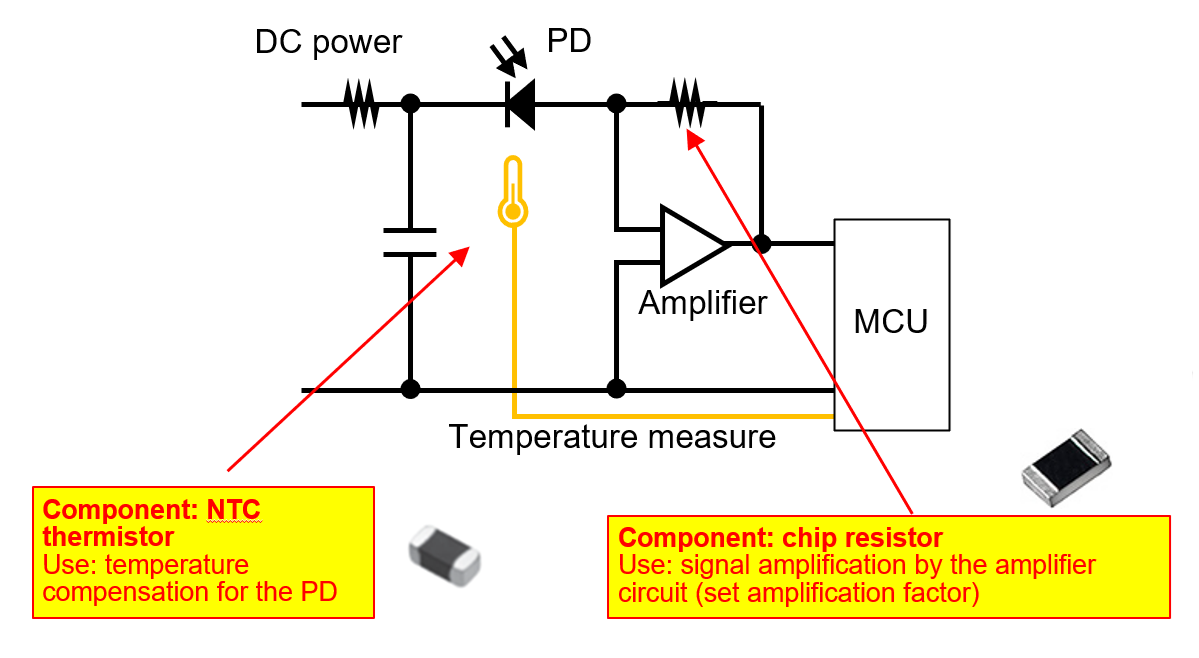
Components used in the photodiode light-receiving circuit


5‑4. Laser Diode Irradiation Circuit

A GaN FET is typically used to deliver high‑speed, high‑power pulses.

Recommended Components

  • Small, high‑power chip resistor (gate resistor)

Key advantage:

  • Original resistance pattern and electrode design support high‑power switching while enabling device miniaturization
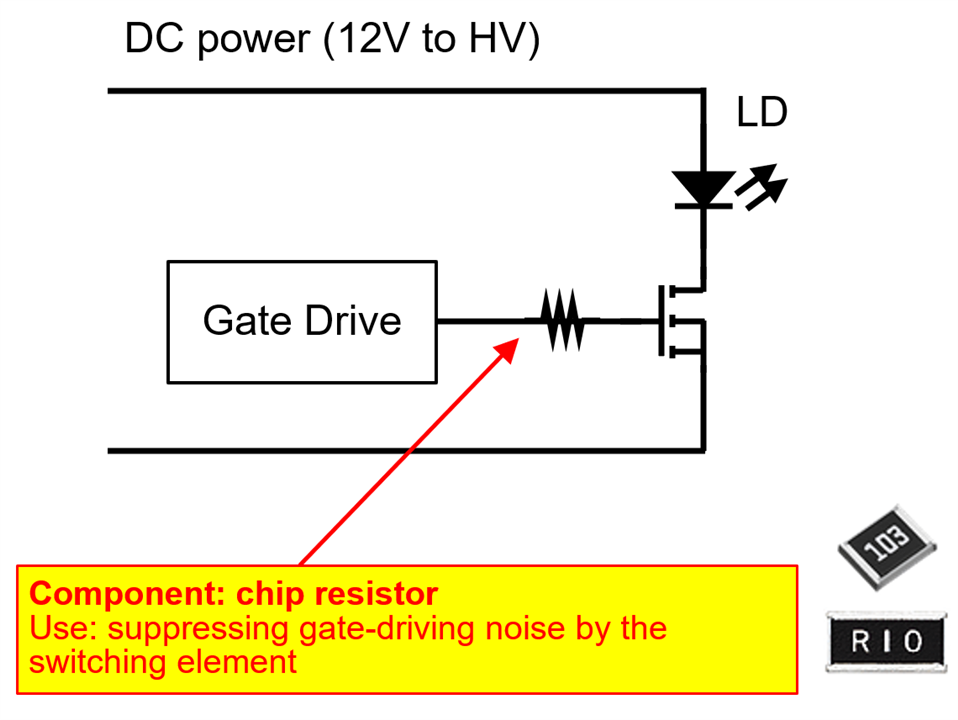
Components used in the laser diode irradiation circuit


6. Conclusion

As autonomous vehicles adopt more LiDAR units, the demand for electronic components offering:

  • Low loss
  • High current capability
  • High‑frequency performance
  • Compact size & high reliability

will continue to grow. Panasonic Industry offers a broad portfolio—including hybrid capacitors, automotive inductors, high‑precision resistors, varistors, ESD suppressors, and thermistors—that aligns well with these requirements. 

Component Feature Large current Low loss High frequency Small size High precision
Conductive polymer hybrid aluminum electrolytic capacitor Low ESR
High reliability
Heavy check mark Heavy check mark Heavy check mark Heavy check mark
Automotive power inductor Large current, low loss
High reliability
Heavy check mark Heavy check mark Heavy check mark Heavy check mark
Chip resistor (high-precision chip resistor)

Chip resistor (small and high-power chip resistor)
High precision, high resistance to heat Heavy check mark Heavy check mark
Chip varistor Small and light Heavy check mark
ESD suppressor Low capacitance
Ultrafast data I/F
Heavy check mark Heavy check mark
NTC thermistor (chip type) Small, high resistance to heat Heavy check mark Heavy check mark
  • Sign in to reply
  • riyo@panasonic
    riyo@panasonic 6 days ago in reply to robogary

    Hello. Thank you very much for your comment!

    It cannot be said that there are no errors, but we believe the probability is low.
    The transmission and reception of the laser are synchronized, so reception data at different timings are unlikely to be processed.
    Even if there are a few errors, I think they wouldn't pose a problem for safety assessments.
    Additionally, ADAS does not rely solely on LiDAR for safety judgments, so I believe there is no issue.

    • Cancel
    • Vote Up 0 Vote Down
    • Sign in to reply
    • More
    • Cancel
  • robogary
    robogary 7 days ago

    I always wondered if every vehicle in traffic had lidar would they crosswalk and create errors, or is it like FHSS, the chance of detecting pulses from a different source are unlikely to align time wise, or maybe the lidar pulse is an encoded burst ? 

    • Cancel
    • Vote Up 0 Vote Down
    • Sign in to reply
    • More
    • Cancel
  • DAB
    DAB 7 days ago

    Yes LIDAR has come a long way since I was first involved with it many decades ago.

    • Cancel
    • Vote Up 0 Vote Down
    • Sign in to reply
    • More
    • Cancel
element14 Community

element14 is the first online community specifically for engineers. Connect with your peers and get expert answers to your questions.

  • Members
  • Learn
  • Technologies
  • Challenges & Projects
  • Products
  • Store
  • About Us
  • Feedback & Support
  • FAQs
  • Terms of Use
  • Privacy Policy
  • Legal and Copyright Notices
  • Sitemap
  • Cookies

An Avnet Company © 2026 Premier Farnell Limited. All Rights Reserved.

Premier Farnell Ltd, registered in England and Wales (no 00876412), registered office: Farnell House, Forge Lane, Leeds LS12 2NE.

ICP 备案号 10220084.

Follow element14

  • X
  • Facebook
  • linkedin
  • YouTube