element14 Community
element14 Community
    Register Log In
  • Site
  • Search
  • Log In Register
  • Community Hub
    Community Hub
    • What's New on element14
    • Feedback and Support
    • Benefits of Membership
    • Personal Blogs
    • Members Area
    • Achievement Levels
  • Learn
    Learn
    • Ask an Expert
    • eBooks
    • element14 presents
    • Learning Center
    • Tech Spotlight
    • STEM Academy
    • Webinars, Training and Events
    • Learning Groups
  • Technologies
    Technologies
    • 3D Printing
    • FPGA
    • Industrial Automation
    • Internet of Things
    • Power & Energy
    • Sensors
    • Technology Groups
  • Challenges & Projects
    Challenges & Projects
    • Design Challenges
    • element14 presents Projects
    • Project14
    • Arduino Projects
    • Raspberry Pi Projects
    • Project Groups
  • Products
    Products
    • Arduino
    • Avnet & Tria Boards Community
    • Dev Tools
    • Manufacturers
    • Multicomp Pro
    • Product Groups
    • Raspberry Pi
    • RoadTests & Reviews
  • About Us
  • Store
    Store
    • Visit Your Store
    • Choose another store...
      • Europe
      •  Austria (German)
      •  Belgium (Dutch, French)
      •  Bulgaria (Bulgarian)
      •  Czech Republic (Czech)
      •  Denmark (Danish)
      •  Estonia (Estonian)
      •  Finland (Finnish)
      •  France (French)
      •  Germany (German)
      •  Hungary (Hungarian)
      •  Ireland
      •  Israel
      •  Italy (Italian)
      •  Latvia (Latvian)
      •  
      •  Lithuania (Lithuanian)
      •  Netherlands (Dutch)
      •  Norway (Norwegian)
      •  Poland (Polish)
      •  Portugal (Portuguese)
      •  Romania (Romanian)
      •  Russia (Russian)
      •  Slovakia (Slovak)
      •  Slovenia (Slovenian)
      •  Spain (Spanish)
      •  Sweden (Swedish)
      •  Switzerland(German, French)
      •  Turkey (Turkish)
      •  United Kingdom
      • Asia Pacific
      •  Australia
      •  China
      •  Hong Kong
      •  India
      • Japan
      •  Korea (Korean)
      •  Malaysia
      •  New Zealand
      •  Philippines
      •  Singapore
      •  Taiwan
      •  Thailand (Thai)
      • Vietnam
      • Americas
      •  Brazil (Portuguese)
      •  Canada
      •  Mexico (Spanish)
      •  United States
      Can't find the country/region you're looking for? Visit our export site or find a local distributor.
  • Translate
  • Profile
  • Settings
Panasonic
  • Products
  • Manufacturers
  • Panasonic
  • More
  • Cancel
Panasonic
Blog Solving thermal management challenges in a minimum space
  • Blog
  • Forum
  • Documents
  • Polls
  • Members
  • Mentions
  • Sub-Groups
  • Tags
  • More
  • Cancel
  • New
Join Panasonic to participate - click to join for free!
  • Share
  • More
  • Cancel
Group Actions
  • Group RSS
  • More
  • Cancel
Engagement
  • Author Author: Resistor+caps
  • Date Created: 21 Nov 2014 2:37 PM Date Created
  • Views 737 views
  • Likes 0 likes
  • Comments 1 comment
  • graphite
  • heatsink
  • pgs
  • panasonic
  • panasonic_industrial_europe
  • thermal
  • dissipation
Related
Recommended

Solving thermal management challenges in a minimum space

Resistor+caps
Resistor+caps
21 Nov 2014
Solving thermal management challenges in a minimum space
Electronic equipment needs an efficient means of managing and dispersing heat as systems continue to shrink in size.
Heat is a killer for electronic systems. As applications get thinner and lighter, this statement has never been more true, yet space and weight restrictions – especially in portable mobile devices – mean that conventional solutions may not be feasible.  But it’s not just consumer products such as smartphones, tablets and cameras that are at risk. Communications infrastructure equipment cram more and more complex electronics systems into a small space; electric (Eco) and hybrid cars require long-lasting, lightweight batteries; the advent of the smart factory (Industry 4.0) calls for greater levels of monitoring and control; solar panels (ironically) need to be able to cope with constant exposure to the sun; modern medical devices must be able to be worn comfortably.
All these examples require heat to be transferred or dispersed effectively, using a minimum amount of space. Pyrolytic Graphite Sheet (PGS) is a new, ultra-light graphite interface film material, developed by Panasonic, which has a thermal conductivity up to five times greater than copper. It is pliable enough to be cut and folded into complex three dimensional shapes then simply stuck onto the heat source to diffuse the heat or provide a path for heat to flow to a cold wall.
 
What is PGS?
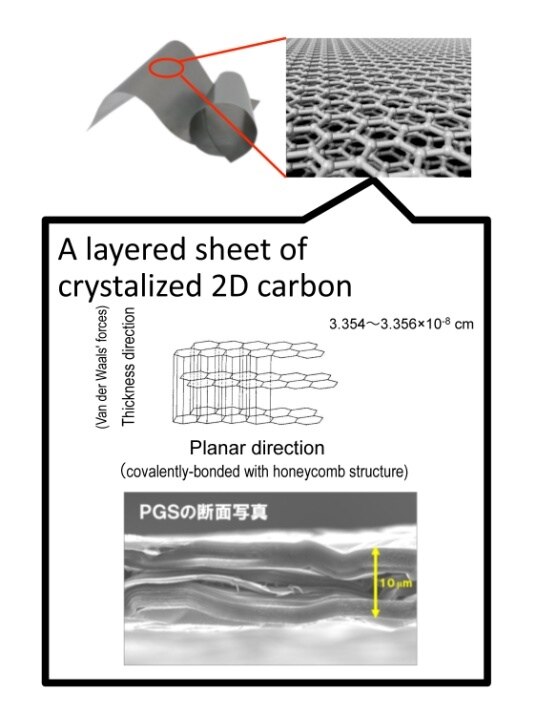
Pyrolytic Highly Oriented Graphite Sheet is made of graphite with a structure that is close to a single crystal. It is produced from polymeric film using a heat de-composition process. The hexagonal crystal structure of graphite is arranged uniformly in a horizontal 2D structure see figure 1
Fig 1.
image
Features
PGS has a number of features which make it highly suitable as an easy-to-use, space-saving, thermal management solution:
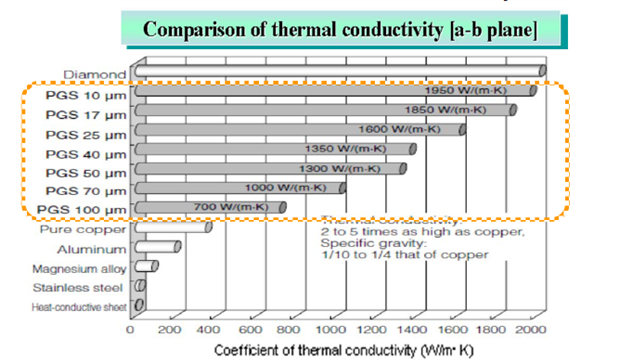
l it is very thin – available in a range of thicknesses from 100µm down to 10µm – and has excellent thermal conductivity from 700 to 1950W/m.K which is two to five times higher than copper and up to seven times better than aluminium (see fig 2)
image
 
l it is flexible and pliable so it can be easily cut and folded into a complex shape. With a bend radius or 2mm, sheets can be bent through 180 degrees more than 3000 times, and its thermal conductivity is unaffected if sharp folds are avoided;
l the material is very stable so it is resistant to environmental effects and shows no deterioration with age;
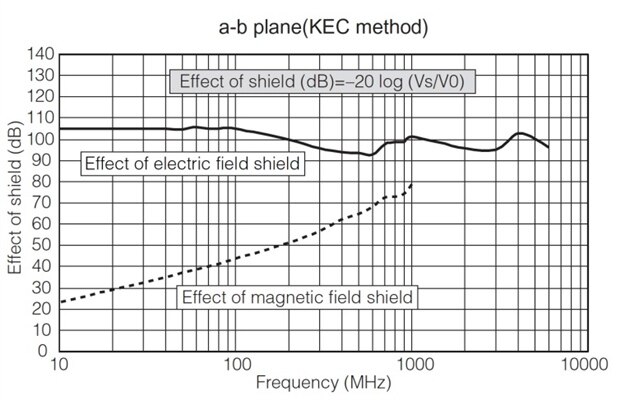
l PGS can provide some shielding to electromagnetic noise, providing a simultaneous EMI and thermal solution (see fig 3).image


Usage and Results
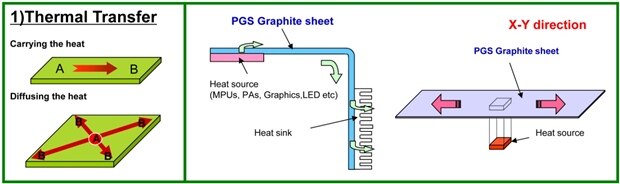
PGS film is used to transfer heat away from a heat source, or to diffuse or spread heat away from a hot spot (A>B) as shown in figure 4.
image
 
 
It can also be used as a highly-efficient thermal interface material as in figure 5.
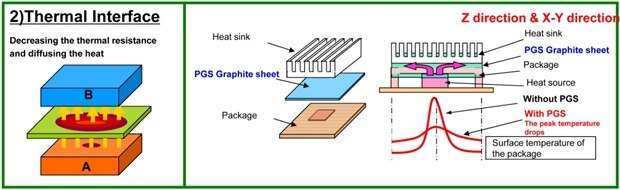
image
 
The efficacy of PGS in reducing IC hot spot temperatures is demonstrated in figure. The temperatures at the ABS (Acrylnitril-Butadien-Styrol )surface, the IC and the PCB are shown for two different 70 µm thick PGS sheet sizes.
 
Applications
Two examples show how PGS film can be used.
Figure 7 demonstrates how heat can be transferred away from an IC (LED) to the casing in a camera design, reducing the heat sinking that is required.
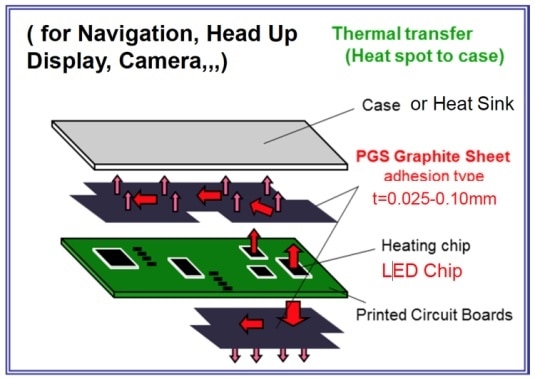
image
 
 
Figure 8 shows how when applied in a IGBT or switching FET module, PGS acts as a thermal interface, reducing the thermal contact resistance and thermal soaking required.
image
 
Alternative solutions.
PGS has a lower thermal resistance than silicon sheet material and graphite products from other manufacturers. Silicone grease has a lower thermal resistance, but it has the disadvantage of drying up over time and losing effectiveness. Also it is less easy to apply uniformly so results can be variable.
 
Product overview at Farnell

http://uk.farnell.com/webapp/wcs/stores/servlet/Search?catalogId=15001&langId=44&storeId=10151&st=EYG**&pageSize=25&showResults=true


For more information please contact Ian.needham@eu.panasonic.com


  • Sign in to reply
  • DAB
    DAB over 11 years ago

    Graphene is one of those very interesting compounds.

    When I looked into the atomic structure it was easy to see how it could move so much thermal energy so easily.

    The secret is in the homogeneous carbon atoms.  Together, they form a matrix like substance where they all want to maintain the same level of energy excitation across the entire structure.

    So if you put part of it against a high energy component, the atoms will very quickly try to move thermal photons to equalize the energy load across the entire structure.


    This effect is very cool when you look at the photon exchange between the atoms.


    DAB

    • Cancel
    • Vote Up 0 Vote Down
    • Sign in to reply
    • More
    • Cancel
element14 Community

element14 is the first online community specifically for engineers. Connect with your peers and get expert answers to your questions.

  • Members
  • Learn
  • Technologies
  • Challenges & Projects
  • Products
  • Store
  • About Us
  • Feedback & Support
  • FAQs
  • Terms of Use
  • Privacy Policy
  • Legal and Copyright Notices
  • Sitemap
  • Cookies

An Avnet Company © 2025 Premier Farnell Limited. All Rights Reserved.

Premier Farnell Ltd, registered in England and Wales (no 00876412), registered office: Farnell House, Forge Lane, Leeds LS12 2NE.

ICP 备案号 10220084.

Follow element14

  • X
  • Facebook
  • linkedin
  • YouTube