


Introduction
1. Evolving Market Demands in the Transportation Sector
Electrification Is Redefining Component Requirements
Automotive Electrification
- Gasoline vehicles: primarily mechanical → require high‑reliability components
- Electric vehicles (EVs): motor‑driven → need high reliability plus high current capability
Rapid Expansion of the E‑Bike Market
- Motor output increasing: 500 W → 750 W+
- System voltages rising: 36 V → 48 V / 60 V
- Compact, multifunctional designs becoming standard
Core Requirements Across Transportation Systems
- High current capability
(low DCR, low ESR to improve efficiency) - Thermal robustness
(–55 °C to +170 °C operating range) - Miniaturization & high density
(SMD formats, compact power modules) - EMI suppression
(especially for motor‑drive and switching circuits) - Long operational life
(10+ years demanded in EV/AGV applications)
2. Hybrid Capacitors: Panasonic’s High‑Performance, Long‑Life Solution for Modern Mobility
Panasonic’s hybrid capacitors are engineered to meet the rapidly intensifying demands of transportation electronics. By combining the strengths of electrolytic and polymer capacitor technologies, Panasonic delivers a balance of high ripple current, long operational life, and failsafe reliability—attributes essential in EVs, e‑bikes, AGVs, and automotive power electronics.
Hybrid capacitors have become one of the most impactful innovations in Panasonic’s passive component lineup, enabling compact, thermally robust, and electrically stable designs for high‑power mobility systems.
2.1 Technical Challenges in Transportation Power Systems
Designers working on EV inverters, DC‑link circuits, e‑bike motor drivers, and industrial AGVs face several recurring challenges:
High Current Handling Requirements
E‑bike and AGV platforms demand DC‑link capacitors capable of managing 20–60 A ripple currents—especially in systems ranging from 500 W to 6 kW.
Conventional aluminum electrolytic capacitors often require multiple parts in parallel, consuming valuable PCB area and increasing BOM cost.
Long‑Term Reliability Under Extreme Conditions
Modern EVs and AGVs require product lifetimes of 10 years and operating endurance exceeding 4,000 hours at 125 °C, far surpassing the typical 2,000‑hour rating of general electrolytic capacitors.
This creates a significant reliability gap traditional technologies cannot bridge.
Fail‑Safe Behavior in Failure Modes
Polymer capacitors can offer low ESR and high current handling but risk short‑circuit failure, which is unacceptable in safety‑critical automotive and industrial systems.
Regulations require open‑circuit failsafe behavior to prevent secondary damage or thermal hazards.
Panasonic’s hybrid technology directly addresses all three challenges simultaneously.
2.2 Panasonic Hybrid Capacitor Technology
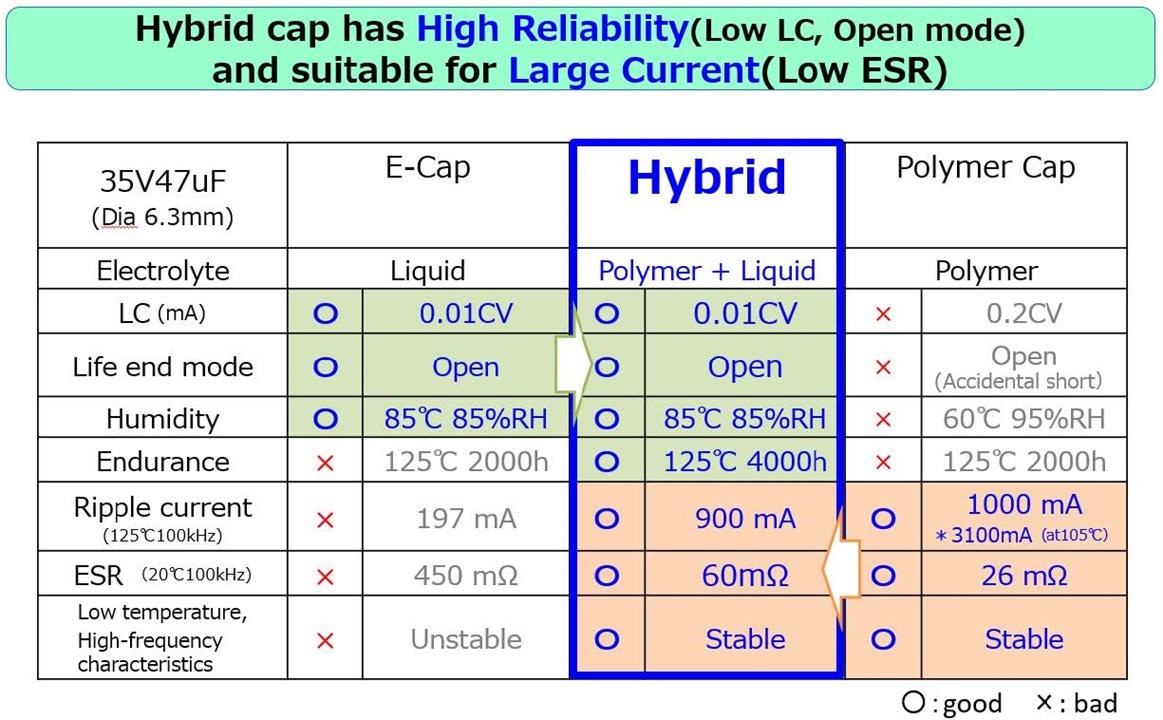
Panasonic’s hybrid capacitors merge liquid electrolyte with conductive polymer to create a component category that excels in both performance and safety.
Key Advantages (Example: 35 V 47 μF device)
- Low ESR rivaling polymer capacitors → dramatically improved ripple current capability
- Open‑circuit fail‑safe behavior like aluminum electrolytics → enhanced safety margin
- Double the operational life compared with conventional capacitors
- Up to 4.5× higher ripple current tolerance for high‑power converters
This allows engineers to reduce component count, shrink board size, and enhance system reliability—crucial benefits in compact traction inverters and motor‑control units.
2.3 Key Hybrid Capacitor Series for Transportation
Panasonic offers multiple hybrid capacitor families tailored for different mobility applications:
| Series | Capacitance | Ripple Current | Miniaturization |
|---|---|---|---|
| ZTU | Up to 1.7× larger than entry‑level hybrids (e.g., 330 µF → 560 µF, φ10×10.2 mm) | 1.8× improvement (2900 mA → 3500 mA) | Smaller case option: φ10×10.2 → φ8×10.2 |
| ZUU | Highest capacitance class, up to 1000 µF | Industry‑leading ripple current up to 6100 mA | Enables 1‑to‑many replacements to reduce cost/space |
| ZVU | 1.7× capacity increase compared to ZC series | Maintains high ripple current similar to ZV (up to 4.6 A in 10×10.2 mm) | Supports design consolidation & PCB reduction |
Series Highlights
- ZTU: Build higher capacity or achieve miniaturization
- ZUU: Best for high ripple current + ultra‑high capacitance
- ZVU: Higher capacitance while keeping low‑profile packaging
These series are widely used in EV power steering, cooling fans, OBCs, and e‑bike motor drives.
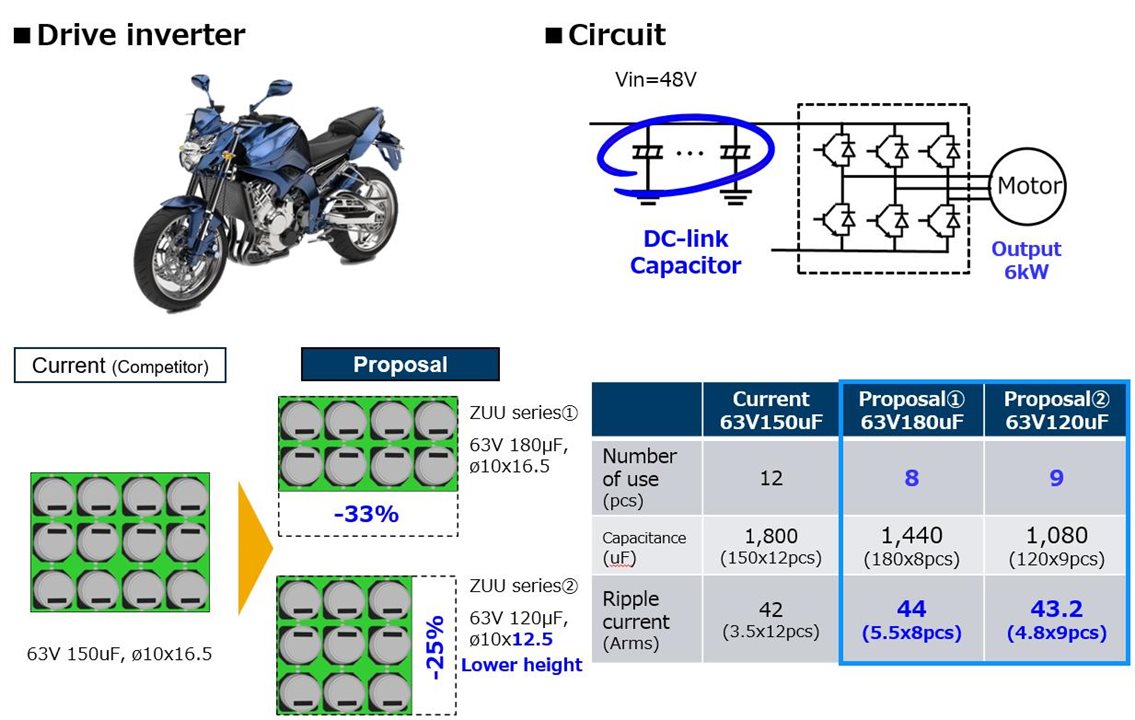
2.4 Application Example: E‑Bike 6 kW Drive Inverter
System Overview
48 V Li‑ion Battery → DC‑DC Converter → BM‑IC → Motor Drive Inverter
Conventional Design
- 12 × 63 V, 150 μF, φ10 × 16.5 mm
Proposal 1 (Using ZUU Series)
- 63 V, 180 μF × 8 pcs (φ10 × 16.5 mm)
- Total Capacitance: 1,440 μF
- Ripple Current: 44 Arms
- Component reduction: –33%
Proposal 2 (ZUU Low‑Profile Option)
- 63 V, 120 μF × 9 pcs (φ10 × 12.5 mm)
- Height reduced 16.5 mm → 12.5 mm (–24%)
- Ideal for compact e‑bike frames and integrated motor systems
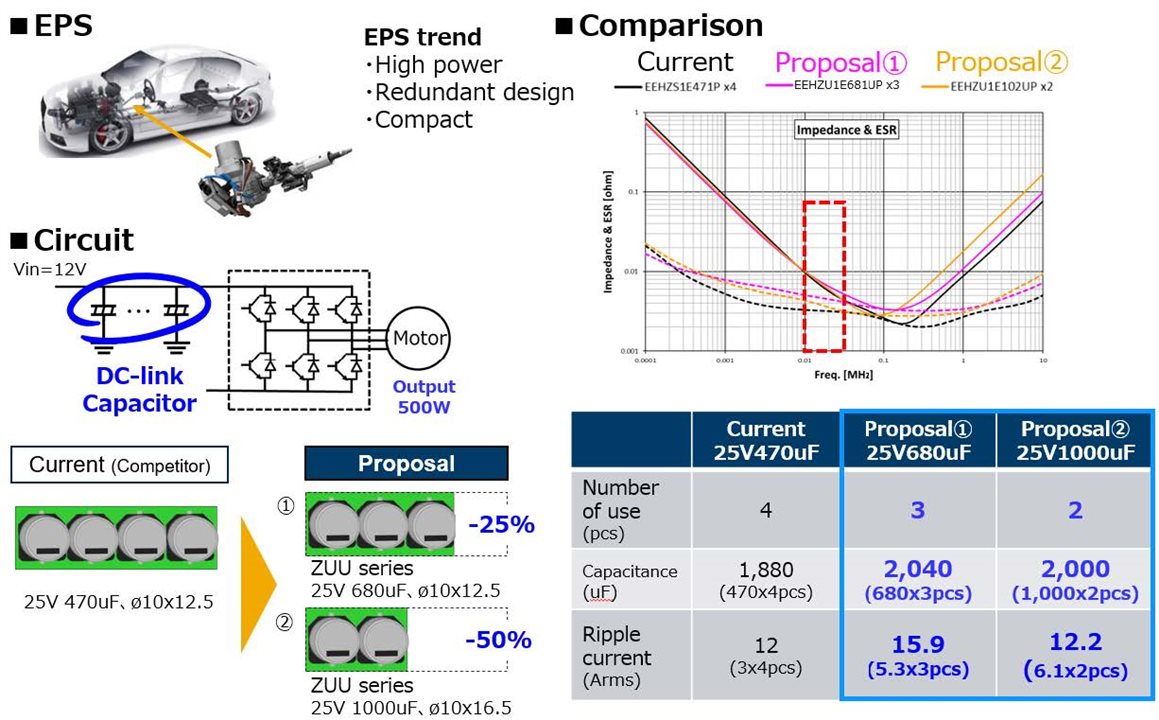
2.5 Automotive Example: Electric Power Steering (EPS, 12 V / 500 W)
Conventional Design
- 4 × 25 V, 470 μF, φ10 × 12.5 mm
-
25 V, 1000 μF × 2 pcs (φ10 × 16.5 mm)
-
Total Capacitance: 2,000 μF (+6.4%)
-
Ripple Current: 12.2 Arms
-
Component count reduced by 50%
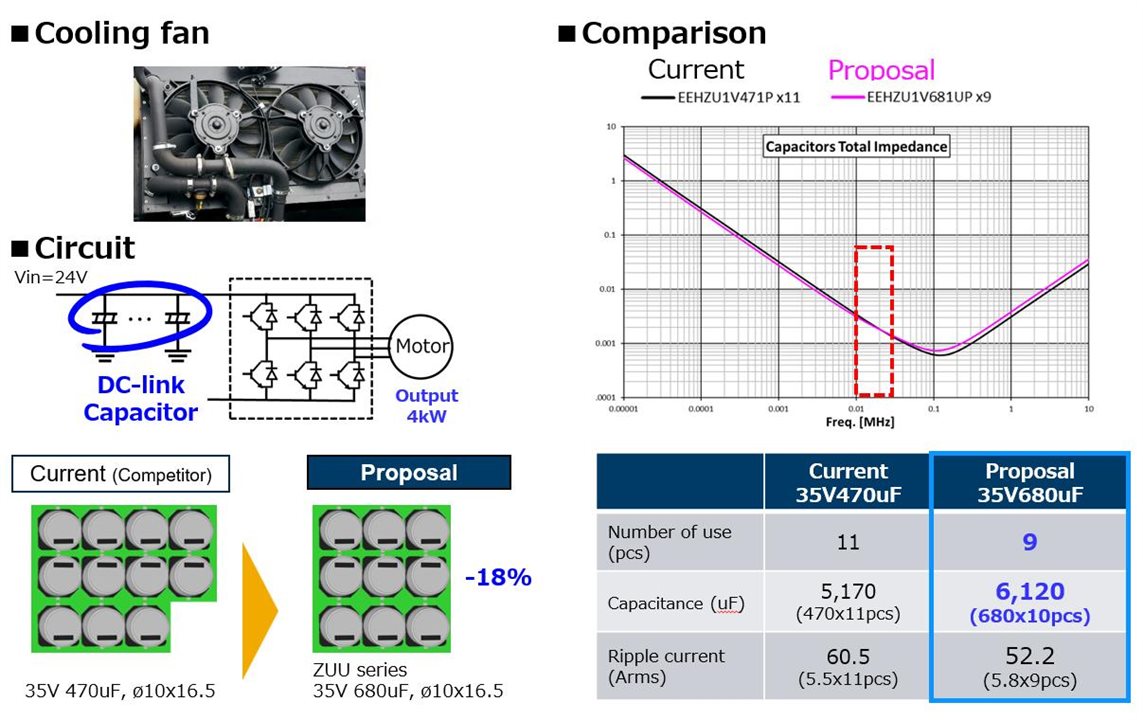
2.6 Automotive Example: Cooling Fan (24 V / 4 kW, 3‑Phase Motor)
Conventional Design
- 35 V, 470 μF × 11 pcs (φ10 × 16.5 mm)
-
35 V, 680 μF × 9 pcs
-
Total Capacitance: 6,120 μF (+18%)
-
Component reduction: –18%
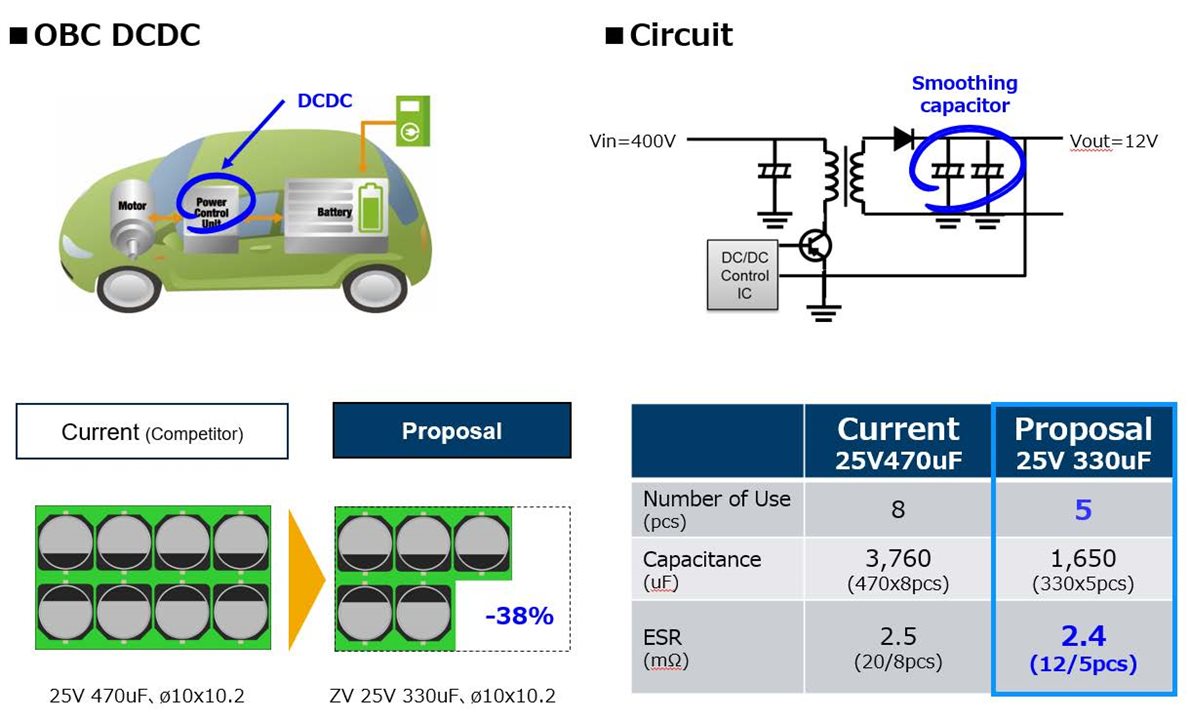
2.7 Automotive OBC DC‑DC Converter (400 V → 12 V)
Conventional Design
- 25 V, 470 μF × 8 pcs (φ10 × 10.2 mm)
- 25 V, 330 μF × 5 pcs (φ10 × 10.2 mm)
- Component count reduced by 38%
- Maintains equivalent electrical performance thanks to low‑ESR characteristics
3. Power Inductors: Panasonic’s Metal Composite (MC) Core Technology for High‑Current, Low‑EMI Mobility Systems
Power inductors are central to every high‑efficiency power conversion stage found in electric vehicles, e‑bikes, AGVs, battery management systems, and compact industrial drives. As system voltages rise and switching frequencies increase, passive magnetic components must deliver higher current, lower EMI, and greater thermal stability—all within increasingly compact mechanical footprints.
Panasonic’s proprietary Metal Composite (MC) Core inductors are engineered precisely for these next‑generation requirements. By combining advanced materials science with robust structural design, Panasonic creates inductors that offer exceptional current capability, low DC resistance, minimal magnetic flux leakage, and industry‑leading thermal performance, enabling designers to optimize power density without compromising reliability.
3.1 Key Technical Challenges in Modern Mobility Designs
As mobility platforms move toward higher power and higher switching frequencies, traditional ferrite-core inductors encounter several limitations. Panasonic’s MC-core technology directly addresses these challenges.
EMI Mitigation & Magnetic Noise Reduction
E‑bikes, AGVs, and compact EV systems employ fast-switching MOSFET/SiC power stages that generate high-frequency electromagnetic noise.
Ferrite inductors typically exhibit high leakage flux, making compliance with EMC regulations more difficult.
Panasonic MC inductors dramatically reduce radiated noise through a dense metal‑composite material structure that naturally suppresses flux leakage—greatly simplifying EMC countermeasures.
Miniaturization Constraints
As system voltages grow to 48–60 V and beyond, inductors must handle 5 A+ continuous currents without requiring larger, bulkier components.
Ferrite cores saturate sharply, limiting their downsizing potential.
MC-core inductors allow engineers to reduce size while supporting higher currents, maintaining stable inductance even during transient loads.
Thermal Management & High‑Temperature Reliability
In harsh automotive environments—near motors, inverters, or engine compartments—temperatures frequently exceed 100 °C.
Heat causes drift in inductance, impacts efficiency, and accelerates component aging.
Panasonic MC inductors deliver stable electrical performance from –55 °C to +170 °C, offering dependable reliability for automotive powertrains and outdoor AGVs.
3.2 Panasonic’s Metal Composite (MC) Core Solution
Panasonic’s MC inductors integrate a metal‑composite magnetic core that offers a unique combination of high current handling, low EMI, and stable inductance, enabling superior power‑conversion performance compared to ferrite-based competitors.
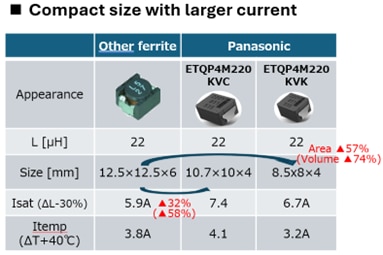
Compact Size with Higher Current Capability
A comparison of 22 μH inductors highlights how MC-core technology supports larger current ratings in significantly smaller form factors—ideal for space‑constrained BMS and drive-inverter boards.
Low-EMI Characteristics
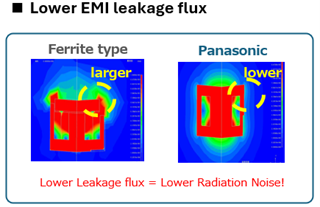
- MC-core inductors produce substantially lower magnetic flux leakage than ferrite types
- Reduced leakage directly leads to lower radiated emissions
- This makes it easier to meet automotive EMC standards and reduces the need for shielding materials
Inductance Stability Without Hard Saturation
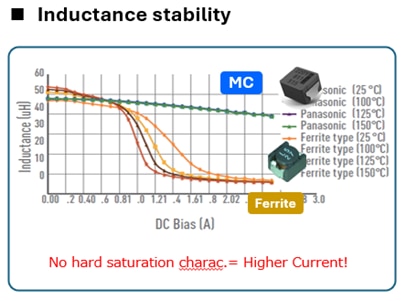
Conventional ferrite inductors experience abrupt inductance collapse under high current (hard saturation).
Panasonic MC inductors maintain stable inductance across the full operating range.
Automotive-Grade Reliability
- AEC‑Q200 compliant
- Operating temperature: –55 °C to +170 °C
- Vibration resistance up to 50 G
- 80 V withstand voltage, providing wide margin for 48‑V class systems
These attributes make Panasonic MC inductors ideal for EV powertrains, ADAS power modules, onboard chargers, and next‑generation mobility platforms.
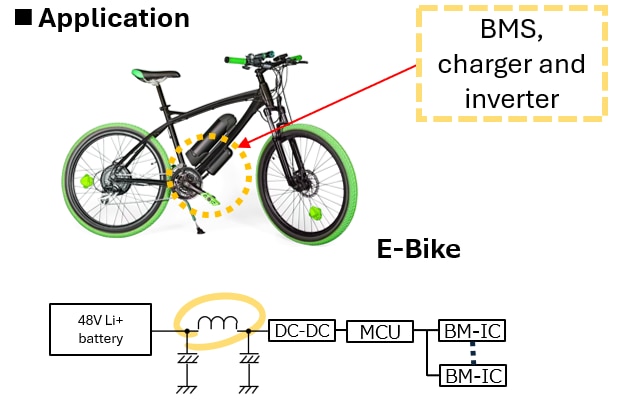
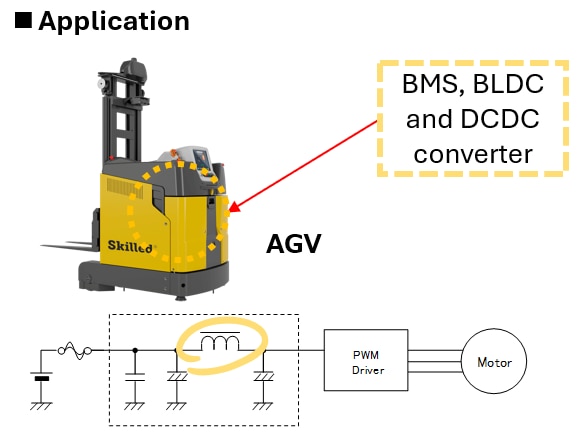
3.3 Applications in E‑Bike and AGV Power Systems
Panasonic’s MC inductors deliver tangible design advantages in 48‑V Li‑ion battery ecosystems used across e‑bikes, AGVs, and compact mobility vehicles.
Key Benefits for Next‑Generation 48‑V & 60‑V Systems
-
Significant Space Savings in BMS Boards
- MC inductors deliver equivalent performance with a 57% reduction in board footprint
- Volume reduction up to 74% enables lighter and more compact BMS modules
-
Simplified EMI Compliance
- Low leakage flux reduces radiated noise, lowering the burden on EMI filters
-
Thermal Robustness for Harsh Environments
- Stable inductance under heat ensures consistent charge/discharge control
-
High Saturation Current for Design Margin
- Suitable for 48–60 V systems and even higher transient-load environments
-
Optimized for SMD Integration
- Low-profile surface-mount format supports highly integrated inverter/BMS layouts
-
High-Voltage, High-Current Capability
- Designed for next‑generation traction systems and power electronics
- Designed for next‑generation traction systems and power electronics
4. High‑Performance Chip Resistors: Precision, Power, and Reliability for Transportation Electronics
As mobility platforms continue their shift toward electrification and digitalization, resistors play an increasingly critical role in enabling safe, precise, and power‑efficient operation. From high‑voltage battery management in EVs to precision sensing in e‑bikes and rugged AGV control circuitry, the demands placed on surface‑mount resistors have intensified dramatically.
Panasonic’s resistor portfolio—including the ERJP, ERJB, ERJ*BW, ERA, and ERJU series—delivers unmatched performance across power density, precision, thermal stability, and environmental resistance.
These components are designed specifically for harsh and space‑constrained applications common in modern transportation systems, making them ideal for engineers building next‑generation mobility solutions.
4.1 Required Characteristics Across Transportation Circuits
Different sections of transportation electronics require resistors with highly specialized characteristics. Panasonic offers tailored resistor families that address each circuit’s unique demands.
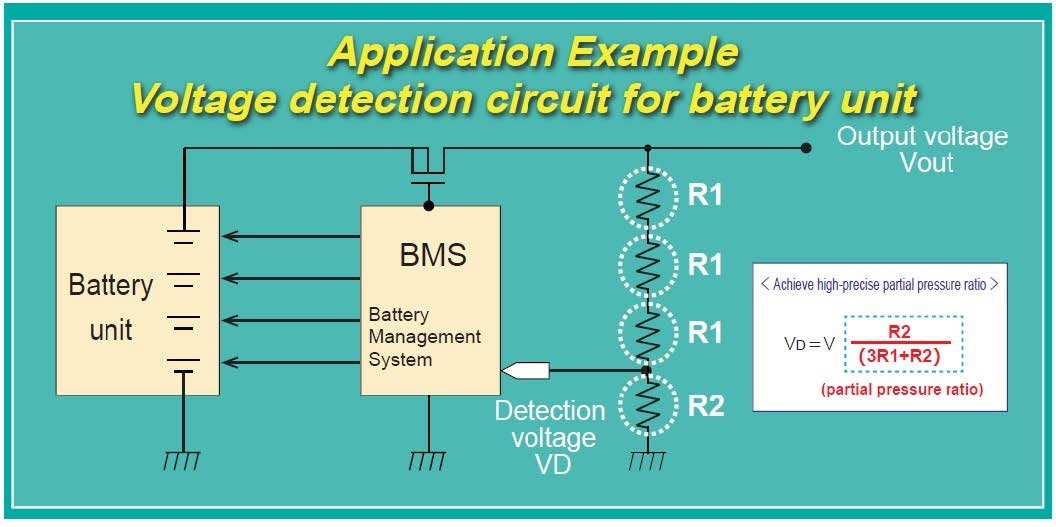
Voltage Measurement
Key Requirements:
- High accuracy (±0.1%)
- Low TCR (~25 ppm/K)
- Long‑term stability against temperature cycling
Technical Challenge:
Accurate detection of small voltage fluctuations in EVs and BMS circuits is extremely sensitive to resistance drift, especially under harsh conditions from –40 °C to +125 °C.
Recommended Panasonic Solution:
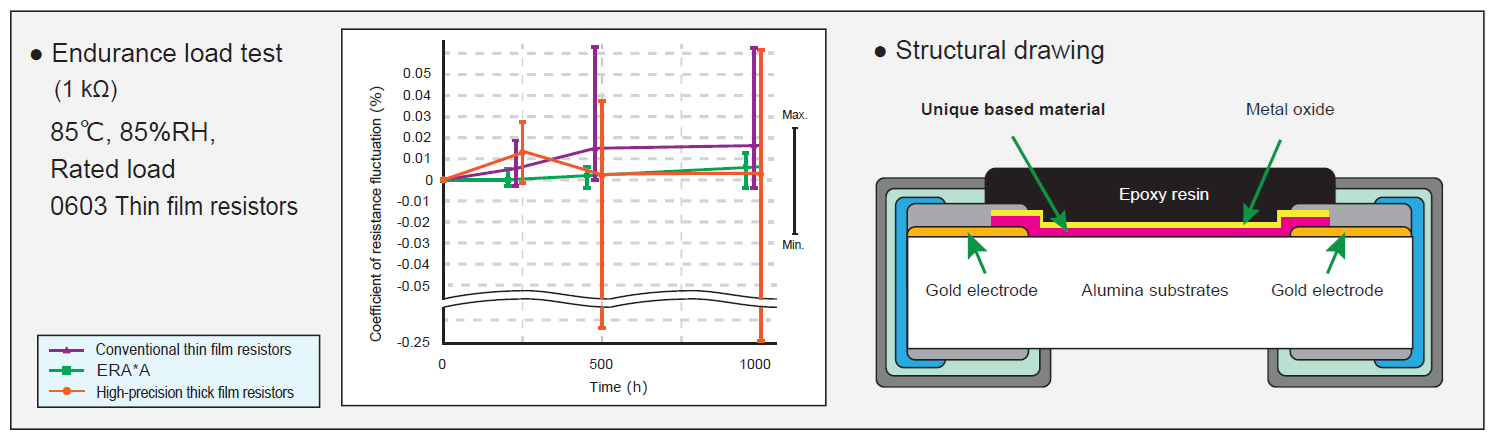
Achieves high reliability through proprietary resistive material (±0.1% tolerance after durability testing)-ERA-A series
Voltage Divider for High‑Voltage Battery Systems
Key Requirements:
- High voltage capability (up to 500 V)
- Wide resistance range (~10 MΩ)
- Compliance with creepage and clearance rules
Technical Challenge:
Traditional voltage dividers require multiple low‑voltage resistors in series, increasing PCB area, complicating layout, and impacting cost.
Recommended Panasonic Solutions:
- ERA8P Series
- ERJPM8 Series
Both are AEC‑Q200 qualified and support limiting element voltages up to 500 V.
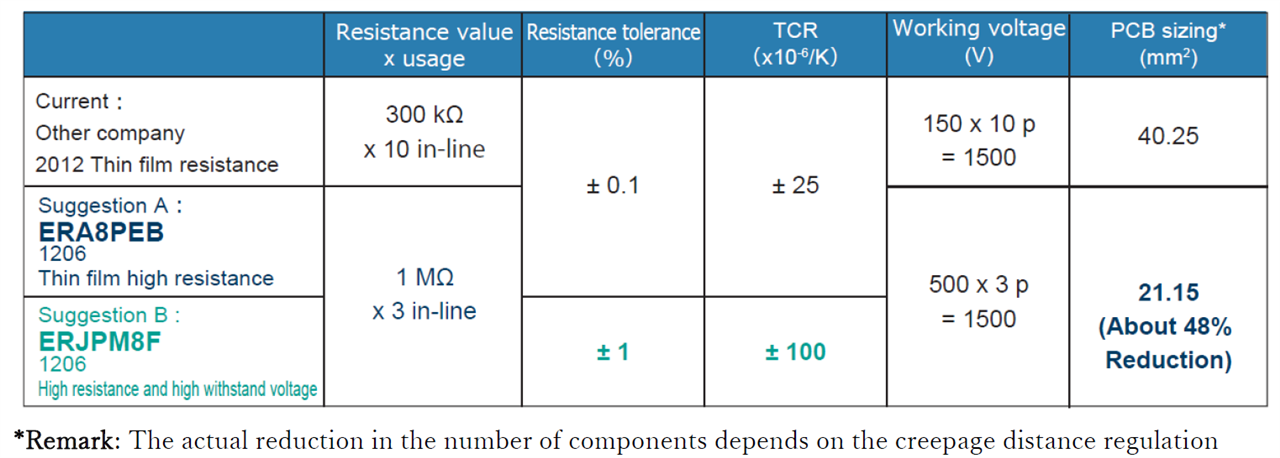
*Remark: The actual reduction in the number of components depends on the creepage distance regulation
Current Sensing (Traction Systems, Charging, Fuse Protection)
Key Requirements:
- Low resistance values
- High power rating (1–3 W)
- Stability under heat, vibration, and high current
Technical Challenge:
Current sensing applications face resistive drift and thermal stress, especially in EV traction inverters.
Recommended Panasonic Solutions:
- ERJB / ERJD (Wide Terminal Types)
- ERJ*BW (Double‑Sided Resistive Element)
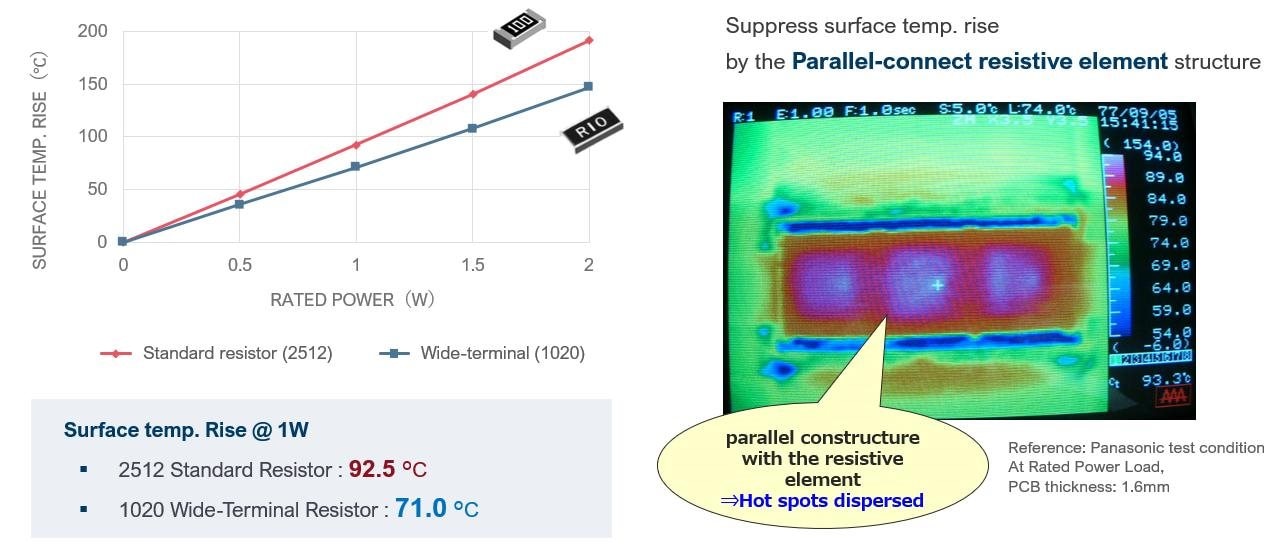
These devices improve power handling, reduce hotspot formation, and allow PCB downsizing.
Gate Drive Resistors
Key Requirements:
- High power (~3 W)
- Strong thermal dissipation
- Reliability during continuous switching
Technical Challenge:
Fast‑switching IGBT and MOSFET drivers experience constant surges and thermal load, demanding robust resistor structures.
Recommended Panasonic Solutions:
- ERJP (High Power Thick Film)
- ERJB / ERJD (Wide Terminal)
Environmental Reliability (Outdoor / Harsh Environments)
Key Requirements:
- Sulfur resistance
- Moisture, vibration, and thermal durability
Technical Challenge:
Agricultural AGVs, industrial vehicles, and railway systems frequently encounter sulfur‑rich environments that cause sulfuration failures in standard resistors.
Recommended Panasonic Solutions:
- ERJU / ERJS Anti‑Sulfur Series
- With optional high‑precision variants and wide‑terminal high‑power versions
4.2 Panasonic Solutions for Each Technical Challenge
4.2.1 Precision Voltage Measurement — ERA Series
Technical Challenge:
BMS voltage accuracy can degrade due to resistance drift from temperature fluctuations and long‑term operation.
Panasonic Solution:
- ERA Series (Thin Film):
- ±0.1% tolerance
- ±25 ppm/K TCR
- Stable under long‑term environmental stress
- Excellent durability performance due to proprietary resistive materials
Image: image_c67DrOiSie00ZhSdaFzMxQ==(insert here)
4.2.2 High‑Voltage Voltage Divider — ERA8P & ERJPM8
Technical Challenge:
High‑voltage BMS circuits (300–500 V) traditionally require 10+ resistors in series, increasing PCB area and complicating creepage requirements.
Panasonic Solution:
- ERA8P / ERJPM8
- 500 V limiting element voltage
- ±0.1% tolerance, ±15 ppm/K (ERA8P)
- AEC‑Q200 compliant
- Reduces component count and PCB size significantly
Component Reduction Example:
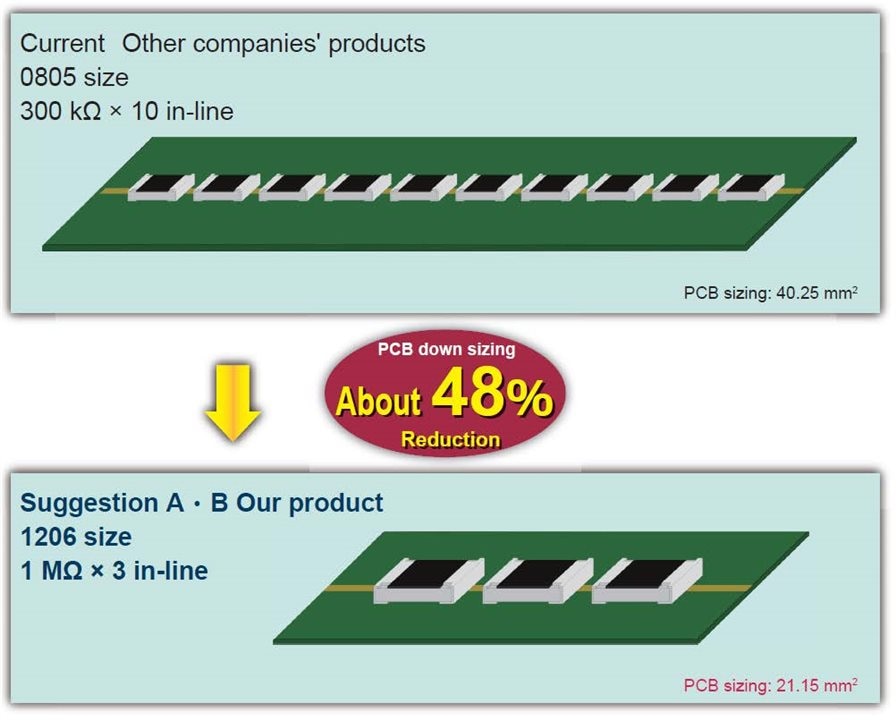
- Conventional: 10 × 300 kΩ (0805), PCB area 40.25 mm²
- Panasonic Proposal: 3 × 1 MΩ (1206), PCB area 21.15 mm²
→ 48% PCB area reduction
4.2.3 High‑Power Current Sensing — ERJB/D & ERJ*BW
Technical Challenge:
High currents generate heat and vibration stress that can cause drift and failure in standard resistors.
Panasonic Solutions:
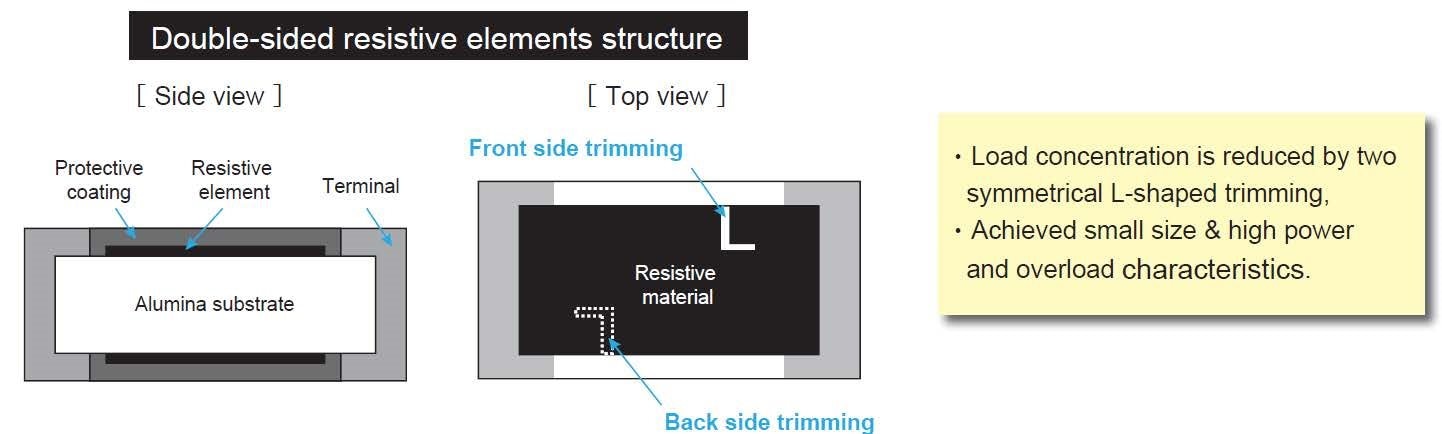
ERJ*BW (Double‑Sided Resistive Element)
- Low resistance down to 5 mΩ
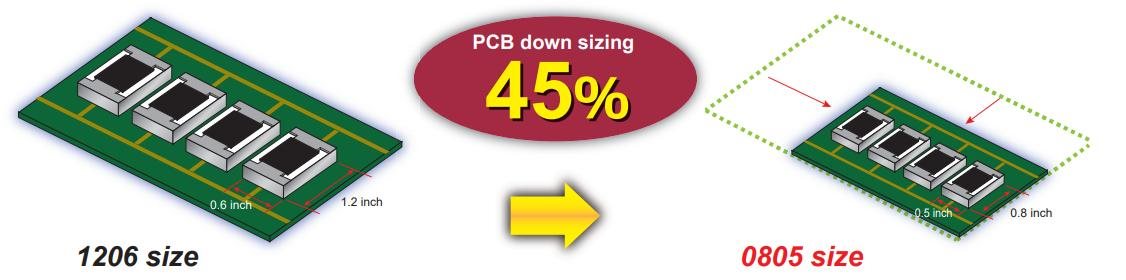
- Higher power density in compact package
- Supports PCB downsizing
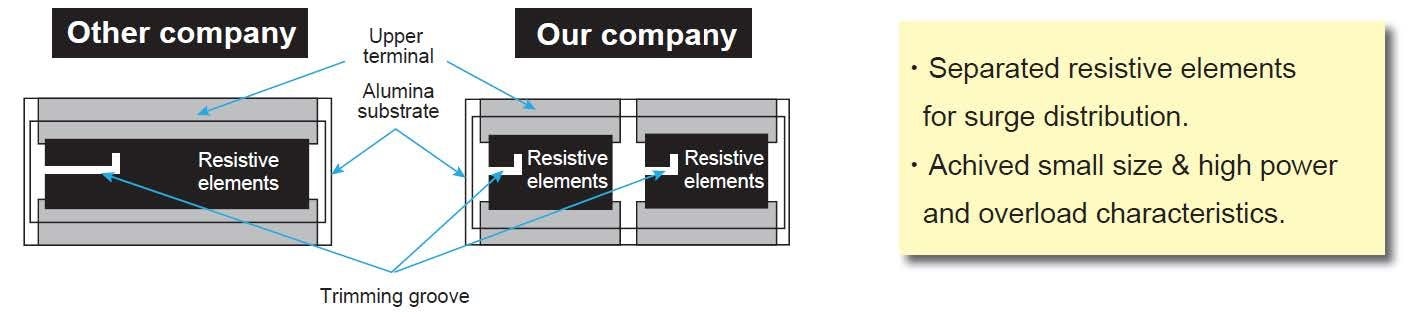
ERJB/D (Wide Terminal)
- Multiple resistive elements spread heat load
- Lower hotspot temperature rise
- Long terminal structure improves thermal shock resistance
4.2.4 Gate Drive Solutions — ERJP / ERJB
Technical Challenge:
Gate drivers in EV traction inverters require resistors with strong surge endurance and power dissipation.
Panasonic Solutions:
- ERJP / ERJPA Series:
- PCB miniaturization through downsizing
- High surge resistance
- Optimized structure for thermal stability

- ERJB/D Series:
- Supports heavy load and power cycling
- Matches gate‑drive reliability requirements
4.2.5 Anti‑Sulfur Solutions — ERJU / ERJS
Technical Challenge:
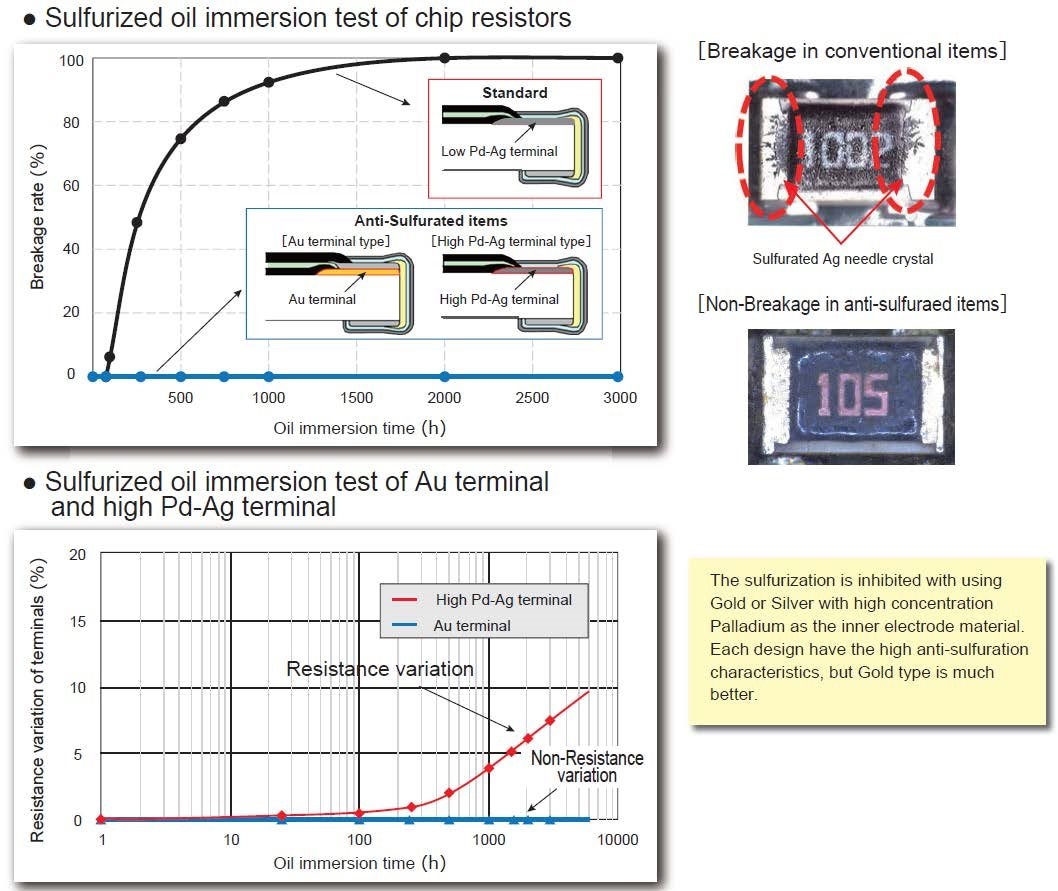
Outdoor AGVs and agricultural vehicles often see sulfur‑rich gases that cause silver‑terminal sulfuration.
Panasonic Solution:
- ERJU / ERJS
- Prevents sulfur‑related open circuits
- Removes the need for board sealing
- AEC‑Q200 compliant (–55 °C to +155 °C)
- Multiple variations for high‑precision, high‑power, low‑resistance, and wide‑terminal needs
5. Recommended Panasonic Components by Application
Panasonic offers a comprehensive lineup of passive components engineered to meet the stringent demands of transportation systems—ranging from high‑power e‑bike inverters to automotive BMS and harsh‑environment AGVs.
This section provides application‑specific recommendations to help design engineers quickly select the ideal Panasonic components and seamlessly transition into purchasing decisions on platforms such as Farnell.
E‑Bike / AGV Drive Inverters (48 V–60 V, 500 W–6 kW)
High‑power traction inverters in e‑bikes and AGVs require components that can withstand large ripple currents, deliver stable inductance, and provide accurate current sensing. Panasonic’s hybrid capacitors, metal‑composite inductors, and shunt resistors ensure safe, compact, and efficient inverter design.
Recommended Panasonic Products
-
DC‑Link Capacitors:
ZUU / ZVU / ZSU Series- High ripple‑current capability
- Long operational life
- Low‑profile options ideal for compact motor systems
-
Current‑Sensing Resistors:
ERJD Series- ±100 ppm/K TCR performance
- Low resistance values suitable for precise current monitoring
- Nearly equivalent behavior to metal‑shunt resistors
-
Power Inductors:
ETQP4M220KV* Series- Metal Composite (MC) core
- High current capability with low EMI
- Compact SMD package
-
High‑Precision Resistors:
ERA‑V / ERA‑K / ERA‑P Series- Excellent accuracy for control circuits
- Low TCR for stable operation in fluctuating temperatures
Automotive BMS (12 V–48 V Systems)
Battery Management Systems require high‑voltage precision resistors and long‑life capacitors capable of surviving elevated temperatures and high electrical stress. Panasonic’s products address these reliability and safety needs.
Recommended Panasonic Products
-
DC‑Link Capacitors:
ZUU / ZSU Series- Rated for 125 °C / 4000 h
- Superior durability for long‑term EV battery environments
-
High‑Voltage Resistors:
ERA8P / ERJPM8 Series- 500 V limiting element voltage
- ±0.1% tolerance options
- Ideal for voltage detection and cell balancing circuits
-
High‑Precision Resistors:
ERAA, ERA‑V / ERA‑K Series- As low as 0.05% tolerance
- ±10 to ±25 ppm/K TCR
- Outstanding long‑term drift performance
Automotive Power Electronics (EPS, OBC, Inverter)
Systems like Electric Power Steering, On‑Board Chargers, and inverters require components with high surge tolerance, long life, and stable performance at high temperatures.
Recommended Panasonic Products
-
DC‑Link Capacitors:
ZUU / ZV Series- Maximum ripple‑current handling
- Supports downsizing via reduced component count
-
Current‑Sensing Resistors:
ERJD / ERJ*BW Series- Wide‑terminal and double‑sided resistive structures
- Handle high power in compact formats
- Improved heat spreading for reduced hotspots
-
High‑Voltage Resistors:
ERA8P / ERJPM8 Series- 500 V rated
- High precision for gate-drive and sensing circuits
AGV and Outdoor / Harsh Environment Applications
AGVs used in logistics, smart agriculture, and industrial settings operate in dusty, humid, and sulfur‑contaminated environments. Panasonic’s anti‑sulfur technology provides the necessary reliability for these conditions.
Recommended Panasonic Products
-
Power Circuits:
ERJU / ERJS Series + ZUU / ZSU Capacitors- Prevent sulfurization-related failures
- Ensure long‑term electrical stability
-
Control Circuits:
ERJU‑R Series (High‑Precision Anti‑Sulfur)- Ideal for sensor interfaces and microcontroller circuits
-
Current Sensing in Harsh Environments:
ERJU‑S / ERJU‑Q Series- Low‑resistance anti‑sulfur resistors
- Suitable for outdoor traction and power monitoring
6. Summary
Panasonic’s passive components play a defining role in advancing the next generation of transportation systems. As mobility continues its rapid transformation toward electrification, automation, and higher power density, engineers face a growing need for components that deliver reliability, efficiency, miniaturization, EMI stability, and long‑term durability—often under extreme environmental conditions.
Hybrid capacitors, metal‑composite inductors, and automotive‑grade chip resistors from Panasonic provide precisely these performance attributes. Each technology line has been engineered to solve real design challenges: from reducing ripple and handling high current in traction inverters, to stabilizing inductance in high‑temperature environments, to ensuring precise voltage detection in EV battery systems, and resisting sulfur contamination in outdoor AGVs.
These components are not just incremental improvements—they form the backbone of safe, efficient, high‑performance power electronics across EVs, e‑bikes, AGVs, railway applications, industrial equipment, and emerging mobility platforms.
For designers working on modern transportation architecture, Panasonic offers a comprehensive, field‑proven portfolio of passive components that accelerate development, reduce risk, and support long‑term system reliability.
Whether the goal is to reduce component count, improve thermal management, optimize EMI performance, or increase system lifetime, Panasonic provides the right solution.
As electrified mobility continues to expand, Panasonic remains committed to driving innovation and delivering high‑value passive components that keep transportation systems safer, smarter, and more connected—now and into the future.