


EDIT 31/1/21: I've added a reply below with an embedded video which is worth watching after reading the white paper.
I've been reading around about grounding for PCBs over the last couple of days and opinions seem to fall into either "Star grounding, all the way" or "Ground plane, all the way". Everyone has an opinion and a seemingly limitless number of solutions based on one of those two approaches. Any white paper that attempts to explain Star Ground seems to immediately drop down into mixed-signal grounding with the star ground as the point analog and digital grounds are joined. Generally, any explanation seems incomplete and assumptive on the reader's level of knowledge and understanding - often in respect to esoteric points to do with dialectrics, expansion beyond traces, equations and so on. It's all pretty confusing for the most part.
However, I did come across this white paper from Maxim Integrated "Successful PCB Grounding with Mixed-Signal Chips - Follow the Path of Least Impedance" which seems to be the best explanation I've found of how DC, low frequency and high frequency currents flow in respect to ground and does so in a way that is understandable and not just in mixed signal chips, despite it's title. Actually, it's a lot about mixed-signal chips but it does so with a clear explanation of the DC and AC components of any current and thus offers a degree of clarity I've not found elsewhere for any sort of circuit/IC. It also describes approaches to laying out parts on a PCB in a way that is clear. In many respects, it covers the topic similarly to others, but in a way that hasn't made assumptions on understanding of the reader.
It does approach the topic by using a ground plane and that left me wondering how a star ground approach would work. For DC current, it's seems clear: it would follow the trace back to the source which would be the power source; for AC I'm less clear. I've copied an image from the paper below and then reproduced it with my own representation using a Star Ground approach (actually, two approaches):
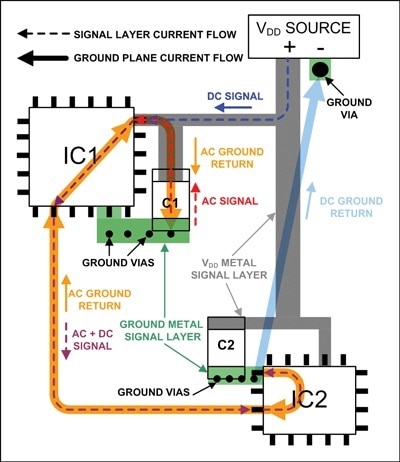
Maxim paper image showing current flow on a ground plane between two ICs

My representation of Maxim's image but using a Star Ground, where the star point is the ground pin of the power source
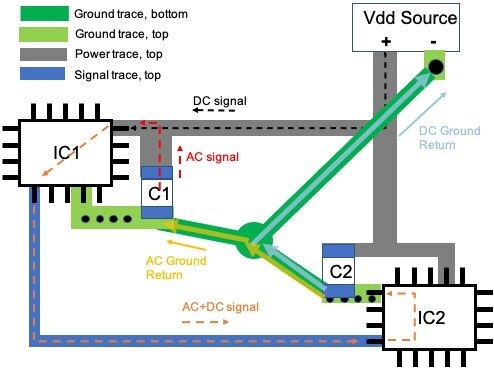
My alternate representation using a Star Ground where the star point is centralised then returned to the power source.
Obviously, the example given to explain how currents flow is pretty simple and in reality will be more complex because there will be many signals flowing across traces and power planes. Could I start a discussion on some points to help me fill in some blanks:
- Have I got my representation of AC return flow in a Star Ground right?
- Would one of my two representations be better than the other - I'm inclined to think the second one purely from the more direct route for AC return but that is a longer path for DC
- This just shows one signal but obviously there would be other returns, eg DC from IC1 that would flow to VDD source; AC from the Vdd Source that is bypassed by C1 and C2 and returns to Vdd source etc. In the case of star ground that is 'against' the flow of what I show for the AC return current flow but even on a ground plane there must be some contention. Is that what causes heat and noise in the trace/plane? Is that a misunderstanding I have?

