


Several many months ago (literally like January or earlier) I started working on an idea; I wanted to create a simple IR communication module for small robots, such that they could "talk" if they ran into each other face to face. For this I wanted short range, directional communication and Infrared seemed like the perfect fit. I also intended to use this same principle to encode digital data in sound waves for a different project. At the same time, I wanted an excuse to play with the LM567, which is an IC that I first encountered as a teen skimming through a Forrest Mims books, and immediately caught my attention by how well it pairs with the NE555, which is a very special IC for me (that's an story for a different day).
Several things happened in between and I couldn't really sit down to work on this for the months that followed. At one point I even considered making this an entry for the "Make a Connection" competition, but try as I might, I couldn't find the time to work on this and finish it on time, even when this isn't a hard project. It's in fact an extremely simple thing. But I even missed my opportunity to participate of the Halloween Hackathon which I was really looking forward to. That's how unfortunately time-constraint I've been.
But to be fair I was also trying new things; I started this project with circuit simulations which is mostly unknown territory for me, but it's something I want to start doing more often. But once I had a simulated circuit and built the thing with real components, I was hit by the non-ideality of reality. After several sessions with my oscilloscope I realized that my IR emitter and receiver were performing horrendously, so it took me some time to dive into my parts bins and find better ones, and I still had to divert some time finding ways of amplifying the received signal which was still extremely faint. I should have also tried amplifying the emitter too, but I'm not well versed in amplifiers, transistors, or op-amps, and I didn't want to double my troubles.
Anyway, long story short; I kept running into issues that I was only able to debug weeks or even months after I ran into them, so this took a long, long time.
But alas, I finally got something I was happy with, and I want to show it here. The circuit is a simple NE555 making an IR LED blink at roughly 50kHz. On the other end there's an IR photodiode connected to a simple 1-transistor "amplifier" whose output is fed to a LM567 "tone decoder" set to the same center frequency.
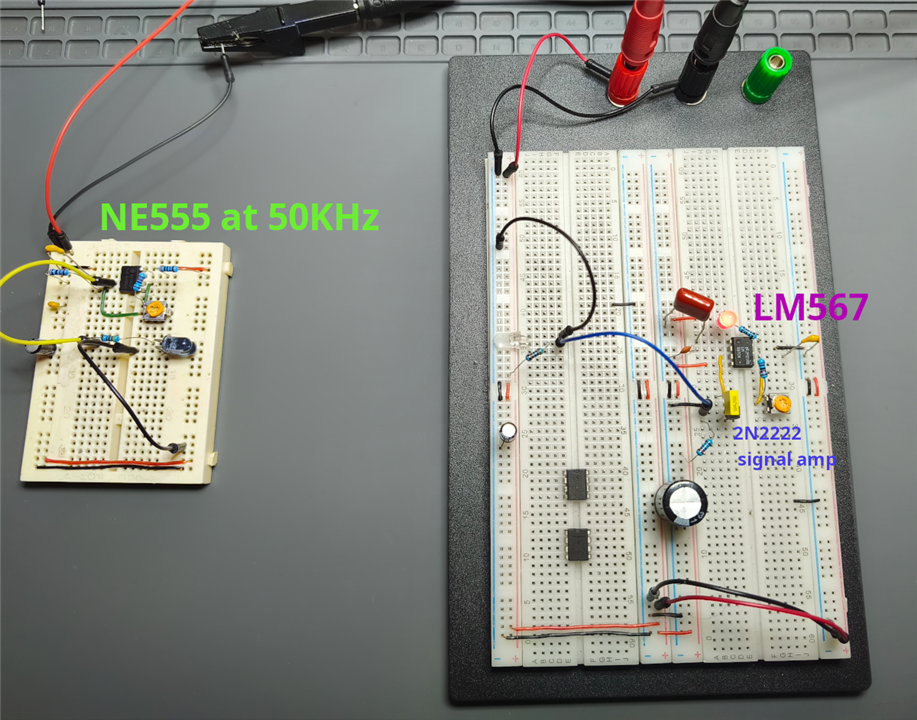
(Ignore the two ICs at the bottom left of the larger breadboard. They live there)
This simple arrangement allows me to detect an IR pulse at a configurable frequency (within a range). Now, I know that there are IR receivers conveniently packaged into a single component and already set to a standard 38kHz, but this gives me the ability to pick any frequency I want, rejecting interference for remote controllers or other IR sources. Also, for the other project I mentioned, I still need to be able to do the tone decoding manually, since it's audio signals and not IR pulses and the frequencies required are a whole lot lower.
Now for the fun part; it's possible to drive pin 4 (RESET) of the NE555 with a signal generator (or any source of digital pulses like a microcontroller) such that the 50kHz train of pulses becomes a carrier on which the (slower) digital signal can be modulated. This is, as far as I know, called OOK (On-Off Keying).
Here's how it looks with a 1kHz signal:
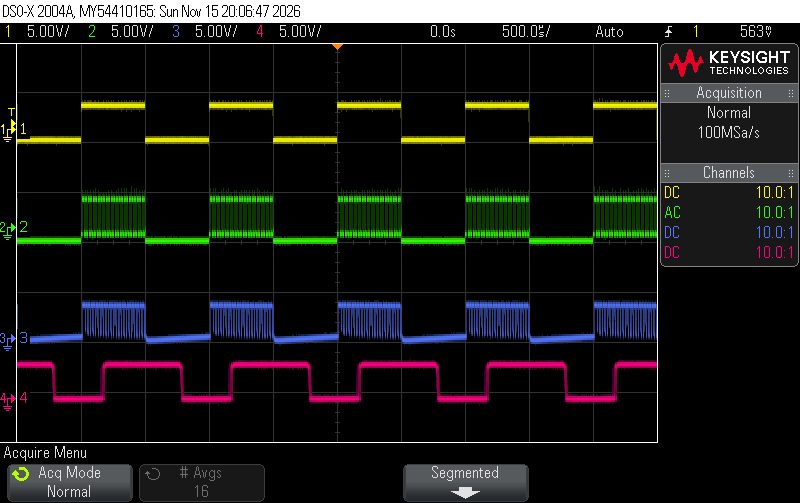
- Ch1, in yellow, that's the 1kHz signal as measured directly on the RESET pin in which is being fed.
- Ch2, In green is the output that goes to the emitter LED, showing the 1kHZ "modulated" over the 50kHZ carrier.
- Ch3; blue/lavender, that's the received signal by the photodiode after it goes through the 1-transistor "amplifier" which is directly fed into the LM567
- Ch4, pink/magenta, that's the output of the LM567. Notice how it's slightly shifted from the received signal, as it takes a few cycles before the frequency is detected.
I still need to make this into a PCB that combines emitter and receiver, and for that I need to decide a few things; Do I want to make a smaller smd-only PCB or go with through-hole components? Should the PCB include the signal amplifier on the receiving end? or expect the signal to come already amplified ? Should the PCB include spots for the IR LED and diode? or should those be expected to be mounted separately? (considering that I want to use this for an audio data encoder/decoder that doesn't need IR components) Should the emitter side have a driver/amplifier too? should they be optional or gain-configurable? etc, etc.
As usual, I'd like to close this with a question to the community; Have you worked in implementing something like this? Do you know of a better way of performing simple modulation/demodulation of digital signals? Perhaps with more modern components? If not, I would gladly read any story centered around the NE555. I love that little guy.