element14 Community
element14 Community
    Register Log In
  • Site
  • Search
  • Log In Register
  • Community Hub
    Community Hub
    • What's New on element14
    • Feedback and Support
    • Benefits of Membership
    • Personal Blogs
    • Members Area
    • Achievement Levels
  • Learn
    Learn
    • Ask an Expert
    • eBooks
    • element14 presents
    • Learning Center
    • Tech Spotlight
    • STEM Academy
    • Webinars, Training and Events
    • Learning Groups
  • Technologies
    Technologies
    • 3D Printing
    • FPGA
    • Industrial Automation
    • Internet of Things
    • Power & Energy
    • Sensors
    • Technology Groups
  • Challenges & Projects
    Challenges & Projects
    • Design Challenges
    • element14 presents Projects
    • Project14
    • Arduino Projects
    • Raspberry Pi Projects
    • Project Groups
  • Products
    Products
    • Arduino
    • Avnet & Tria Boards Community
    • Dev Tools
    • Manufacturers
    • Multicomp Pro
    • Product Groups
    • Raspberry Pi
    • RoadTests & Reviews
  • About Us
    About the element14 Community
  • Store
    Store
    • Visit Your Store
    • Choose another store...
      • Europe
      •  Austria (German)
      •  Belgium (Dutch, French)
      •  Bulgaria (Bulgarian)
      •  Czech Republic (Czech)
      •  Denmark (Danish)
      •  Estonia (Estonian)
      •  Finland (Finnish)
      •  France (French)
      •  Germany (German)
      •  Hungary (Hungarian)
      •  Ireland
      •  Israel
      •  Italy (Italian)
      •  Latvia (Latvian)
      •  
      •  Lithuania (Lithuanian)
      •  Netherlands (Dutch)
      •  Norway (Norwegian)
      •  Poland (Polish)
      •  Portugal (Portuguese)
      •  Romania (Romanian)
      •  Russia (Russian)
      •  Slovakia (Slovak)
      •  Slovenia (Slovenian)
      •  Spain (Spanish)
      •  Sweden (Swedish)
      •  Switzerland(German, French)
      •  Turkey (Turkish)
      •  United Kingdom
      • Asia Pacific
      •  Australia
      •  China
      •  Hong Kong
      •  India
      •  Japan
      •  Korea (Korean)
      •  Malaysia
      •  New Zealand
      •  Philippines
      •  Singapore
      •  Taiwan
      •  Thailand (Thai)
      •  Vietnam
      • Americas
      •  Brazil (Portuguese)
      •  Canada
      •  Mexico (Spanish)
      •  United States
      Can't find the country/region you're looking for? Visit our export site or find a local distributor.
  • Translate
  • Profile
  • Settings
Raspberry Pi
  • Products
  • More
Raspberry Pi
Raspberry Pi Forum Raspberry Pi - Hardware Flaws and Fixups?
  • Blog
  • Forum
  • Documents
  • Quiz
  • Events
  • Polls
  • Files
  • Members
  • Mentions
  • Sub-Groups
  • Tags
  • More
  • Cancel
  • New
Join Raspberry Pi to participate - click to join for free!
Featured Articles
Announcing Pi
Technical Specifications
Raspberry Pi FAQs
Win a Pi
Raspberry Pi Wishlist
Actions
  • Share
  • More
  • Cancel
Forum Thread Details
  • Replies 188 replies
  • Subscribers 717 subscribers
  • Views 22871 views
  • Users 0 members are here
  • flaws
  • hardware
  • single_board_computer
  • single_board_computers
  • raspberry_pi
  • Design
  • fixups
Related

Raspberry Pi - Hardware Flaws and Fixups?

e14 Contributor
e14 Contributor over 14 years ago

Several people have commented on the hardware design of the Raspberry Pi.  Some are buried in other topics so please post your comments here.  I'll try my best to answer questions about the design decisions we made.  The Raspberry Pi is not perfect, never will be.  I've always found that perfect designs have a habit of never getting built, engineers are always a bit guilty of that, but I had Eben phoning/emailing me every day wanting to know when it would be finished.  Also, one persons perfection is another persons nightmare.


e14 is the home for engineers so please contribute to make Raspberry Pi better.


Thanks


Pete

  • Sign in to reply
  • Cancel
  • morgaine
    morgaine over 14 years ago in reply to mcb1

    I used to think that the Foundation's choice of cellphone chargers for power was "genius", but that's now changed to "worst idea ever". image


    It's only in the light of experience that we now know that cellphone chargers are a complete disaster, and don't really qualify as "USB power supply" at all.  They've taken the concept of voltage regulation back in time by 3 decades.


    I strongly believe that Pi v2 needs a completely different power source and power management strategy.


    Morgaine.

    • Cancel
    • Vote Up 0 Vote Down
    • Sign in to reply
    • Cancel
  • morgaine
    morgaine over 14 years ago in reply to morgaine

    OMG, it's just been pointed out to me on the Pi forum that the USB spec for "chargers" allows the voltage to drop to 3.6V up to the rated current, as long as it supplies 5V at up to 500mA.  Forum link:  http://www.raspberrypi.org/phpBB3/viewtopic.php?f=24&t=6187&p=80651#p80651


    If so, it's no surprise at all then that people are experiencing problems.


    UPDATE: It may not be so, the Wikipedia entry is not consistent with the spec.  See the update on forum link above.


    Morgaine.

    • Cancel
    • Vote Up 0 Vote Down
    • Sign in to reply
    • Cancel
  • jamodio
    jamodio over 14 years ago in reply to mcb1

    I had very good results using Texas Instruments SWIFT DC-DC converters to step down from a wide voltage range (sort of 7-24V) to a stable

    5V output. Here is a sample circuit using the TP54231, very efficient, can handle up to 2A and if you wish you can put a bridge rectifier on

    front and not worry about polarity.


    -J

    image

    • Cancel
    • Vote Up 0 Vote Down
    • Sign in to reply
    • Cancel
  • morgaine
    morgaine over 14 years ago in reply to jamodio

    Thanks jamodio, that could be very useful.


    In looking up more resources on the TPS54231, I found an application node / user guide with a fairly similar circuit but designed for 3.3V operation, which may be useful in other applications  --- http://www.ti.com/lit/ug/slvu263/slvu263.pdf  .  Circuit diagram is on p.17 of the PDF.

    • Cancel
    • Vote Up 0 Vote Down
    • Sign in to reply
    • Cancel
  • Nate1616
    Nate1616 over 14 years ago in reply to morgaine

    very nice posts jamodio and Morgaine.  I will have to try this in future experiments i do.

    • Cancel
    • Vote Up 0 Vote Down
    • Sign in to reply
    • Cancel
  • mcb1
    mcb1 over 14 years ago in reply to morgaine

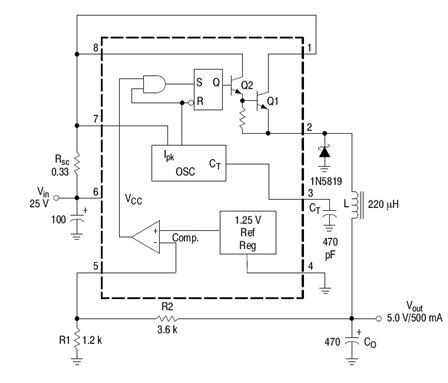
    The range of cheap 12v phone chargers often use a MC34063ABD-TRMC34063ABD-TR which is an up or down converter capable of 1.5A.

    Often they are found in the bargin bin, and the datasheet shows the resistor ratio required for any voltage.


    They may need an extra capacitor to help the case, but at least most of the parts are on a board for a few dollars.

    Below is the schematic from the datasheet for 5v output, and the actual device uses most parts, but not the same values.


    It might save a bit of work, and resolve the issues.

    Mark

    image

    • Cancel
    • Vote Up 0 Vote Down
    • Sign in to reply
    • Cancel
  • jamodio
    jamodio over 14 years ago in reply to morgaine

    That is correct, there are two pairs of resistors where one pair sets the output voltage and the other pair the input low voltage shutdown.


    TI has a little evaluation module that you can get for ~USD $11, or if you have good contacts at TI you may get it for free, and you can use it as a power supply module.


    I had this circuit under test on the lab for months and it has been one of the more stable and reliable designs based on a DC/DC switching converter.

    • Cancel
    • Vote Up 0 Vote Down
    • Sign in to reply
    • Cancel
  • morgaine
    morgaine over 14 years ago

    I asked myself a bit of a rhetorical question about Pi hardware over in the "Combining BeagleBone and Raspberry Pi" thread -- http://www.element14.com/community/thread/18382?tstart=0 .  I really don't know the answer to it so perhaps it makes sense to raise it as a question here in Pete's hardware thread:


    Morgaine Dinova wrote:


    ...

    It makes me wonder whether some ambitious Pi hacker could route the unconnected pins of the Pi's micro-USB power socket through level translators to the Pi's GPIO header, and bit-bang up a client-mode USB interface for the Pi. image


    Is this kind of thing feasible?


    While it wouldn't have the speed of dedicated USB hardware, it would be an awesomely cool hack if it worked at all!


    Morgaine.

    • Cancel
    • Vote Up 0 Vote Down
    • Sign in to reply
    • Cancel
  • rew
    rew over 14 years ago in reply to morgaine

    While possible in theory (it's possible with an AVR clocked at 12 MHz), it is not the "way to go" IMHO.


    The raspberry pi has the "USB device" hardware on-chip. Why not use that? Buy yourself a model A,

    remove R36, and R37 (not present on Model B) and patch the pads to the micro USB connector.


    (Should you find yourself stuck with a model B at this point in time, you'll have to remove the LAN9512 instead of the two resistors).


    If you're not into hardware patching your 'PI just yet, wait for a model A and make/buy an A-A straight through USB cable. Then you get to work on the drivers.


    If you want your 'pi patched but don't want to do it yourself, I'll do it for you. $25 excluding return shipping.... (no guarantees)

    • Cancel
    • Vote Up 0 Vote Down
    • Sign in to reply
    • Cancel
  • morgaine
    morgaine over 14 years ago in reply to rew

    Thanks for your feedback, Roger.  It was very interesting to hear that such a hack is indeed feasible, and even more interesting to hear that Model A boards could allow a more efficient USB hardware interface to be brought out reasonably easily.


    While I don't expect to want the above kind of hardware hack on my Pi personally (I'm still waiting for mine anyway), playing with my new BeagleBone is inevitably bringing up various ideas by comparison with the Pi's design.


    Thinking about such hardware modifications is important in two ways I think:


    • On the one hand, with millions of Pi eventually in the world once the plans to introduce it into education finally unfold, it is quite inevitable that many enthusiasts will be eager to take their Pi in directions that were never envisaged at design time, as this often adds interest and appeal.  That's in the nature of enthusiasts and budding engineers, and encouraging their efforts fits in perfectly with the Pi's educational goals.
    • On the other hand, professional engineers are alway interested in the next generation of things that they create, and ideas for improvements in their designs can come from anywhere and everywhere.  The Foundation's engineers are no exception of course, and your suggestion regarding extended USB abilities for Model A could spark some interesting design changes for next generation boards.


    The Pi Model A is by design a less well connected board than the model B, in the very important interest of low BOM cost.  But removing R36 and R37 reduces the component cost even further, and routing the micro-USB's unused pads to the SoC's USB device could give a hypothetical Model "A2" extra USB connectivity in place of Model B's more costly Ethernet.  This even fits in well on power budget grounds, since the Model A has lower power requirements than Model B and a 500mA upstream port will in most cases be perfectly adequate.


    This seems like a good idea to bounce off Pete.  How about redesigning Model A for extra upstream USB capability?  After all, there are no Model A boards mass produced yet, so this would be a good time to do it.  But even if not now, it sounds like a great way of making a future Model A better at no extra cost.


    Morgaine.

    • Cancel
    • Vote Up 0 Vote Down
    • Sign in to reply
    • Cancel
<>
element14 Community

element14 is the first online community specifically for engineers. Connect with your peers and get expert answers to your questions.

  • Members
  • Learn
  • Technologies
  • Challenges & Projects
  • Products
  • Store
  • About Us
  • Feedback & Support
  • FAQs
  • Terms of Use
  • Privacy Policy
  • Legal and Copyright Notices
  • Sitemap
  • Cookies

An Avnet Company © 2026 Premier Farnell Limited. All Rights Reserved.

Premier Farnell Ltd, registered in England and Wales (no 00876412), registered office: Farnell House, Forge Lane, Leeds LS12 2NE.

Follow element14

  • X
  • Facebook
  • linkedin
  • YouTube