Yet another ARM Cortex board ... The pcDuino com ... getting one to see how compares with the Rpi ...
Atr least I didn't have to wake up in wee hours like a year ago to get one.
Cheers
Jorge

Yet another ARM Cortex board ... The pcDuino com ... getting one to see how compares with the Rpi ...
Atr least I didn't have to wake up in wee hours like a year ago to get one.
Cheers
Jorge
selsinork wrote:
I'm still hoping to see someome produce a simple BBB / cubieboard style device with an iMX6 on it.
I think there's ample room for quite a variety of i.MX6-based boards, each cost-optimized for a specific niche.
One obvious candidate is an Internet microserver board containing nothing but SoC, memory, LAN, SATA and power. The BOM cost of such a minimalist feature set would be substantially less than the Wandboard for the corresponding number of cores, maybe even half the cost because the board area could be shrunk and numerous connectors eliminated. Very much a child of the Pi cost era.
I have a pcDuino and I like it. I like it better than my old 256Mb Pi, thought I didn't spend much time on the Pi before I got rid of it, it was really slow and cumbersome. Not sure how well the new Pi does.
I plan on using my pcDuino for a makerfaire project involving a webcam. I also recently got a BeagleBone Black from a contest on Element14. After I get my stuff up and running on the pcDuino, I might port it to the BBB because of its smaller size and lower current consumption.
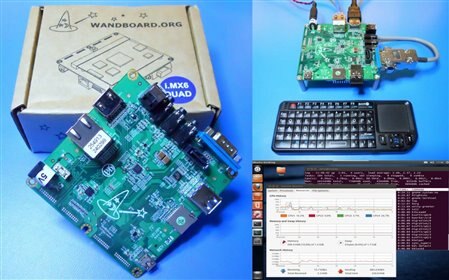
I've the Wandboard Quad on the bench, worked out of the box !
Added the WiFi antenna, few minutes configuration via the ubuntu system settings, and joined my WiFi network without a glitch.
Very, very impressed with the quality of video, even playing videos through vnc. Nicely done. Blog article coming soon ...
Cheers
Jorge
I'm interested to know if that heatsink is really needed, and how hot it gets... The SL doesn't come with one, so it's intesesting that the wandboard does.
You are welcome Drew.
I do embedded system development and R&D on Internet of Things, so I'm always looking for modular solutions where an RTOS is not enough or needs to be complemented with something that can support eLinux, so yes I've a large collection of sbc's and trying to make some time to start writing some blog articles about them.
Cheers
Jorge
Selsinork,
I believe only the quad has a heatsink, didn't measure it but just running the operating system with a graphics session on the console via HDMI, wireless keyboard/touchpad and another X server for remote VNC access it feels slightly warm.
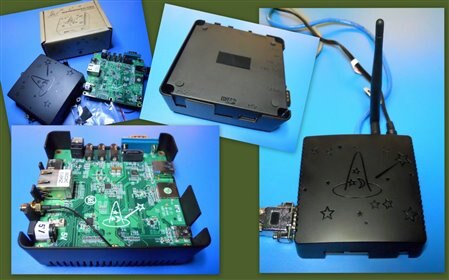
I had it up and running for over a week without a glitch so I finally decided to give a permanent spot in the lab, so I've got the enclosure ($9 and better stuff than what you get for the same money for the Rpi) and has been up for over 3 days now.
One con about the enclosure is that you lose access to the microSD on the processor board, but you still have accesible the socket on the carrier board which I'm planning to use for a separate /home filesystem. Didn't try yet to use the SATA interface.
Here are some pics of the board in its enclosure.
Very tempted to get another but the Solo model for another project.
Cheers
Jorge
Drew Fustini wrote:
Off-topic... when I advocate OSHW, one of the points I makes is that it enables a professional engineer to modify a devkit or SBC to optimize for their use case. Do you ever do this? It would be interesting to have some examples to back up this theory.
Yes it is a lot of fun, never took a job that I didn't have fun doing it 
About your question, it depends on the application and the volume. Most of the time we look for off-the-shelf modular solutions that can help doing quick prototyping, proof of concept development and small production runs, in those cases it is not worth the extra time adding uncertainity, risk and cost driven by a new set of design files, parts procurement, pcb fabrication, assembly, etc. When you get a ready made SBC you have a high probability that it will work out of the box at no additional cost, and if it doesn't work you return it and get a new one.
Now if the application requires a lot of customization, the volume justifies the extra design and production costs or you are trying also to increase reliability, having an OSHW design gives you a better starting point than starting from scratch, but again it has a lot to do with the application and the costs.
One of the great benefits of OSHW besides that you can modify an existing design, is that you can learn a lot by looking at the deteails on the design files, for example on dense pcb layouts a bga fan out and scape routing strategy that you know it worked, or placement of decoupling caps, parts used on the design like a PMIC that you can consider using in your designs, etc.
Also having full access to design files helps to perform a more educated analysis of a particular SBC, most of the time in serious engineering you can't keep folks happy with the taste of the sausage, we really want to know what is on it and how it is made.
My .02
Jorge
jamodio wrote:
Most of the time we look for off-the-shelf modular solutions that can help doing quick prototyping, proof of concept development and small production runs, in those cases it is not worth the extra time adding uncertainity, risk and cost driven by a new set of design files, parts procurement, pcb fabrication, assembly, etc. When you get a ready made SBC you have a high probability that it will work out of the box at no additional cost, and if it doesn't work you return it and get a new one.
Do you get any sense of the embedded industry moving (or even wanting to move) towards modular standardisation of the EDM, SOM or even EOMA-68 kind? Unfortunately, I don't. Almost everyone seems so intent to go their own sweet way through proprietary form factors for entirely isolated competition that the concept of partial cooperation on standards to create a massive global ecosystem appears to be entirely foreign to the sector.
I find it very blinkered. The few companies that are bucking the trend have almost no mindshare and so the few modular systems remain niche and expensive. As a result, there isn't even a cost carrot to break the vicious cycle.