This one puzzles me. I only received 19 applications for this roadtest: Silicon Labs Bluetooth Design Kit
I'm not sure why I received a low level of interest.
Any Idea why?
This one puzzles me. I only received 19 applications for this roadtest: Silicon Labs Bluetooth Design Kit
I'm not sure why I received a low level of interest.
Any Idea why?
I had pondered it, but already had/have too much else going on. I also couldn't come up with a really specific cool testing/usage scenario that would be something I'd want to make anyway, which sort of is my requirement to apply. If I don't have something i'd want to build for myself using it anyway, it's a bit more likely I won't put the time I need into it being thorough.
I suspect one of the reasons is that with any of these sorts of development boards, for people who may not be familiar with the toolchain, APIs and IDE used by a given company's products, it can be a rather steep learning curve that takes quite a bit of time. Depending on the value of the product to their needs, this time investment might not be justified, especially if they have a lot of other things going on - e.g. for academics such as myself, it's basically the middle of grant application season (amongst other distractions). After the amount of head-scratching I did for the last BLE-board I reviewed (Cypress EZ-BT Mesh), I'm not sure I'm quite the right person to take on the challenge either ...
- Gough
Exactly.
This is an established segment within BLE modules whereby they operate in this particular way, i.e. via an AT command set or equivalent and they typically act as a wireless serial bridge. Some examples:
Laird Connectivity do it with their modules: https://www.lairdconnect.com/wireless-modules/bluetooth-modules
some of the Microchip BLE modules e.g. RN4870/1 https://www.microchip.com/wwwproducts/en/RN4871
Adafruit do it with their Bluefruit module https://www.adafruit.com/product/2633
Another thing worth noting is that Silicon labs have also launched a new range of BLE 5.1 devices which can be developed using their IDE (I believe you can modify this device or the accompanied board's firmware using same IDE). So I view it as a good way to get started with their products and development ecosystem.
I reckon it would have got a lot more interest if they'd designed the board to plug on an Arduino or something.
Right now, people would have to want to use both boards (or recognise that the Bluetooth board can be paired with whatever their favourite microcontroller is).
BLE is a great problem-solver, and this kit seems ideal for those wanting to use BLE in an easy way.
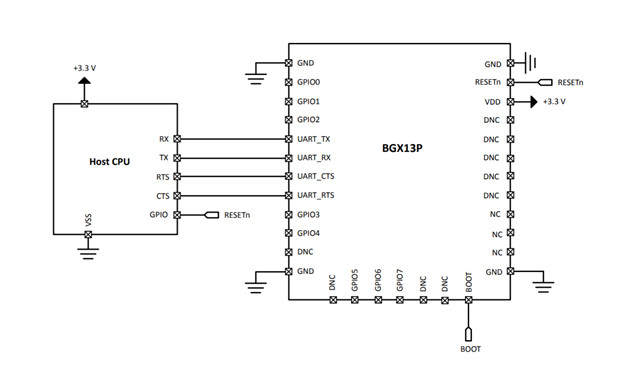
Maybe people didn't understand, that this kit contains a module that has a simplified connection (UART) that can be connected to (say) existing microcontrollers, to extend a design into something that is BLE-capable. The module even looks hand-solderable.
As well as new products, it has great applications to retrofit BLE into products - e.g. if a customer now wants to have configurability via a PC or mobile. Can't stand products with awkward button-press combinations to configure them... I have a speaker/mic for my PC/phone, this should be a trivial product, but it is so complicated to remember the button-press combinations (and how long to press buttons for), I had to write and print an instruction sheet and stick it to the back of it..
One reason I can think of is that the Bluetooth module is paired with the support board which is based on an 8051 processor.
This isn't exactly mainstream.
8051s were OK in their day and the Silabs ones are quite quick (for an 8051) but they not in the same league as modern ARM based parts like ST's STM32Gxx or STM32Lxx (or even SIlabs' ARM based parts.)
MK