RoadTest: Become a Tester of the STMicroelectronics STM32U083C-DK Discovery Kit
Author: rcsim10
Creation date:
Evaluation Type: Evaluation Boards
Did you receive all parts the manufacturer stated would be included in the package?: True
What other parts do you consider comparable to this product?: The STM32U083C-DK and its STM32U0 microcontroller family target the Ultra-Low Power market, featuring capabilities like ultra-low power, segment LCD control, and security. A comparable option is the Microchip SAM L22 Xplained Pro Evaluation Kit, which includes the ATSAML22N18A microcontroller (ARM® Cortex®-M0+), segment LCD support, a touch LCD display, and features such as a QTouch button, user LED, and ATECC508A Crypto Authentication. It also has a backup system with a supercapacitor and tamper simulation functionality. This kit offers robust features for low-power, secure applications.
What were the biggest problems encountered?: I didn’t find any big problems testing the STM32U083C-DK Discovery Kit, all the examples from ST worked as expected and I could even play with Zephyr RTOS which also work without any issue.
Detailed Review:
The STM32U083C-DK Kit is based on STM32U083MCT6 microcontroller, a new MCU family from ST targeting ultra-low power applications. The Kit includes a 4x24-segment LCD, three user LEDs, a reset push-button, a touchkey, and a temperature sensor. It also comes with a plant of connectors for different use cases: ST-LINK USB Type-C, user USB Device with USB Type-C, mikroBUS , ARDUINO®, MIPI® debug in connector, Extension connectors for full access to all STM32 I/Os and VBAT dedicated connector provides the capability to power the board on a battery.
The picture below from the user manual UM3292 shows the main components and connectors for the kit:

The STM32U0 series microcontrollers are based on the Arm® Cortex®-M0+ core, operating at frequencies up to 64 MHz. Below are the detailed technical specifications and key features of the STM32U0 series:
Core:
Memory:
Power Consumption:
Power Consumption Details:
Peripherals:
Security Features:
Connectivity:
Analog Features:
Packaging Options:
Available in various packages, including WLCSP49, UFBGA64, LQFP48, and LQFP32
Operating Conditions:
The STM32U083MC microcontroller is part of the STM32U0 new family and targets battery-powered applications such as Industrial Thermostats, smoke detectors, Medical insulin pumps, glucose meters, smart metering for water, gas, electricity, smart home and Consumer headphones, and activity trackers. It is based on an Arm® Cortex®-M0+ 32-bit RISC core operating up to 56 MHz and ST claims to have 52% energy saving versus previous product generation. Alongside STM32U083C-DK the STM32U0 microcontroller family can also be evaluated with the other two kits available, the NUCLEO-U031R8 and the NUCLEO-U083RC.
Additionally to the specs already mentioned for STM32U0 series, here are the features from STM32U083MC from ST documentation:
The STM32U083C-DK offers a very good package of features for a low price point (USD/Qty 20.0/1), given that the kit comes with a 4x24-segment LCD and USB Type-C makes it even better. The microcontroller itself also offers a very good package of features for a low price point (USD/Qty 1.648 / 10k). It is very low priced when compared to SAM L22 L22 Xplained Pro Kit (USD/Qty 88.54/1) and its microcontroller on ATSAML22N18A (USD/Qty 4.38/5k).
The ST documentation is usually very good, the kit comes with a flyer that has the link to the documentation:
https://www.st.com/en/evaluation-tools/stm32u083c-dk.html
I also watched a series of videos where ST demonstrates some of the features of STM32U0 family, which I recommend to watch:
https://youtu.be/1OykM7WAPx0?si=I8WD9pyjHw3Ne-UP
The box size is 12 cm x 9,5 cm x 4 cm and the kit contents include the STM32U083C-DK board itself and a flyer with some information and the link to the documentation. Although the board uses USB Type-C, there is no USB cable included in the box, which is not a problem as this cable is very common nowadays, and most of us may have many of these cables already.


The STM32U083C-DK comes with a preloaded firmware that demonstrates some of the features of the kit. The demo firmware has 4 main demonstrations:
Very detailed documentation for the demo firmware can be found at UM3313, it includes even details about the architecture for the firmware:

ST provides many example projects either when using the STM32CubeIDE or the STM32CubeMX, it is as simple as inputting the board name and getting a list of 41 projects to play with:
STM32CubeIDE:

STM32CubeMX:

A list of all available projects can be found below:
|
Name |
Board |
Board Type |
|
OpenBootloader |
STM32U083C-DK |
Discovery Kit |
|
Tx_CMSIS_Wrapper |
STM32U083C-DK |
Discovery Kit |
|
Tx_LowPower |
STM32U083C-DK |
Discovery Kit |
|
TouchSensing_1touchkey |
STM32U083C-DK |
Discovery Kit |
|
Ux_Device_CDC_ACM |
STM32U083C-DK |
Discovery Kit |
|
Ux_Device_HID |
STM32U083C-DK |
Discovery Kit |
|
Ux_Device_HID_CDC_ACM |
STM32U083C-DK |
Discovery Kit |
|
Ux_Device_HID_Standalone |
STM32U083C-DK |
Discovery Kit |
|
Demo |
STM32U083C-DK |
Discovery Kit |
|
ADC_SingleConversion_TriggerTimer_DMA |
STM32U083C-DK |
Discovery Kit |
|
ADC_TemperatureSensor |
STM32U083C-DK |
Discovery Kit |
|
BSP |
STM32U083C-DK |
Discovery Kit |
|
CORTEXM_SysTick |
STM32U083C-DK |
Discovery Kit |
|
CRC_Example |
STM32U083C-DK |
Discovery Kit |
|
CRYP_AESModes |
STM32U083C-DK |
Discovery Kit |
|
DAC_SignalsGeneration |
STM32U083C-DK |
Discovery Kit |
|
DMA_FLASHToRAM |
STM32U083C-DK |
Discovery Kit |
|
FLASH_EraseProgram |
STM32U083C-DK |
Discovery Kit |
|
GPIO_EXTI |
STM32U083C-DK |
Discovery Kit |
|
GPIO_IOToggle |
STM32U083C-DK |
Discovery Kit |
|
I2C_Sensor_Private_Command_IT |
STM32U083C-DK |
Discovery Kit |
|
I2C_TwoBoards_ComDMA |
STM32U083C-DK |
Discovery Kit |
|
IWDG_WindowMode |
STM32U083C-DK |
Discovery Kit |
|
LCD_Blink_Frequency |
STM32U083C-DK |
Discovery Kit |
|
LCD_SegmentsDrive |
STM32U083C-DK |
Discovery Kit |
|
LPTIM_Timeout |
STM32U083C-DK |
Discovery Kit |
|
OPAMP_PGA |
STM32U083C-DK |
Discovery Kit |
|
PWR_SLEEP |
STM32U083C-DK |
Discovery Kit |
|
PWR_STANDBY |
STM32U083C-DK |
Discovery Kit |
|
PWR_STOP2 |
STM32U083C-DK |
Discovery Kit |
|
RCC_ClockConfig |
STM32U083C-DK |
Discovery Kit |
|
RCC_SwitchClock |
STM32U083C-DK |
Discovery Kit |
|
RTC_Alarm |
STM32U083C-DK |
Discovery Kit |
|
RTC_InternalTimeStamp |
STM32U083C-DK |
Discovery Kit |
|
RTC_LowPower_STANDBY_WUT |
STM32U083C-DK |
Discovery Kit |
|
UART_LowPower_HyperTerminal_DMA |
STM32U083C-DK |
Discovery Kit |
|
UART_ReceptionToIdle_CircularDMA |
STM32U083C-DK |
Discovery Kit |
|
UART_TwoBoards_ComDMA |
STM32U083C-DK |
Discovery Kit |
|
GPIO_InfiniteLedToggling_Init |
STM32U083C-DK |
Discovery Kit |
|
TouchSensing_1touchkey_LowPower |
STM32U083C-DK |
Discovery Kit |
|
TouchSensing_OptimizedAcq_LowPower |
STM32U083C-DK |
Discovery Kit |
One of the most common first projects when embedded engineers play with some demo board is blinky the LED, this is one of the projects provided by ST as listed above with name GPIO_IOToggle.
There are two main options to load the built firmware into the board, you can use the STM32CubeProgrammer embedded at STM32CubeIDE


The other option for loading the firmware is using STM32CubeProgrammer

As already said in STM32U083C-DK feature description, it comes with a 4x24-segment LCD and we also have an example available on STM32CubeIDE to play with it:
ST also makes available the source code for the Demo and it is possible to build the demo firmware from the source using STM32CubeIDE:


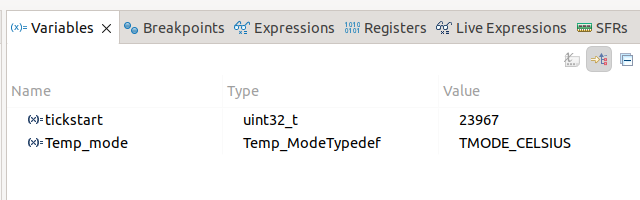
The STM32CubeIDE is based on Eclipse IDE, so we can debug your application using the Eclipse IDE features:


Nowadays, it is very common to use some kind of RTOS to support the development of complex applications, so I also investigated which RTOS would support this demo board and found out that Zephyr supports it. But to be honest, NuttX is my favorite RTOS and I’ve plans to add support to this board at NuttX, but for now, I played with Zephyr.
Zephyr Getting Started:
https://docs.zephyrproject.org/latest/develop/getting_started/index.html
STM32U083C-DK
I’ve tried two different examples on Zephyr, first, it is a simple hello world, where the string “Hello World” is printed on the serial console:
The second example was the blinky, which is another hello world, but for embedded enthusiasts:
Overall I’m delighted with the STM32U083C-DK Discovery Kit, it provides an excellent set of features for engineers to explore the full potential of the STM32U0 Ultra-Low-Power MCU series.
The inclusion of some external peripherals such as the 4x24-segment LCD, the touchkey, and the temperature sensor gives engineers the possibility to explore scenarios without the need to add external hardware, which is even better with the support from ST Tools like the STM32CubeIDE and STM32CubeMX where we can find plenty of examples ready to play with.
Also using this board I could have my first experience using Zephyr, which surprisingly was pretty straightforward and works as expected.
My next step is to add support for the STM32U083MCT6 and STM32U083C-DK to the NuttX RTOS, leveraging its scalable, small-footprint real-time capabilities, POSIX-compliant multi-threaded features, and open-source Apache license. Stay tuned at https://nuttx.apache.org/ .


