RoadTest: Become a Tester of the Vishay microBRICK® Synchronous Buck Regulator EVB
Author: dougw
Creation date:
Evaluation Type: Connectors & Cable
Did you receive all parts the manufacturer stated would be included in the package?: True
What other parts do you consider comparable to this product?: Texas Instruments TPSM63606EVM
What were the biggest problems encountered?: There weren't any large issues although the fact that I didn't have the correct 0603 resistors in stock was inconvenient.
Detailed Review:
This road test is focused on using the evaluation module in a real application rather than proving the datasheet was accurate.
The SiC967 microBRICK is a flexible integrated DC-DC converter that can efficiently provide a wide range of voltages at fairly high current and low noise, all in a small form factor.
The SiC967EVB-A evaluation module provides a flexible platform that permits the SiC967 to be configured for a wide variety of power supply applications.
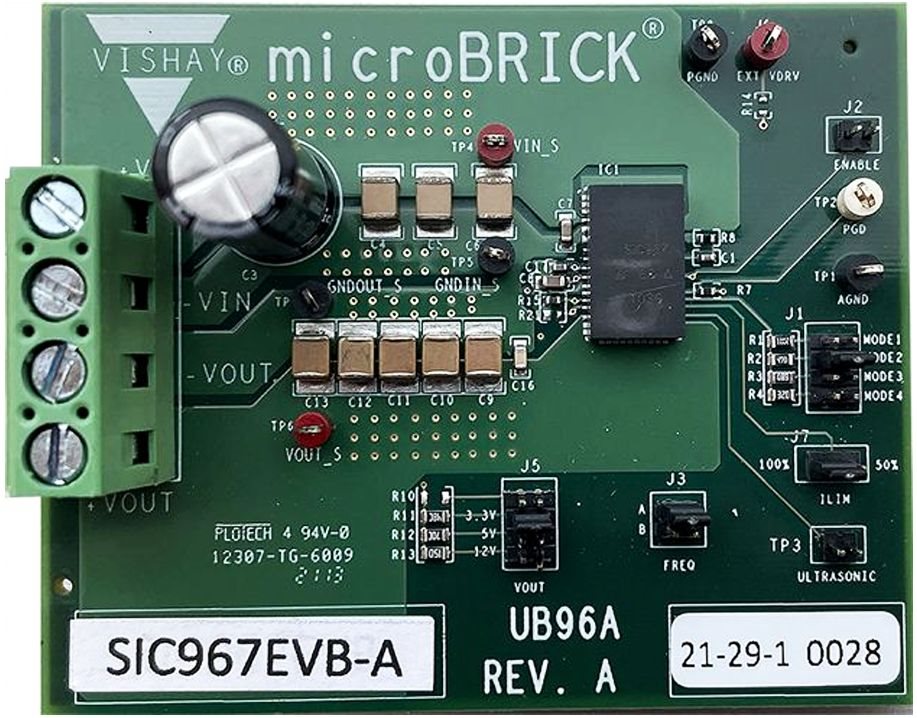
This review describes how the SiC967EVB-A was used to create a power supply suitable to power a camera instead of its normal battery. This camera requires half an Amp of current at 8.4 volts and the voltage needs to have very little noise. The power supply will mount on one of the legs of a tripod holding the camera and feed power to camera via a connector that has the same shape as a battery.
The voltage required by this camera is not one of the standard voltages provided by commercial fixed power supplies so the programmability of this supply gives it a distinct advantage over commercial offerings. The one power supply I was able to buy that claimed to meet the requirements for this camera, ended up generating so much electrical noise that it showed up as audio noise in the video recordings made by the camera. The low noise generated by the Vishay supply will eliminate the unwanted audio noise.
Phase 1 Preparations
Phase 2 Measurements and Calculations
Phase 3 Design & Build
Phase 4 Test & write review
The SiC967EVB-A module has a number of jumpers and resistors that need to be configured properly to achieve a particular result.
This section shows the process I went through to configure the module for my application.
The default input voltage is nominally expecting 48 V DC. My input source is 12.3VDC, so I needed to change R6 from 43K to 68K.
The formula to calculate R6 is as follows:
R6 = (Vin – 1.4) * R5 /1.4 where R5 = 10K
Since I want a non-standard voltage, I had to replace R10 from its original value of 43K to 94K
The formula to calculate r10 is as follows:
R10 = Rfbl * (Vo – Vfb) / Vfb where Rfbl = 10.2K, Vo = 8.2, Vfb = 0.8,
To have R10 define the output voltage, J5 must be in the first position next to R10.
The primary objective of building a continuous power supply for my Panasonic camera that would not contribute audio noise to its recordings was a complete success and I am very happy with the final result.
The star rating for demo software got 5 stars although there was no software needed. Giving it 1 star might have looked bad and the software couldn't have been easier than no software so I gave it 5 stars.
The SiC967EVB-A proved to be able to handle the input voltage I had available and be able to generate the required output voltage and current with appropriately low noise.
I am impressed with the wide range of voltages supported, with the high current capability, with the small form factor, with the low switching noise and decent efficiency.
I was a little surprised that the input voltage needed to exceed the output voltage by 4.1 volts in order to achieve full output regulation. Fortunately there is just enough voltage in my setup to achieve this.
That said, the SiC967 is a very capable DC-DC converter with excellent performance in a small package. It certainly performs well in my fairly demanding application and I am going to get a lot of use out of it.
I had been pondering how to accomplish a good camera power supply for some time, so I was excited to apply for this road test and a chance to see if this module would solve my problem. Thank you element14 and Vishay for accepting my proposal for this road test.


