element14 Community
element14 Community
    Register Log In
  • Site
  • Search
  • Log In Register
  • Community Hub
    Community Hub
    • What's New on element14
    • Feedback and Support
    • Benefits of Membership
    • Personal Blogs
    • Members Area
    • Achievement Levels
  • Learn
    Learn
    • Ask an Expert
    • eBooks
    • element14 presents
    • Learning Center
    • Tech Spotlight
    • STEM Academy
    • Webinars, Training and Events
    • Learning Groups
  • Technologies
    Technologies
    • 3D Printing
    • FPGA
    • Industrial Automation
    • Internet of Things
    • Power & Energy
    • Sensors
    • Technology Groups
  • Challenges & Projects
    Challenges & Projects
    • Design Challenges
    • element14 presents Projects
    • Project14
    • Arduino Projects
    • Raspberry Pi Projects
    • Project Groups
  • Products
    Products
    • Arduino
    • Avnet & Tria Boards Community
    • Dev Tools
    • Manufacturers
    • Multicomp Pro
    • Product Groups
    • Raspberry Pi
    • RoadTests & Reviews
  • About Us
    About the element14 Community
  • Store
    Store
    • Visit Your Store
    • Choose another store...
      • Europe
      •  Austria (German)
      •  Belgium (Dutch, French)
      •  Bulgaria (Bulgarian)
      •  Czech Republic (Czech)
      •  Denmark (Danish)
      •  Estonia (Estonian)
      •  Finland (Finnish)
      •  France (French)
      •  Germany (German)
      •  Hungary (Hungarian)
      •  Ireland
      •  Israel
      •  Italy (Italian)
      •  Latvia (Latvian)
      •  
      •  Lithuania (Lithuanian)
      •  Netherlands (Dutch)
      •  Norway (Norwegian)
      •  Poland (Polish)
      •  Portugal (Portuguese)
      •  Romania (Romanian)
      •  Russia (Russian)
      •  Slovakia (Slovak)
      •  Slovenia (Slovenian)
      •  Spain (Spanish)
      •  Sweden (Swedish)
      •  Switzerland(German, French)
      •  Turkey (Turkish)
      •  United Kingdom
      • Asia Pacific
      •  Australia
      •  China
      •  Hong Kong
      •  India
      •  Japan
      •  Korea (Korean)
      •  Malaysia
      •  New Zealand
      •  Philippines
      •  Singapore
      •  Taiwan
      •  Thailand (Thai)
      •  Vietnam
      • Americas
      •  Brazil (Portuguese)
      •  Canada
      •  Mexico (Spanish)
      •  United States
      Can't find the country/region you're looking for? Visit our export site or find a local distributor.
  • Translate
  • Profile
  • Settings
RoadTests & Reviews
  • Products
  • More
RoadTests & Reviews
Polls Poll: Are You Interested in Roadtesting a USB Software-Defined Radio Platform?
  • Blogs
  • Forum
  • Documents
  • RoadTests
  • Reviews
  • Polls
  • Files
  • Members
  • Sub-Groups
  • More
  • Cancel
  • New
Join RoadTests & Reviews to participate - click to join for free!
Actions
  • Share
  • More
  • Cancel
Engagement
  • Author Author: rscasny
  • Date Created: 14 Feb 2021 1:39 AM Date Created
  • Last Updated Last Updated: 11 Oct 2021 3:00 PM
  • Views 5840 views
  • Likes 2 likes
  • Comments 44 comments
Related
Recommended

Poll: Are You Interested in Roadtesting a USB Software-Defined Radio Platform?

The USRP B205mini-i is a flexible and compact platform. It provides a wide frequency range (70 MHz to 6 GHz) and a user-programmable, industrial-grade Xilinx Spartan-6 XC6SLX150 FPGA.
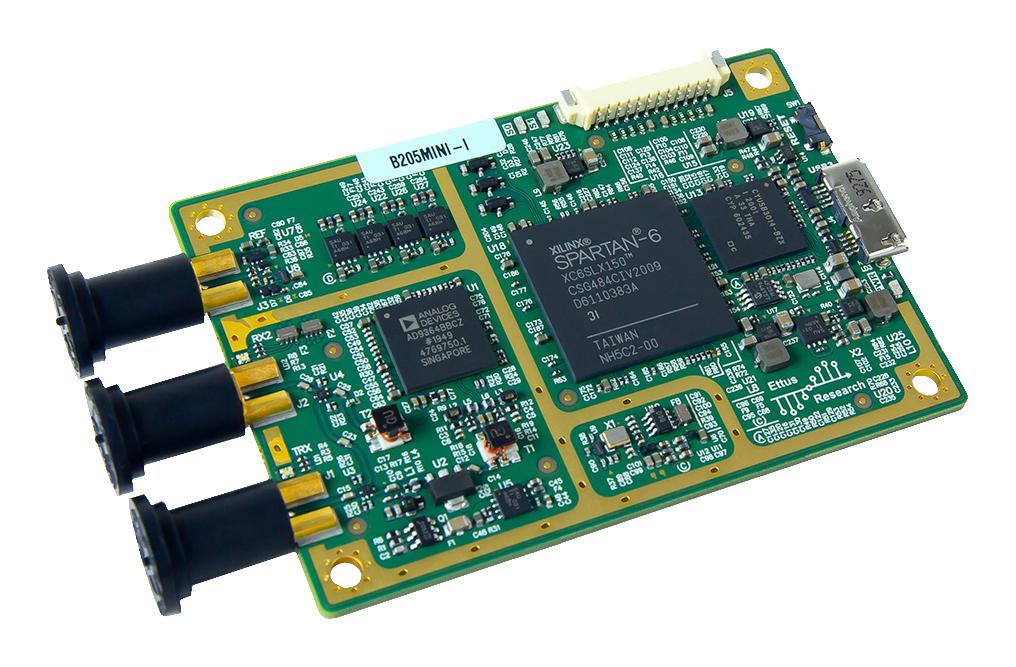
6002-410-021 Development Board, XC6SLX150, Spartan-6 FPGA

The RF front end uses the Analog Devices AD9364 RFIC transceiver with 56 MHz of instantaneous bandwidth. The board is bus-powered by a high-speed USB 3.0 connection for streaming data to the host computer. The USRP B205mini-i also includes connectors for GPIO, JTAG, and synchronization with a 10 MHz clock reference or PPS time reference input signal.


The hardware is conveniently accessible through the USRP Hardware Driver (UHD). UHD provides both a C/C++ and Python API that supports all USRP products and enables users to efficiently develop applications then seamlessly transition designs between platforms as requirements expand. UHD also offers cross-platform support for multiple industry standard development environments and frameworks, including RFNoC, LabVIEW, and Matlab/Simulink. To ensure you have no restrictions on how you use UHD, it is available on Linux, Windows, and Mac OS. Do you prefer graphical programming? Try out GNU Radio, a free and open-source software development framework offering a graphical design approach.


RF Specifications

  • Channels: 1 TX, 1 RX
  • Frequency range: 70 MHz to 6 GHz
  • Instantaneous Bandwidth: Up to 56 MHz
  • IIP3 (at typical NF): -20 dBm
  • Power Output: >10 dBm
  • Receive Noise Figure: <8 dB


Conversion Performance and Clocks

  • ADC Sample Rate (Max.): 61.44 MS/s
  • ADC Resolution: 12 bits
  • DAC Sample Rate (Max.): 61.44 MS/s
  • DAC Resolution: 12 bits
  • Host Sample Rate (16b): 61.44 MS/s
  • Frequency Accuracy: +/-2.0 ppm


Power

  • USB Power: 5V


Environment

  • Operating Temp. Range: 0 - 45 °C
  • USRP Hardware Driver 3.9.2 (or later)
  • GNU Radio


Synchronization

  • 10 MHz clock reference
  • PPS time reference


Additional Information

Datasheet

  • usrp b205mini-i
  • roadtest survey
  • software defined radio
  • sdr
  • community survey
  • Share
  • History
  • More
  • Cancel
  • Sign in to reply

Top Comments

  • Gough Lui
    Gough Lui over 5 years ago +7
    That looks like a great device to test ... as a radio amateur myself, I've been using the Winradio Excalibur G31DDC (2MHz bandwidth, 0-50MHz frequency range) since 2010 - the best we could do at the time…
  • colporteur
    colporteur over 5 years ago in reply to colporteur +6
    On initial discovery I found this RoadTest poll of interest. The picture of the product is deceiving. According to manufactures docs, The USRP B205mini-i delivers a 1×1 SDR/cognitive radio in the size…
  • Gough Lui
    Gough Lui over 5 years ago in reply to Fred27 +4
    Well, how else am I going to DX? Take photos by day, take IQ recordings by night ... Speaking of which, this is what happened ... https://goughlui.com/2017/11/05/an-incomplete-repair-bladerf-x40-software…
Parents
  • Gough Lui
    Gough Lui over 5 years ago

    That looks like a great device to test ... as a radio amateur myself, I've been using the Winradio Excalibur G31DDC (2MHz bandwidth, 0-50MHz frequency range) since 2010 - the best we could do at the time with processing power and USB 2.0 limitations, upgrading to a BladeRF x40 with the XB-200 transverter (~28MHz bandwidth, 60kHz-3.8GHz frequency range) in 2016 while also dabbling with the much-less-capable RTL-SDR (E4000/R820T-based) sticks.


    Since then, unfortunately due to an "accident" while on holidays, the USB 3.0 connector on my BladeRF x40 was sheared off and I only managed to recover USB 2.0 connectivity for about 5MHz of instantaneous bandwidth. Since then, I've been quite heartened by the variety of low-cost SDR alternatives, eyeing the LimeSDR and LimeSDR Mini which looked to be pretty compact and capable (61.44MHz bandwidth 100kHz-3.8GHz frequency range) with MIMO capabilities. Many of these are bare-board so end users can integrate them into end products or build their own cases ... also as a cost-saving measure.


    As always, there are other options like the HackRF One which offers less bandwidth but is more widely supported software-wise. In general, USRPs have also been favoured by researchers and GNU Radio users for its support (and Ethernet interface on some of them), but the price has been a bit higher as a result. It seems that this unit does come with options that have a case or board only and is quite a bit smaller than my BladeRF x40 set-up ... https://www.ettus.com/all-products/usrp-b205mini-i/


    Definitely something I'm interested in for sure.


    - Gough

    • Cancel
    • Vote Up +7 Vote Down
    • Sign in to reply
    • More
    • Cancel
  • robogary
    robogary over 5 years ago in reply to Gough Lui

    Just out of curiosity, how would you go about testing this SDR ?

    The SDRs I'm used to seeing are well defined in purpose and functionality.


    This module doesn't mention modulation scheme: AM (SSB) , FM, FSK, PSK, etc.. is that user defined ?

    Is the antenna user provided as well , is there a small one etched in the PCB ?

    Would you take the 10 mW out and drive a pre amp and a final to get to 5W or so ?

    • Cancel
    • Vote Up +2 Vote Down
    • Sign in to reply
    • More
    • Cancel
Comment
  • robogary
    robogary over 5 years ago in reply to Gough Lui

    Just out of curiosity, how would you go about testing this SDR ?

    The SDRs I'm used to seeing are well defined in purpose and functionality.


    This module doesn't mention modulation scheme: AM (SSB) , FM, FSK, PSK, etc.. is that user defined ?

    Is the antenna user provided as well , is there a small one etched in the PCB ?

    Would you take the 10 mW out and drive a pre amp and a final to get to 5W or so ?

    • Cancel
    • Vote Up +2 Vote Down
    • Sign in to reply
    • More
    • Cancel
Children
  • baldengineer
    baldengineer over 5 years ago in reply to robogary

    robogary  wrote:

    This module doesn't mention modulation scheme: AM (SSB) , FM, FSK, PSK, etc.. is that user defined ?

    The purpose of an SDR, at least such as this one, is that there are no hardware modulators. All modulation would be done in software and provided as I-Q samples to the radio.


    Are you thinking of ham equipment that has moved towards using an SDR instead of a traditional hardware mixer? If that is the case, then this is a module that would get surrounded by other "stuff" to make it application-specific. But the SDR itself only understands digital samples.

    • Cancel
    • Vote Up +2 Vote Down
    • Sign in to reply
    • More
    • Cancel
  • cghaba
    cghaba over 5 years ago in reply to robogary

    Probably the antenna is also software defined!

    • Cancel
    • Vote Up +1 Vote Down
    • Sign in to reply
    • More
    • Cancel
  • robogary
    robogary over 5 years ago in reply to baldengineer

    Thanks, I looked up I Q sampling,have a much better idea of whats going on, My mind is still stuck on superheterodyne.

    • Cancel
    • Vote Up +2 Vote Down
    • Sign in to reply
    • More
    • Cancel
  • Gough Lui
    Gough Lui over 5 years ago in reply to cghaba

    cghaba - Seeing as this one only has one antenna port, no, the antenna isn't "software defined" and nor is this single unit on its own capable of MIMO-style beamforming. But because it does support 10Mhz reference clock input, perhaps phase coherency can be achieved somehow across multiple units in which case, with careful geometrical arrangement of antennas and phasing of the generating signals you could potentially have an electrically-steerable beam.


    - Gough

    • Cancel
    • Vote Up +1 Vote Down
    • Sign in to reply
    • More
    • Cancel
element14 Community

element14 is the first online community specifically for engineers. Connect with your peers and get expert answers to your questions.

  • Members
  • Learn
  • Technologies
  • Challenges & Projects
  • Products
  • Store
  • About Us
  • Feedback & Support
  • FAQs
  • Terms of Use
  • Privacy Policy
  • Legal and Copyright Notices
  • Sitemap
  • Cookies

An Avnet Company © 2026 Premier Farnell Limited. All Rights Reserved.

Premier Farnell Ltd, registered in England and Wales (no 00876412), registered office: Farnell House, Forge Lane, Leeds LS12 2NE.

Follow element14

  • X
  • Facebook
  • linkedin
  • YouTube