


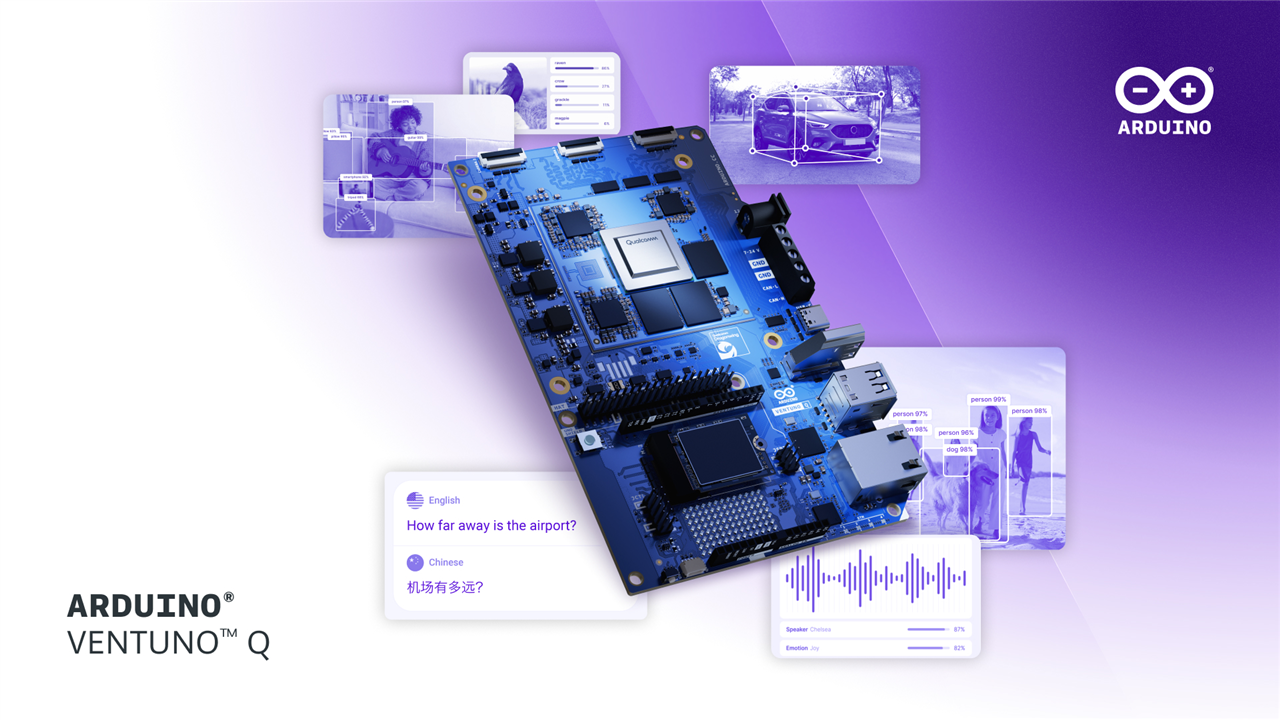
The Arduino VENTUNO Q SBC is perfect for robotics development. (Image Credit: Arduino)
Arduino recently announced the launch of a new single-board computer, the Arduino VENTUNO Q, which combines AI with real-time control. It features the Qualcomm Dragonwing IQ8 microprocessor and an STM32H5F5 microcontroller. According to Arduino, the SBC is designed for systems that “move, manipulate, and respond to the physical world with precision and reliability.”
Arduino’s newest AI SBC is perfect for robotics development, thanks to its Robot Operating System 2 (ROS 2) support. This enables real-time, advanced, robot applications with professional-grade precision. To complement this, the Arduino App Lab provides special robotics bricks that package complex functionalities into reusable components for quick prototyping. VENTUNO Q also delivers real-time motion control via GPIO, PWM, and CAN-FD responses. It ensures zero-jitter motor control and reliability for safety-critical systems.
The Dragonwing IQ8 MPU features an 8-core ARM Cortex-A CPU, an Ardeno Arm Cortex-A623 GPU (877 MHz), a Hexagon Tensor NPU with up to 40 dense TOPS, and a Qualcomm Spectra 692 ISP. This MPU can run the Ubuntu or Debian upstream OS. Meanwhile, the STM32H5F5 MCU (for low-latency actuation and motor control) has an Arm Cortex M33 at 250 Mhz. 4MB flash,1.5MB of RAM, and runs on the Arduino core on Zephyr OS. In addition, the VENTUNO Q features WiFi6, Bluetooth 5.3, 2.5 Gbps ethernet, USB camera support,16GB of RAM for concurrent inference and complex multitasking, 64GB of eMMC storage, and an M.2 connector for NVMe Gen 4 external storage.
VENTUNO Q’s NPU is compatible with a variety of AI models, and users can customize them as needed. Qwen handles on-device natural language understanding without requiring cloud connection or data transfers. Qwen VLM combines visual processing with language tasks like image captioning, scene description, and OCR. Melo TTS and Whisper enable speech recognition, transcription, and natural-sounding responses on offline devices. MediaPipe detects hand gestures, finger movement, and sign language for touchless interfaces or human-robot interaction. YOLO-X performs real-time tracking, such as people or vehicles, across multiple camera feeds. Lastly, PoseNet tracks body poses, joint positions, and movement patterns, an idea for fitness monitoring, safety systems, or interactive applications. All these AI models run offline.
“VENTUNO Q reflects our shared commitment to make edge AI more powerful and more accessible,” said Nakul Duggal, EVP and Group GM, Automotive, Industrial and Embedded IoT, Qualcomm Technologies, Inc. "By uniting Arduino's developer ecosystem with the power of Dragonwing processors, we are making advanced edge AI available to millions of developers worldwide. This platform paves the way for a fresh surge of creativity and innovation, where devices and solutions can instantly comprehend their surroundings and respond, all at the edge."
Have a story tip? Message me here at element14.
Top Comments