element14 Community
element14 Community
    Register Log In
  • Site
  • Search
  • Log In Register
  • Community Hub
    Community Hub
    • What's New on element14
    • Feedback and Support
    • Benefits of Membership
    • Personal Blogs
    • Members Area
    • Achievement Levels
  • Learn
    Learn
    • Ask an Expert
    • eBooks
    • element14 presents
    • Learning Center
    • Tech Spotlight
    • STEM Academy
    • Webinars, Training and Events
    • Learning Groups
  • Technologies
    Technologies
    • 3D Printing
    • FPGA
    • Industrial Automation
    • Internet of Things
    • Power & Energy
    • Sensors
    • Technology Groups
  • Challenges & Projects
    Challenges & Projects
    • Design Challenges
    • element14 presents Projects
    • Project14
    • Arduino Projects
    • Raspberry Pi Projects
    • Project Groups
  • Products
    Products
    • Arduino
    • Avnet & Tria Boards Community
    • Dev Tools
    • Manufacturers
    • Multicomp Pro
    • Product Groups
    • Raspberry Pi
    • RoadTests & Reviews
  • About Us
  • Store
    Store
    • Visit Your Store
    • Choose another store...
      • Europe
      •  Austria (German)
      •  Belgium (Dutch, French)
      •  Bulgaria (Bulgarian)
      •  Czech Republic (Czech)
      •  Denmark (Danish)
      •  Estonia (Estonian)
      •  Finland (Finnish)
      •  France (French)
      •  Germany (German)
      •  Hungary (Hungarian)
      •  Ireland
      •  Israel
      •  Italy (Italian)
      •  Latvia (Latvian)
      •  
      •  Lithuania (Lithuanian)
      •  Netherlands (Dutch)
      •  Norway (Norwegian)
      •  Poland (Polish)
      •  Portugal (Portuguese)
      •  Romania (Romanian)
      •  Russia (Russian)
      •  Slovakia (Slovak)
      •  Slovenia (Slovenian)
      •  Spain (Spanish)
      •  Sweden (Swedish)
      •  Switzerland(German, French)
      •  Turkey (Turkish)
      •  United Kingdom
      • Asia Pacific
      •  Australia
      •  China
      •  Hong Kong
      •  India
      • Japan
      •  Korea (Korean)
      •  Malaysia
      •  New Zealand
      •  Philippines
      •  Singapore
      •  Taiwan
      •  Thailand (Thai)
      • Vietnam
      • Americas
      •  Brazil (Portuguese)
      •  Canada
      •  Mexico (Spanish)
      •  United States
      Can't find the country/region you're looking for? Visit our export site or find a local distributor.
  • Translate
  • Profile
  • Settings
Embedded and Microcontrollers
  • Technologies
  • More
Embedded and Microcontrollers
Blog Engineers Discover Breakthrough with Quantum States Controlled with Everyday Electronics
  • Blog
  • Forum
  • Documents
  • Quiz
  • Polls
  • Files
  • Members
  • Mentions
  • Sub-Groups
  • Tags
  • More
  • Cancel
  • New
Join Embedded and Microcontrollers to participate - click to join for free!
  • Share
  • More
  • Cancel
Group Actions
  • Group RSS
  • More
  • Cancel
Engagement
  • Author Author: Catwell
  • Date Created: 13 Dec 2019 4:32 PM Date Created
  • Views 666 views
  • Likes 5 likes
  • Comments 0 comments
  • quantum
  • research
  • stem
  • student
  • university of chicago
  • on_campus
  • chicago
  • cabeatwell
  • university
  • innovation
Related
Recommended

Engineers Discover Breakthrough with Quantum States Controlled with Everyday Electronics

Catwell
Catwell
13 Dec 2019

image

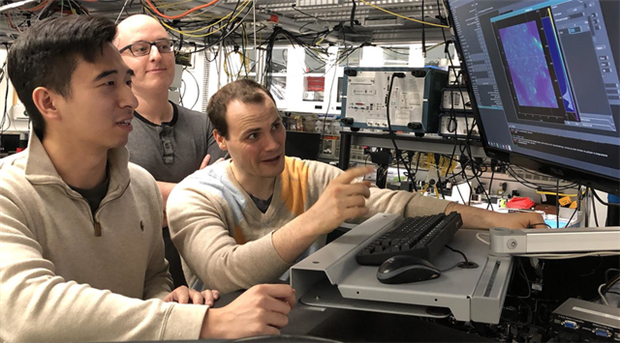
The engineers discovered a way to tune and control quantum bits in today’s electronics, which could make it easier to produce quantum electronics. (Image credit: University of Chicago)


Engineers from the University of Chicago’s Pritzker School of Molecular Engineering have discovered a method that allows quantum states to be integrated and controlled with the electronics we use daily, including smartphones and laptops. The breakthrough brings the possibility of creating quantum information technologies in everyday devices made from silicon carbide.


Quantum technology is a new field of physics and engineering that works under the principles of quantum mechanics at the atomic level, including quantum entanglement and superposition. Most scientists have agreed on the notion that quantum technology is too delicate to function with current technologies, that is, until now.


Liew Family Professor in Molecular Engineering (@ UChicago) David Awschalom stated, “The ability to create and control high-performance quantum bits in commercial electronics was a surprise. These discoveries have changed the way we think about developing quantum technologies—perhaps we can find a way to use today’s electronics to build quantum devices.”


Today’s quantum computers are capable of harnessing the data-crunching power of qubits in a superposition state (0, 1, or both) using pulsed lasers in a super-chilled housing; otherwise those qubits become clogged with errors. They also need a team of physicists on hand to crank the computer to life and keep it humming along while it processes information. This breakthrough means those incredibly expensive rigs for quantum computing are no longer required to produce quantum results, which can now be leveraged using the device in your pocket.


Technically, the engineers garnered two breakthroughs with quantum technology, with the first being the ability to control quantum states in silicon carbide over using exotic materials such as topological insulators, which can conduct electricity on their edge but not in the center, which acts as an insulator.


The second breakthrough tackles the electrical noise issue found in all electronics, even quantum computers. The engineers state that they used lasers in their experiments, which has the side effect of jostling electrons around like driving on uneven dirt roads. When the lasers are switched off, those electrons settle into a different configuration than they were originally, which effects their quantum state, resulting in noise. They found that by applying an electric field, those electrons become much more stable.


The quantum states in silicon carbide also produce single particles of light near the wavelengths of communications bandwidths, which could be used to create an unhackable quantum communications network and applied in current fiber optic systems. The engineers used those properties to create a “quantum FM radio,” which can relay quantum information at long distances similar to how music is transmitted over FM radio. More information on these breakthroughs can be found in recently released papers uploaded here and here.  


Have a story tip? Message me at: cabe(at)element14(dot)com

http://twitter.com/Cabe_Atwell

  • Sign in to reply
element14 Community

element14 is the first online community specifically for engineers. Connect with your peers and get expert answers to your questions.

  • Members
  • Learn
  • Technologies
  • Challenges & Projects
  • Products
  • Store
  • About Us
  • Feedback & Support
  • FAQs
  • Terms of Use
  • Privacy Policy
  • Legal and Copyright Notices
  • Sitemap
  • Cookies

An Avnet Company © 2026 Premier Farnell Limited. All Rights Reserved.

Premier Farnell Ltd, registered in England and Wales (no 00876412), registered office: Farnell House, Forge Lane, Leeds LS12 2NE.

ICP 备案号 10220084.

Follow element14

  • X
  • Facebook
  • linkedin
  • YouTube