element14 Community
element14 Community
    Register Log In
  • Site
  • Search
  • Log In Register
  • Community Hub
    Community Hub
    • What's New on element14
    • Feedback and Support
    • Benefits of Membership
    • Personal Blogs
    • Members Area
    • Achievement Levels
  • Learn
    Learn
    • Ask an Expert
    • eBooks
    • element14 presents
    • Learning Center
    • Tech Spotlight
    • STEM Academy
    • Webinars, Training and Events
    • Learning Groups
  • Technologies
    Technologies
    • 3D Printing
    • FPGA
    • Industrial Automation
    • Internet of Things
    • Power & Energy
    • Sensors
    • Technology Groups
  • Challenges & Projects
    Challenges & Projects
    • Design Challenges
    • element14 presents Projects
    • Project14
    • Arduino Projects
    • Raspberry Pi Projects
    • Project Groups
  • Products
    Products
    • Arduino
    • Avnet & Tria Boards Community
    • Dev Tools
    • Manufacturers
    • Multicomp Pro
    • Product Groups
    • Raspberry Pi
    • RoadTests & Reviews
  • About Us
  • Store
    Store
    • Visit Your Store
    • Choose another store...
      • Europe
      •  Austria (German)
      •  Belgium (Dutch, French)
      •  Bulgaria (Bulgarian)
      •  Czech Republic (Czech)
      •  Denmark (Danish)
      •  Estonia (Estonian)
      •  Finland (Finnish)
      •  France (French)
      •  Germany (German)
      •  Hungary (Hungarian)
      •  Ireland
      •  Israel
      •  Italy (Italian)
      •  Latvia (Latvian)
      •  
      •  Lithuania (Lithuanian)
      •  Netherlands (Dutch)
      •  Norway (Norwegian)
      •  Poland (Polish)
      •  Portugal (Portuguese)
      •  Romania (Romanian)
      •  Russia (Russian)
      •  Slovakia (Slovak)
      •  Slovenia (Slovenian)
      •  Spain (Spanish)
      •  Sweden (Swedish)
      •  Switzerland(German, French)
      •  Turkey (Turkish)
      •  United Kingdom
      • Asia Pacific
      •  Australia
      •  China
      •  Hong Kong
      •  India
      •  Korea (Korean)
      •  Malaysia
      •  New Zealand
      •  Philippines
      •  Singapore
      •  Taiwan
      •  Thailand (Thai)
      • Americas
      •  Brazil (Portuguese)
      •  Canada
      •  Mexico (Spanish)
      •  United States
      Can't find the country/region you're looking for? Visit our export site or find a local distributor.
  • Translate
  • Profile
  • Settings
Embedded and Microcontrollers
  • Technologies
  • More
Embedded and Microcontrollers
Blog Italian Researchers succeed in first ever photon entanglement on a chip exhibition
  • Blog
  • Forum
  • Documents
  • Quiz
  • Polls
  • Files
  • Members
  • Mentions
  • Sub-Groups
  • Tags
  • More
  • Cancel
  • New
Join Embedded and Microcontrollers to participate - click to join for free!
  • Share
  • More
  • Cancel
Group Actions
  • Group RSS
  • More
  • Cancel
Engagement
  • Author Author: Catwell
  • Date Created: 3 Mar 2015 9:41 PM Date Created
  • Views 526 views
  • Likes 2 likes
  • Comments 0 comments
  • research
  • entangle
  • cabeatwell
  • university
  • entanglment_chip
  • ibm
  • innovation
Related
Recommended

Italian Researchers succeed in first ever photon entanglement on a chip exhibition

Catwell
Catwell
3 Mar 2015

image

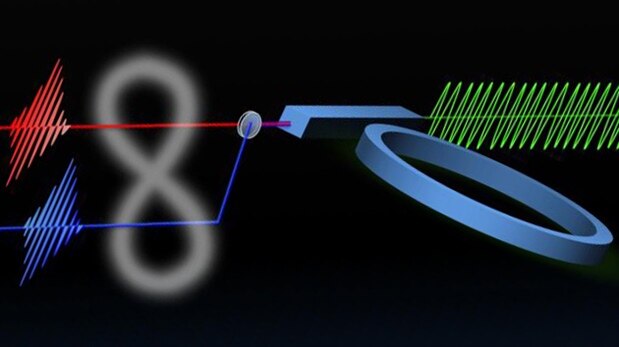
Photon Entanglement Ring Resonator visualization (via Davide Grassani, Stefano Azzini, Marco Liscidini, Matteo Galli, Michael J. Strain, Marc Sorel, J. E. Sipe, and Daniele Bajoni)


As IBM readies its brain-like computer-on-a-chip for mass production, the Università degli Studi di Pavia in Italy is making history, as it just built the very first chip capable of entangling individual light particles. The new technology may inspire a host of novel computing innovations and quite possibly put an end to cyber threats as we known them.


Entanglement is an essential quantum effect that enables the instant connection between two particles, regardless of distance. This means that anything done to one particle will be instantaneously done to another particle, even if it is at the other end of the universe. The entanglement of photons isn’t a new technology, but researchers at the Università degli Studi di Pavia, including co-author on the paper Daniele Bajoni, made history in successfully scaling the technology down to fit on a chip.


Researchers have been trying to scale down entanglement technology for years. Typically, the technology is harnessed through specialized crystals, but even the smallest set-up was still a few millimeters thick. Bajoni and his team decided to try a different approach and instead built what they call micro-ring resonators onto an ordinary silicon chip. The resonators embed coils into silicon wafers that capture and re-release photons. The design results in successful entanglement at an unparalleled width of 20 microns, or one-tenth the thickness of a strand of human hair.


The technology has huge implications for computing, as entanglement can exponentially increase computing power and speed. Computing communication can become instantaneous, as can other communication technologies. Tweeting at the speed of light, anyone? While these potentialities for advancements in computing are impressive, the biggest impact it may make is in inhibiting cyber threats.

In entanglement, particles act as one cohesive unit. Hackers operate by identifying weaknesses in computer and information systems and exploiting them. If computing and information systems, however, operate as one cohesive unit, there would be no way through which a hacker could breach the system, thus eliminating cyber threats. Sorry Dshell analysts.


The new quantum chip is infinitely more powerful than even the most cutting-edge supercomputers around today. It has the potential power to revolutionize communication, computing and cybersecurity, by enabling the adoption of quantum technologies, such as quantum cryptography and quantum information technologies. When we can expect to see this technology rule supreme, however, is another subject entirely.


Bajoni believes the technology is the connector through which innovation technologies can begin harnessing quantum power on a small scale, but others disagree. Some believe ring resonators must be produced on a nanoscale first to compete with up-and-coming nano-processors. Only time will tell, but our bet is cybersecurity stakeholders, at the least, will begin looking into the chip’s development. Until quantum mobile communication is available, however, you’ll just have to upload your social media photos like everybody else, 3-4GBs at a time.


C

See more news at:

http://twitter.com/Cabe_Atwell

  • Sign in to reply
element14 Community

element14 is the first online community specifically for engineers. Connect with your peers and get expert answers to your questions.

  • Members
  • Learn
  • Technologies
  • Challenges & Projects
  • Products
  • Store
  • About Us
  • Feedback & Support
  • FAQs
  • Terms of Use
  • Privacy Policy
  • Legal and Copyright Notices
  • Sitemap
  • Cookies

An Avnet Company © 2025 Premier Farnell Limited. All Rights Reserved.

Premier Farnell Ltd, registered in England and Wales (no 00876412), registered office: Farnell House, Forge Lane, Leeds LS12 2NE.

ICP 备案号 10220084.

Follow element14

  • X
  • Facebook
  • linkedin
  • YouTube