
element14 Community
element14 Community
    Register Log In
  • Site
  • Search
  • Log In Register
  • Community Hub
    Community Hub
    • What's New on element14
    • Feedback and Support
    • Benefits of Membership
    • Personal Blogs
    • Members Area
    • Achievement Levels
  • Learn
    Learn
    • Ask an Expert
    • eBooks
    • element14 presents
    • Learning Center
    • Tech Spotlight
    • STEM Academy
    • Webinars, Training and Events
    • Learning Groups
  • Technologies
    Technologies
    • 3D Printing
    • FPGA
    • Industrial Automation
    • Internet of Things
    • Power & Energy
    • Sensors
    • Technology Groups
  • Challenges & Projects
    Challenges & Projects
    • Design Challenges
    • element14 presents Projects
    • Project14
    • Arduino Projects
    • Raspberry Pi Projects
    • Project Groups
  • Products
    Products
    • Arduino
    • Avnet & Tria Boards Community
    • Dev Tools
    • Manufacturers
    • Multicomp Pro
    • Product Groups
    • Raspberry Pi
    • RoadTests & Reviews
  • About Us
    About the element14 Community
  • Store
    Store
    • Visit Your Store
    • Choose another store...
      • Europe
      •  Austria (German)
      •  Belgium (Dutch, French)
      •  Bulgaria (Bulgarian)
      •  Czech Republic (Czech)
      •  Denmark (Danish)
      •  Estonia (Estonian)
      •  Finland (Finnish)
      •  France (French)
      •  Germany (German)
      •  Hungary (Hungarian)
      •  Ireland
      •  Israel
      •  Italy (Italian)
      •  Latvia (Latvian)
      •  
      •  Lithuania (Lithuanian)
      •  Netherlands (Dutch)
      •  Norway (Norwegian)
      •  Poland (Polish)
      •  Portugal (Portuguese)
      •  Romania (Romanian)
      •  Russia (Russian)
      •  Slovakia (Slovak)
      •  Slovenia (Slovenian)
      •  Spain (Spanish)
      •  Sweden (Swedish)
      •  Switzerland(German, French)
      •  Turkey (Turkish)
      •  United Kingdom
      • Asia Pacific
      •  Australia
      •  China
      •  Hong Kong
      •  India
      •  Japan
      •  Korea (Korean)
      •  Malaysia
      •  New Zealand
      •  Philippines
      •  Singapore
      •  Taiwan
      •  Thailand (Thai)
      •  Vietnam
      • Americas
      •  Brazil (Portuguese)
      •  Canada
      •  Mexico (Spanish)
      •  United States
      Can't find the country/region you're looking for? Visit our export site or find a local distributor.
  • Translate
  • Profile
  • Settings
Embedded and Microcontrollers
  • Technologies
  • More
Embedded and Microcontrollers
Blog MIT Researchers Improve Chip-to-Chip Optical Communication
  • Blog
  • Forum
  • Documents
  • Quiz
  • Polls
  • Files
  • Members
  • Mentions
  • Sub-Groups
  • Tags
  • More
  • Cancel
  • New
Join Embedded and Microcontrollers to participate - click to join for free!
  • Share
  • More
  • Cancel
Group Actions
  • Group RSS
  • More
  • Cancel
Engagement
  • Author Author: Catwell
  • Date Created: 18 Aug 2026 6:38 PM Date Created
  • Views 13 views
  • Likes 1 like
  • Comments 0 comments
  • interconnect
  • mit
  • photonics
  • university
  • optical
  • data
  • communication
Related
Recommended

MIT Researchers Improve Chip-to-Chip Optical Communication

Catwell
Catwell
18 Aug 2026

image

The FUTUR-IC program is intended to address resource efficiency, such as integrating photonics with electronics. (Image Credit: MIT)

AI systems, high-performance data centers, and cloud computing continue to expand. And those have led to higher demand for faster computing. Researchers have been exploring alternatives to address speed and energy consumption limitations. MIT recently developed new photonic technologies to boost communication bandwidth while reducing the amount of power necessary to transfer data between chips.

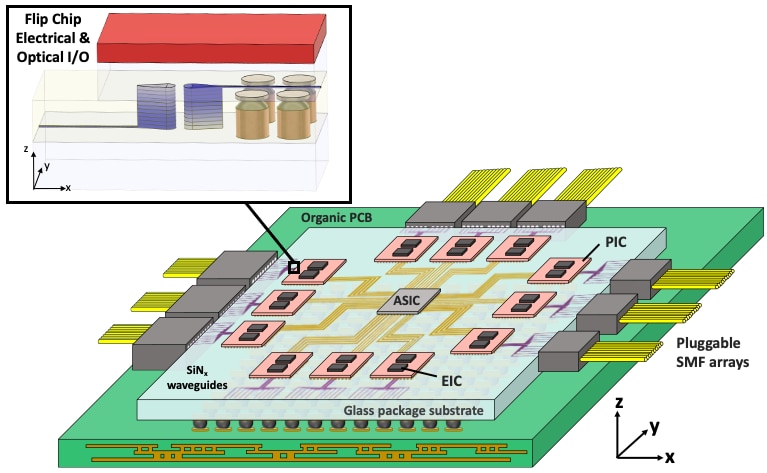
This is part of MIT’s FUTUR-IC research program, which aims to achieve more efficient electronic and photonic component integration.  By combining photonic devices with electronic circuits, systems like AI accelerators and high-performance computing can move large amounts of data while consuming less power than before.

In this program, the team doesn’t redesign processors. Instead, they improved the way individual chips communicate inside advanced computing packages. They came up with optical coupling techniques, the evanescent coupler and the graded index coupler, that move light between photonic chips without losing many signals. It’s also compatible with current semiconductor manufacturing methods. The researchers say this could make production simpler compared to specialized fabrication.
image
MIT’s new photonic coupler that transfers light between chips and electrical interconnects. (Image Credit: Drew Weninger)

Integrating photonics with electronics will require solder bumps. “You’ll need both metal bumps and optical bumps, because there are devices on your photonics chip that will require both an electrical signal and an optical signal,” says Drew Weninger, PhD ’25, first author of the papers on both the evanescent and GRIN couplers.

Modern computing has a growing bottleneck, and this project aims to address it. Multiple chips run together on AI hardware for training and running complex tasks. However, communication between them may become limited as more processors are integrated into a system. This makes it less energy efficient and worsens performance. A faster optical connection can enable higher bandwidth, which may relieve that bottleneck.

Additionally, the researchers believe this technology could enable communication speeds to go from hundreds of terabits per second to higher than one petabit per second. This huge jump would benefit AI infrastructures that could process even larger workloads in the future.

Apart from performance improvements, the technology is designed for practical manufacturing. Since the photonic packing methods are compatible with semiconductor fabrication processes, companies could adopt them without revamping their production infrastructure. Doing so simplifies the shift from research to commercial products.

The technology is still a work in progress. So, it hasn’t reached the commercial stages yet. It shows how optical communication is becoming a more important area of research as AI pushes the limits of electronic interconnects.

https://www.youtube.com/watch?v=xcm3eIeBMws

Have a story tip? Message me here at element14.

  • Sign in to reply
element14 Community

element14 is the first online community specifically for engineers. Connect with your peers and get expert answers to your questions.

  • Members
  • Learn
  • Technologies
  • Challenges & Projects
  • Products
  • Store
  • About Us
  • Feedback & Support
  • FAQs
  • Terms of Use
  • Privacy Policy
  • Legal and Copyright Notices
  • Sitemap
  • Cookies

An Avnet Company © 2026 Premier Farnell Limited. All Rights Reserved.

Premier Farnell Ltd, registered in England and Wales (no 00876412), registered office: Farnell House, Forge Lane, Leeds LS12 2NE.

Follow element14

  • X
  • Facebook
  • linkedin
  • YouTube