element14 Community
element14 Community
    Register Log In
  • Site
  • Search
  • Log In Register
  • Community Hub
    Community Hub
    • What's New on element14
    • Feedback and Support
    • Benefits of Membership
    • Personal Blogs
    • Members Area
    • Achievement Levels
  • Learn
    Learn
    • Ask an Expert
    • eBooks
    • element14 presents
    • Learning Center
    • Tech Spotlight
    • STEM Academy
    • Webinars, Training and Events
    • Learning Groups
  • Technologies
    Technologies
    • 3D Printing
    • FPGA
    • Industrial Automation
    • Internet of Things
    • Power & Energy
    • Sensors
    • Technology Groups
  • Challenges & Projects
    Challenges & Projects
    • Design Challenges
    • element14 presents Projects
    • Project14
    • Arduino Projects
    • Raspberry Pi Projects
    • Project Groups
  • Products
    Products
    • Arduino
    • Avnet & Tria Boards Community
    • Dev Tools
    • Manufacturers
    • Multicomp Pro
    • Product Groups
    • Raspberry Pi
    • RoadTests & Reviews
  • About Us
  • Store
    Store
    • Visit Your Store
    • Choose another store...
      • Europe
      •  Austria (German)
      •  Belgium (Dutch, French)
      •  Bulgaria (Bulgarian)
      •  Czech Republic (Czech)
      •  Denmark (Danish)
      •  Estonia (Estonian)
      •  Finland (Finnish)
      •  France (French)
      •  Germany (German)
      •  Hungary (Hungarian)
      •  Ireland
      •  Israel
      •  Italy (Italian)
      •  Latvia (Latvian)
      •  
      •  Lithuania (Lithuanian)
      •  Netherlands (Dutch)
      •  Norway (Norwegian)
      •  Poland (Polish)
      •  Portugal (Portuguese)
      •  Romania (Romanian)
      •  Russia (Russian)
      •  Slovakia (Slovak)
      •  Slovenia (Slovenian)
      •  Spain (Spanish)
      •  Sweden (Swedish)
      •  Switzerland(German, French)
      •  Turkey (Turkish)
      •  United Kingdom
      • Asia Pacific
      •  Australia
      •  China
      •  Hong Kong
      •  India
      •  Korea (Korean)
      •  Malaysia
      •  New Zealand
      •  Philippines
      •  Singapore
      •  Taiwan
      •  Thailand (Thai)
      • Americas
      •  Brazil (Portuguese)
      •  Canada
      •  Mexico (Spanish)
      •  United States
      Can't find the country/region you're looking for? Visit our export site or find a local distributor.
  • Translate
  • Profile
  • Settings
Embedded and Microcontrollers
  • Technologies
  • More
Embedded and Microcontrollers
Blog Renesas RX23E-B microcontroller: a look at the analogue front end
  • Blog
  • Forum
  • Documents
  • Quiz
  • Polls
  • Files
  • Members
  • Mentions
  • Sub-Groups
  • Tags
  • More
  • Cancel
  • New
Join Embedded and Microcontrollers to participate - click to join for free!
  • Share
  • More
  • Cancel
Group Actions
  • Group RSS
  • More
  • Cancel
Engagement
  • Author Author: Jan Cumps
  • Date Created: 1 Nov 2024 10:32 PM Date Created
  • Views 880 views
  • Likes 9 likes
  • Comments 4 comments
  • rx23E-B
  • renesas
Related
Recommended

Renesas RX23E-B microcontroller: a look at the analogue front end

Jan Cumps
Jan Cumps
1 Nov 2024

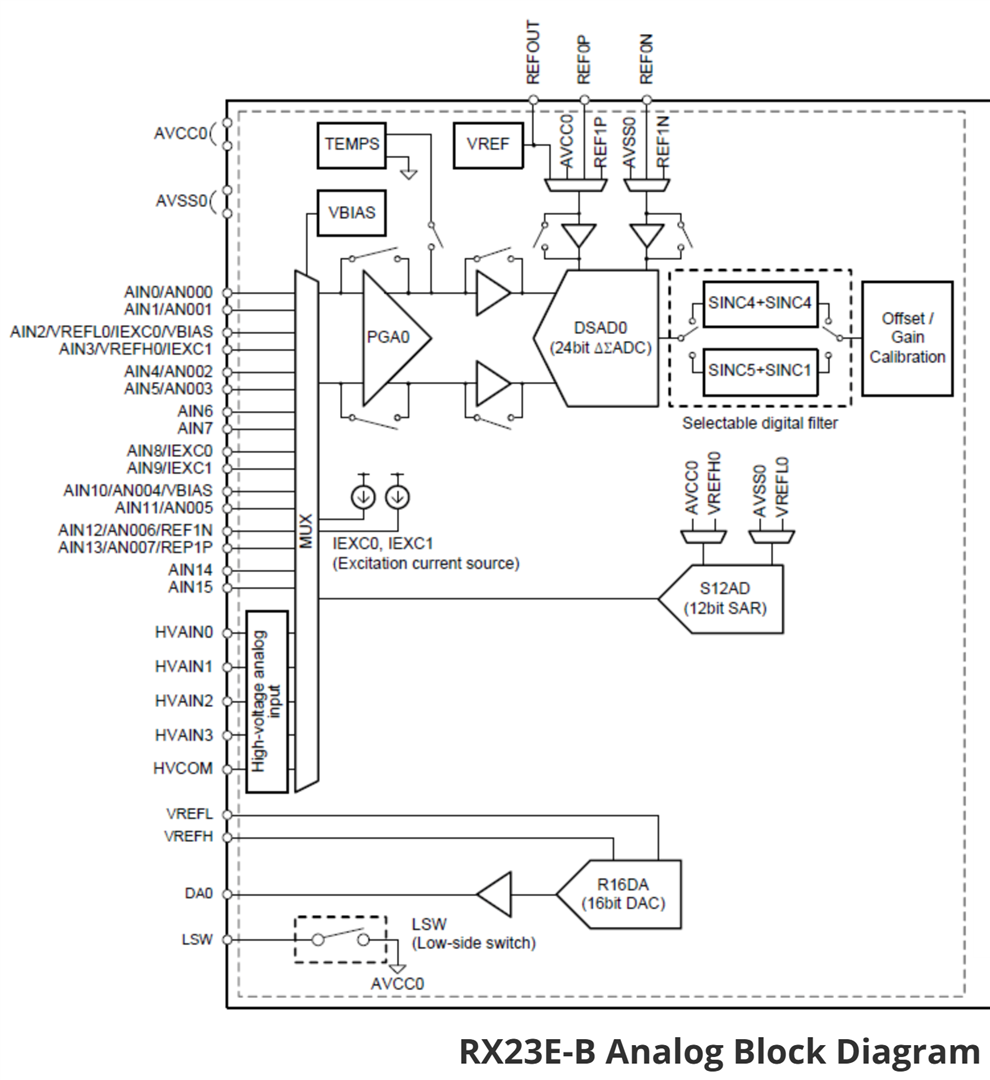
The Renesas RX23E-B is the second RX family member that's made for precision analogue designs. The digital part is a fairly small microcontroller. Renesas' own RX core. The analogue part is why you 'd select this device. It has most of the things used to make sensitive sensor measurements:

  • 24 bit delta-sigma ADC, with a
  • programmable gain amplifier (x1 - x128)
  • 5 V (and on some devices 10 V) analogue inputs

and a set of modules to assist with measuring signals:

  • a multiplexer that can switch 6 differential signals or 16 single ones
  • voltage reference
  • BIAS voltage generator
  • current sources for excitation
  • 16-bit DAC, with buffer
  • an additional, faster, 12-bit 8 channel ADC 
  • a low side switch, 10 Ohm on-resistance, max 30 mA.
  • temperature sensor, and
  • (absence of) voltage detectors

image
image source: product page

These blocks are register-controlled. Parts can be bypassed or switched off if not needed. For sensitive measurements, e.g.: like load cells (and other bridge type setups), thermocouples, the IC can provide the signals to bias / excite the circuit. The reference signals can be routed to the ADCs.

I'm working on a PCB for the controller. My goal is to get all of the analogue related functionality broken out. And create a development kit.
My original goals were simpler: I wanted to use the smallest of packages, and create a decent load cell design. But no vendor has the low-pin-count packages in stock (at the time of writing). The only one on stock is the biggest of the family.100 pins, full option. My board will exploit most of that version's capabilities. Whatever I manage to fit in.
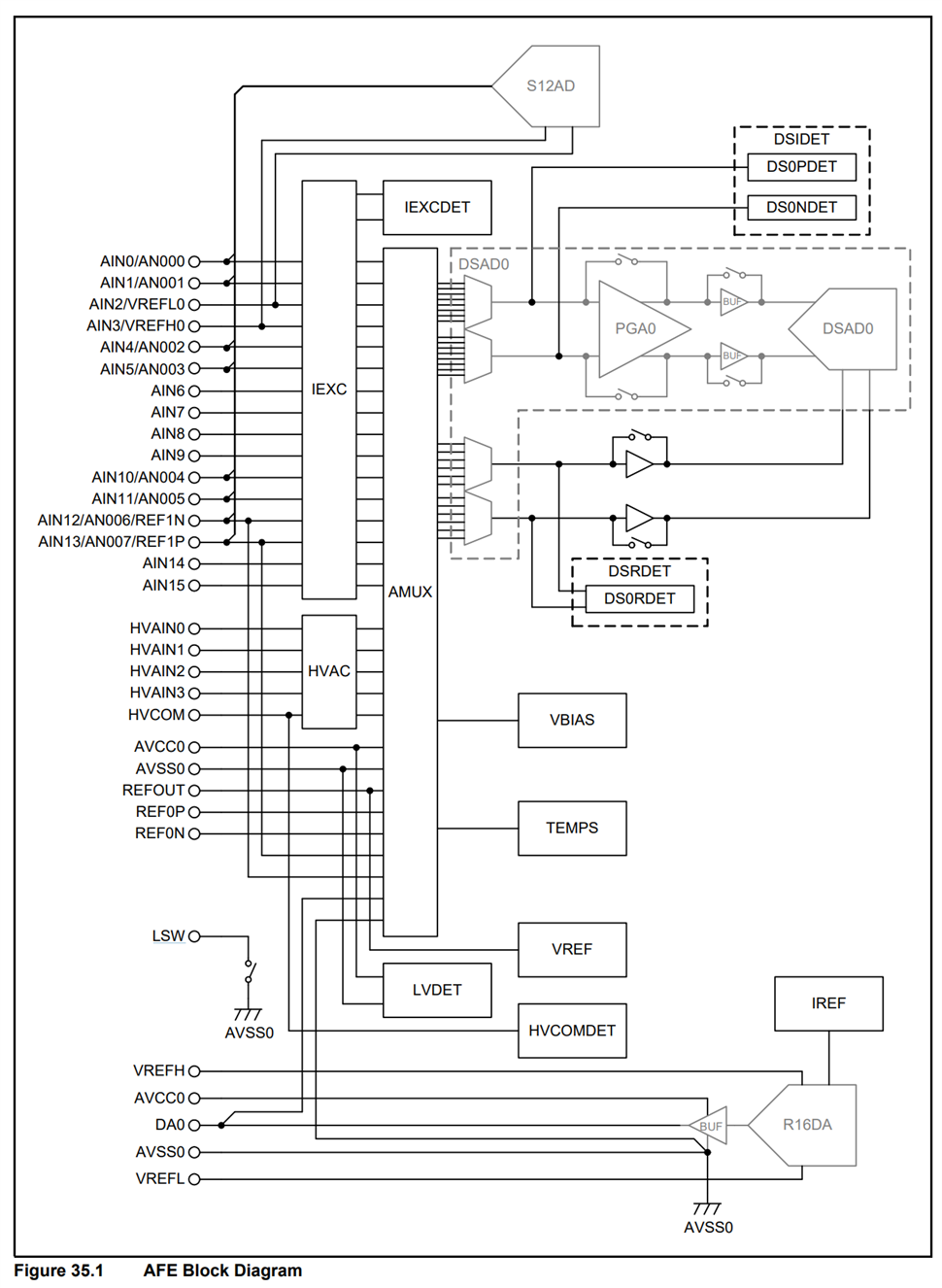
image
image: user manual

  • Sign in to reply
  • Jan Cumps
    Jan Cumps over 1 year ago in reply to Jan Cumps

    I have a board with an RX23E-A - a controller from the same family with different front-end options. My kit has that thermocouple circuit on the PCB. For no particular reason Slight smile I tested the excitation current that the microcontroller generates. 

    500 µA

    image

    250 µA:

    image

    • Cancel
    • Vote Up 0 Vote Down
    • Sign in to reply
    • More
    • Cancel
  • Jan Cumps
    Jan Cumps over 1 year ago in reply to genebren

     genebren wrote:

    "I could see where this might be very helpful interfacing to thermocouples."

    There's an example design for that: 

    image

    source: starter kit manual

    redrawn:

    image

    The RTD compensation circuit generates its own reference voltage for the ADC. Drift in the constant current source (provided by the analogue front end) is compensated that way, because both the RTD and ref see the same drift.

    The 309R resistor lifts the measurements off ground, to the ADC range that has better linearity than at 0V.

    The thermocouple itself is tied to a fixed voltage, by applying a BIAS voltage. It prevents that the PGA's bias current impacts the measurement.

    Thermocouple connector (the reference junction) sits right next to  the RTD.

    • Cancel
    • Vote Up 0 Vote Down
    • Sign in to reply
    • More
    • Cancel
  • genebren
    genebren over 1 year ago

    I could see where this might be very helpful interfacing to thermocouples.  I once designed in an external PGA part to handle thermocouples with an internal ADC. Funny thing happened in the development.  Apparently, the parts shipped to me were mislabeled (not actually PGAs) and I spent some much time trying to get them to work.  After a while (much too long later) I verified the part labeling, only to find that they sent the wrong part.  

    • Cancel
    • Vote Up 0 Vote Down
    • Sign in to reply
    • More
    • Cancel
  • DAB
    DAB over 1 year ago

    Nice post Jan.

    I look forward to seeing how well this device performs.

    • Cancel
    • Vote Up 0 Vote Down
    • Sign in to reply
    • More
    • Cancel
element14 Community

element14 is the first online community specifically for engineers. Connect with your peers and get expert answers to your questions.

  • Members
  • Learn
  • Technologies
  • Challenges & Projects
  • Products
  • Store
  • About Us
  • Feedback & Support
  • FAQs
  • Terms of Use
  • Privacy Policy
  • Legal and Copyright Notices
  • Sitemap
  • Cookies

An Avnet Company © 2025 Premier Farnell Limited. All Rights Reserved.

Premier Farnell Ltd, registered in England and Wales (no 00876412), registered office: Farnell House, Forge Lane, Leeds LS12 2NE.

ICP 备案号 10220084.

Follow element14

  • X
  • Facebook
  • linkedin
  • YouTube