


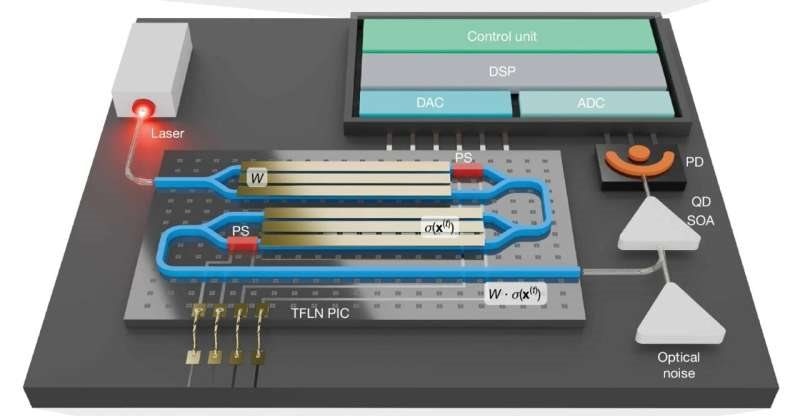
Illustration of the team’s light-based computer. (Image Credit: Nature (2025). DOI: 10.1038/s41586-025-09838-7)
Researchers at Queen’s University have developed a light-based computer capable of performing a wide range of complex tasks, including number partitioning and protein folding. This machine combines cascaded thin-film lithium niobate (TFLN) modulators, a semiconductor optical amplifier (SOA), and a digital signal processing (DSP) engine in a recurrent time-encoded loop, enabling over 200 giga operations per second for spin interactivity and linear processing. Operating at room temperature, the computer performs billions of operations per second, remaining stabilized through the entire process.
More impressively, the system doesn’t require as much power compared to advanced computers. The team ran tests, discovering it remains stable while running for hours---ideal for solving problems requiring repetitive steps. This means it can handle problems with thousands of variables.
The team uses an Ising-based processor that solves complex optimization problems. To do this, it encodes variables as binary spins and looks for the lowest-energy configuration, which corresponds to the optimal solution. Rather than magnets, the system uses light pulses to represent each spin. A pulse passes through a loop before interacting with others and slowly settling into a configuration representing a solution. This works similarly to a group reaching an agreement after many rapid exchanges.
Additionally, the light-based system features five basic components to achieve 256 spins. It performs better than other commercial systems with billions of dollars in funding. Due to its high stability, the machine can tackle more complicated problems compared to other optical Ising machines, where spins decay within milliseconds.
Initially, developing systems like this required special materials or very cold temperatures, and they ran for a short time. Operating at standard temperatures allows the system to consume less power, making the technology more practical and scalable.
The team is currently upgrading this system. Future steps involve upscaling, system integration, adding more spins, and improving energy and cost efficiency. They also plan to form pilot projects with industrial partners to deploy the technology in real-world applications.
Have a story tip? Message me here at element14.