


(Image credit: PXHere)
Development boards continue to evolve as designers push for more computing power, lower power consumption, better connectivity, and integrated AI acceleration. The boards released over the last year reflect those notions, with manufacturers rolling out platforms that target edge AI, embedded automation, rapid prototyping, and low-power IoT. The following entries highlight 10 boards that stood out in 2025 for their performance and flexibility, underscoring why engineers are adopting them for new projects.
Nvidia Jetson Orin Nano Super Developer Kit
(Image credit: Nvidia)
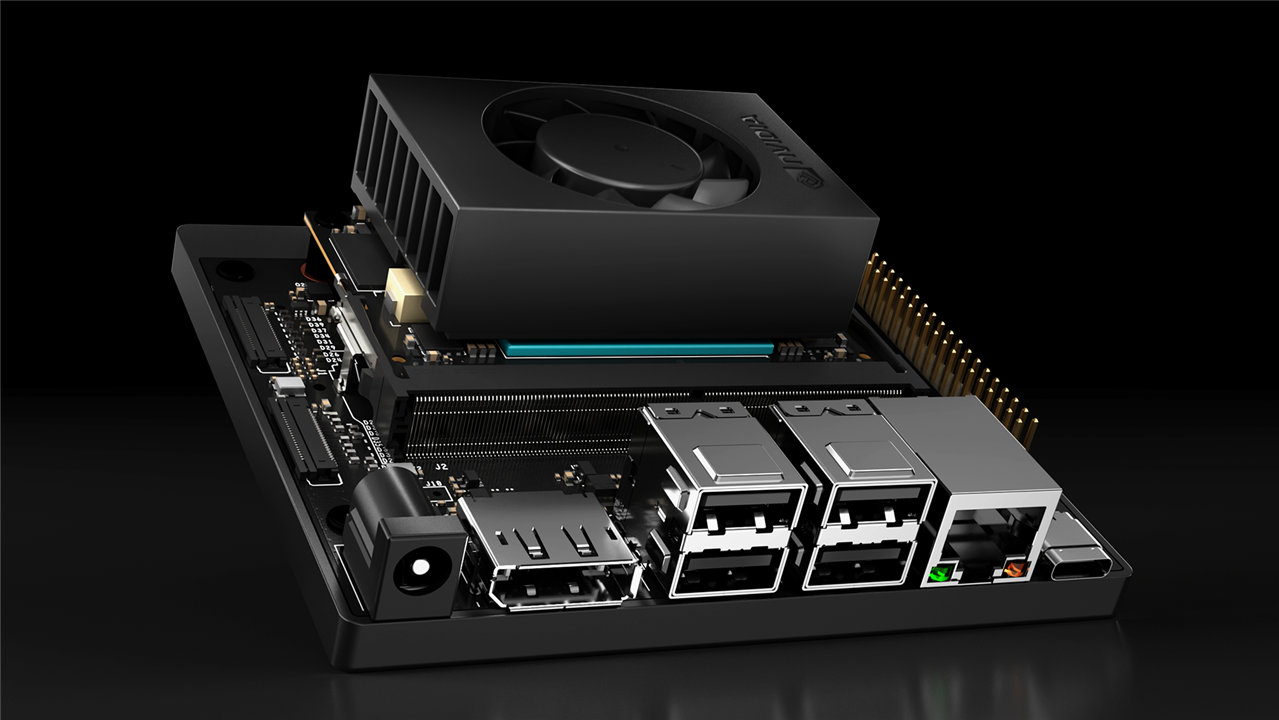
Nvidia’s Jetson Orin Nano Super Kit is a popular platform released this year that offers expanded neural processing, higher GPU throughput, and improved thermal headroom compared to previous Orin Nano editions. Designed for robotics, edge-AI, and embedded vision, the Super kit targets developers building autonomous systems, sensor applications, and small-form-factor AI devices.
The Jetson Orin Super comes equipped with a Jetson Orin Nano 8GB Module, a 6-core Arm Cortex-A78AE processor, an Ampere architecture GPU with 1024 CUDA cores and 32 tensor cores, 8GB of LPDDR5 RAM, and a myriad of ports, expansion slots, a GPIO header, and networking options.
Arduino UNO R4 Minima
(Image credit: Arduino)
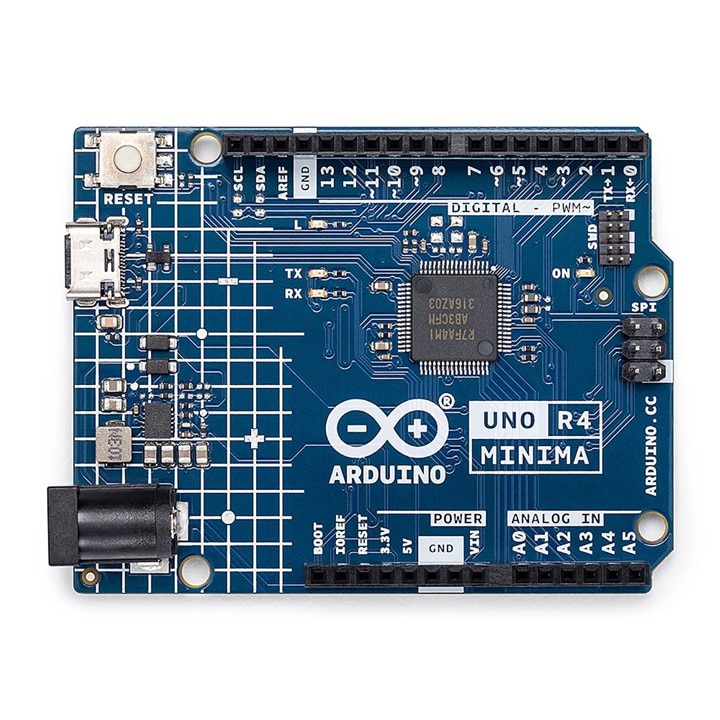
Arduino’s UNO R4 Minima is designed for both beginners and hardware enthusiasts alike and comes equipped with a Renesas RA4M1 microcontroller outfitted with an Arm Cortex-M4 processor. The board still retains the familiar Uno form factor, allowing it to use Arduino’s Shields and add-on boards.
Unlike the previous versions in the Uno family, the R4 Minima comes equipped with a range of onboard peripherals, including a 12-bit DAC, CAN BUS, and OP AMP. It also supports a wider input voltage range up to 24 V, an SWD connector for debugging, and built-in HID (Human Interface Device) support.
MaaXBoard AES-MC-SBC-IMX8M-G
(Image credit: Avnet)
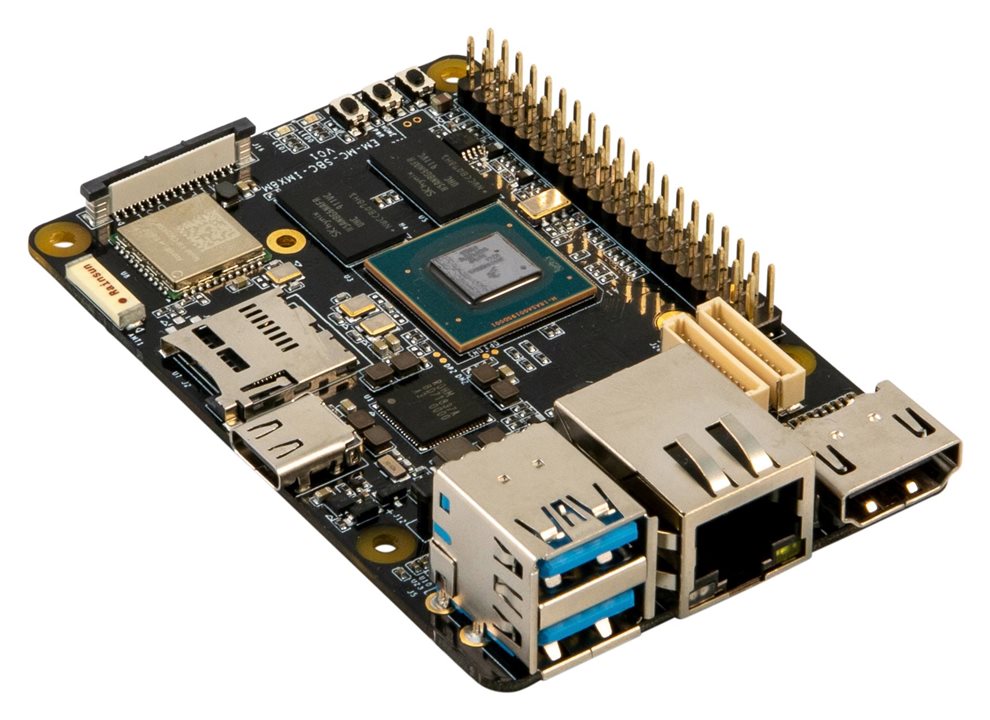
The MaaXBoard AES-MC-SBC-IMX8M-G is aimed at developers who require low-power edge-compute designs with modern 64-bit processing, secure boot, and expandable memory. It’s built around NXP’s i.MX 8M processor, providing designers with a scalable ARM-based compute package for embedded control interfaces, small industrial systems, or portable instrumentation. The module format also enables integration into carrier boards for application-specific layouts.
The board features a quad-core Arm Cortex-A53 and a single Cortex-M4, 2GB of DDR4 SDRAM, and a MicroSD Slot or 8GB of eMMC. It also features Gigabit Ethernet, dual USB 3.0 ports, MIPI-DSI, MIPI-CSI and an HDMI port. Additional features include Wi-Fi 802.11 b/g/n/ac, Bluetooth 4.2 (Bluetooth Low Energy), an onboard ceramic antenna (Default), a traditional 40-pin header and more.
MaaXBoard AES-MC-SBC-IMXRT1176-G
(Image credit: Newark)
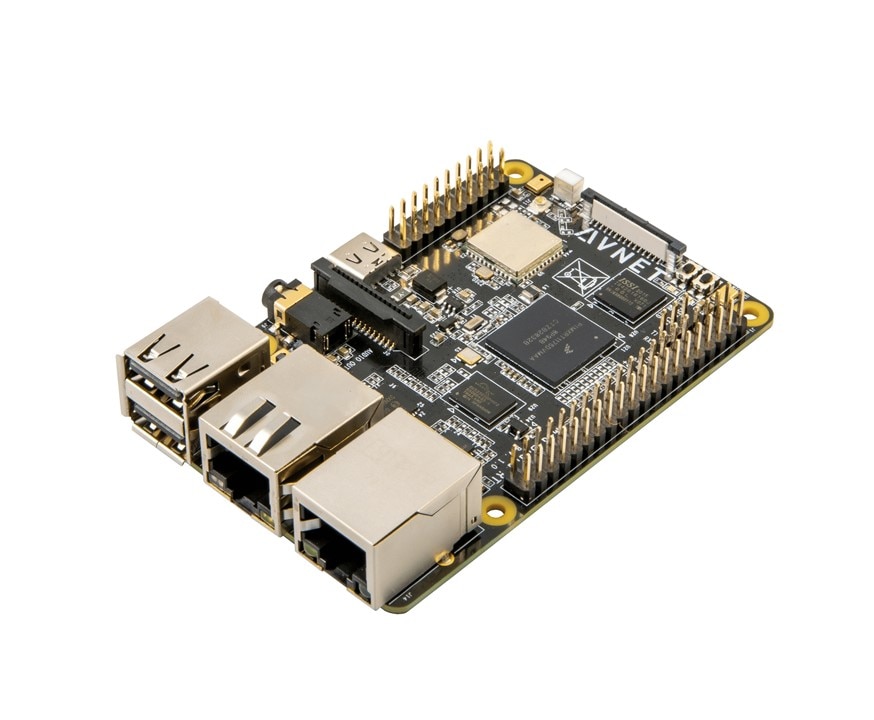
The MaaXBoard RT1176 is ideal for embedded control and edge-processing applications that require deterministic real-time capabilities and modern connectivity options. It’s built around NXP’s dual-core i. MX RT1176 MCU and features an Arm Cortex-M7 and Arm Cortex-M4F processors, 2MB On-Chip SRAM, 32MB of SDRAM and 32MB of HyperFlash.
The board also comes equipped with a pair of USB 2.0 ports, MIPI DSI, an RJ45 port, an NXP SGTL5000 audio port, MIPI-CSI, a 40-pin Pi-compatible GPIO header, a 10-pin JTAG/SWD debugger header, and more.
LattePanda Sigma
(Image credit: LattePanda)
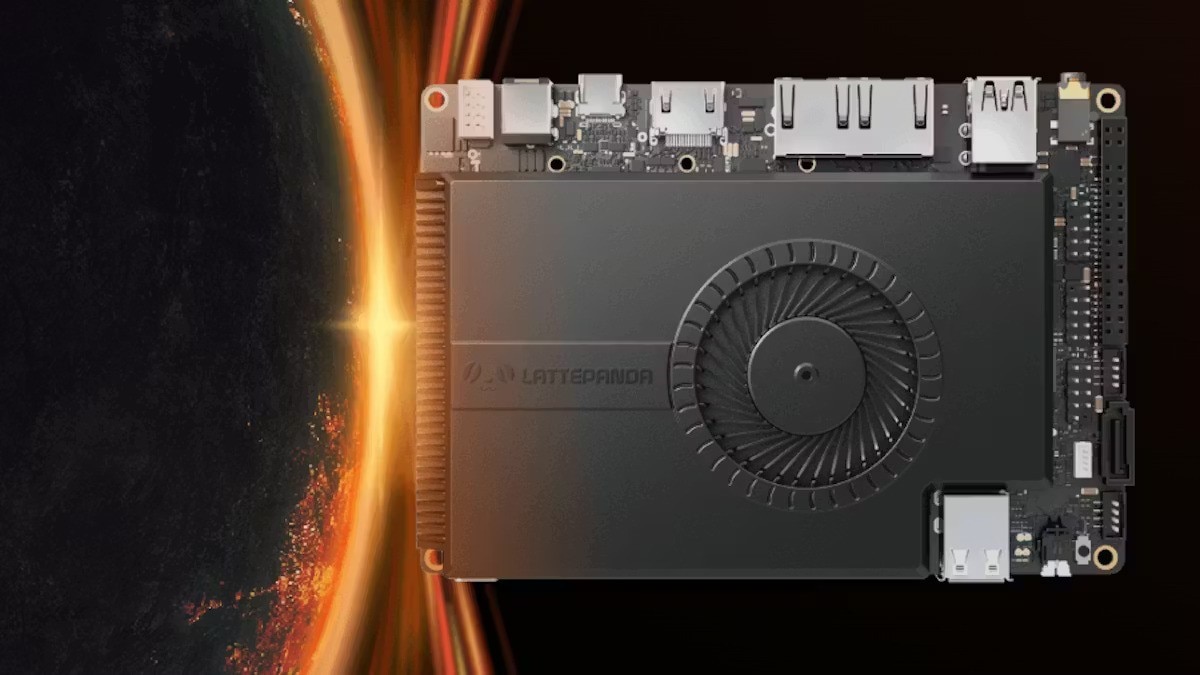
LattePanda’s Sigma is a single-board server (SBS) that’s outfitted with an Intel Core i5-1340P Raptor Lake-P processor and a Microchip ATmega32U4 microcontroller to drive I/O via Arduino programming. The board comes equipped with up to 32GB of LPDDR5 RAM, M.2 NVMe/SATA SSD sockets and SATA ports for additional storage. The Sigma also boasts HDMI 2.1, eDP, and USB-C DisplayPort video outputs, dual 2.5GbE networking, 2x Thunderbolt 4 ports, and 3x M.2 sockets for expansion, including Wi-Fi and 4G/5G modules.
Renesas RZ/V2L SBC
(Image credit: Newark)
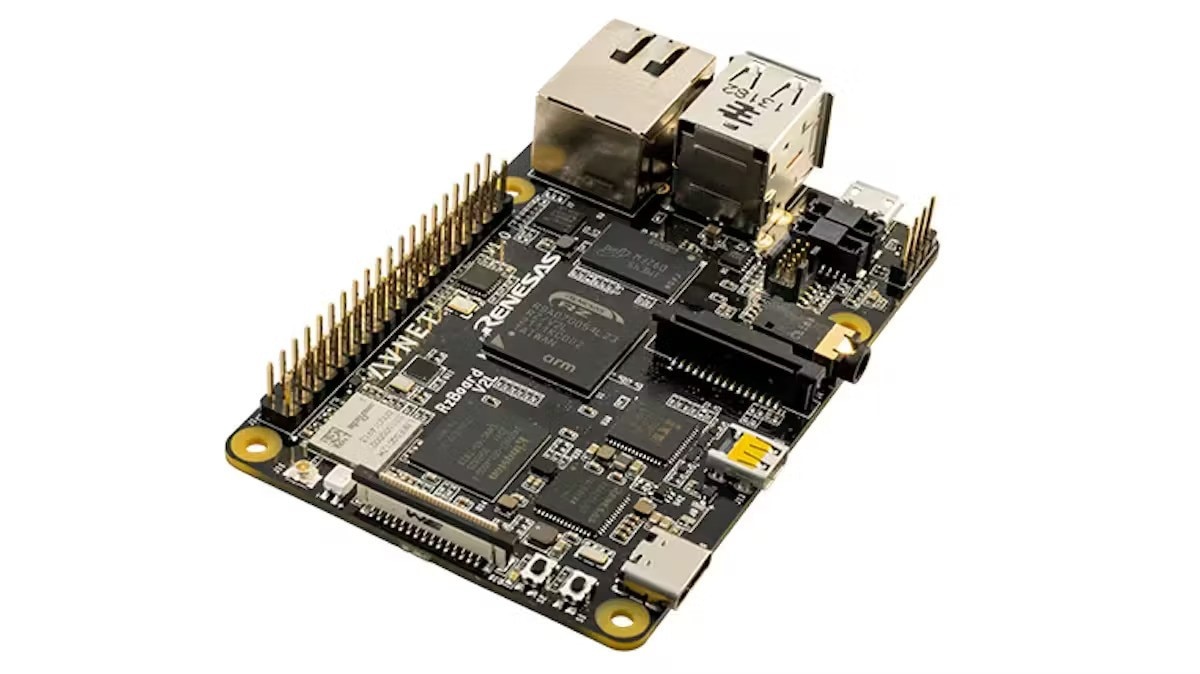
Renesas’ RZ/V2L SBC is designed for embedded systems and machine-vision applications, including inference for classification, inspection, motion assistance, and inline detection for industrial platforms. The board integrates an RZ/V2L SoC that features a pair of Arm Cortex-A55 cores, a single Arm Cortex-M33 core, a MALI-3D GPU, 2GB of DDR4 RAM, and 32GB of eMMC.
The RZ/V2L is also equipped with a microSD slot, a pair of USB 2.0 ports, Ethernet, Wi-Fi (802.11ac), Bluetooth 5, and CAN FD. It also features MIPI DSI and HDMI display interfaces, a MIPI CSI camera interface and a Pi-compatible 40-pin GPIO header.
reComputer J2021-Edge AI device with Jetson Xavier NX
(Image credit: Newark)
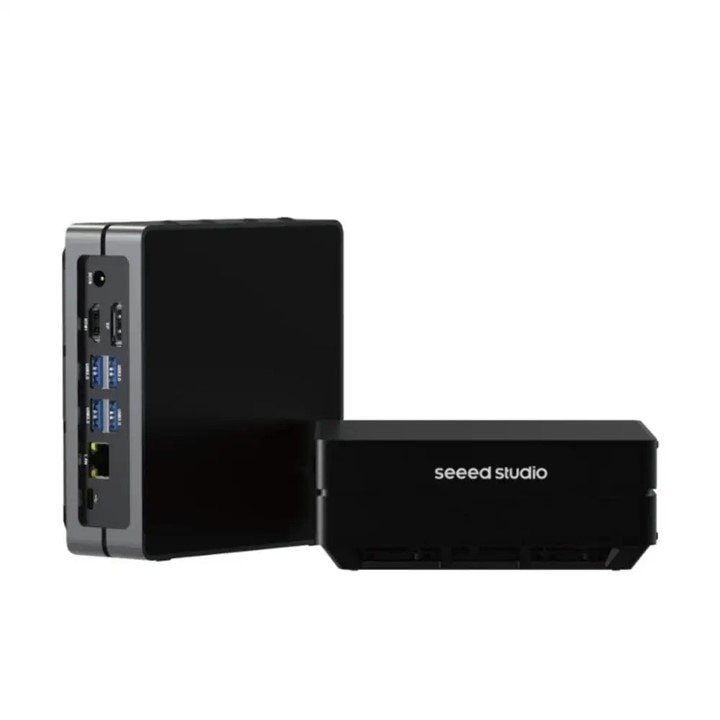
The Jetson Xavier NX Developer Kit is designed for heavier edge inference applications, including robotics, vision inspection, and multi-sensor fusion. The kit features a reComputer J2021 outfitted with a Jetson Xavier NX SoM, equipped with a 6-core NVIDIA Carmel Arm v8.2 64-bit CPU, 8GB of 128-bit LPDDR4x RAM, 16GB of eMMC 5.1, and a 384-core NVIDIA Volta GPU with 48 Tensor Cores.
The kit also features an RJ45 Gigabit Ethernet connector, an M.2 Key E, 4x USB 3.1 Type A ports and a single USB Type-C port. Additional features include an HDMI port, a pair of CSI camera connectors, a 40-pin header and more.
UNIHIKER M10 with Touchscreen

(Image credit: UNIHIKER)
The UNIHIKER M10 SBC combines a compact single-board computer with an integrated touchscreen and built-in sensors, and is designed for interactive IoT applications, educational projects, and rapid prototyping. The board comes outfitted with a quad-core ARM Cortex-A35 GD32VF103 processor, 512MB of RAM, and 16GB of flash.
The board also packs 2.4 GHz Wi-Fi, Bluetooth 4.0, USB Type-C and USB-A, along with a 2.8-inch touchscreen with integrated accelerometer, gyroscope, light sensor and microphone. It offers onboard support for Python, VS Code, Thonny, or Jupyter Notebook, makes it ideal for both embedded engineers and makers.
FRDM-MCXN236 Development Board
(Image credit: Newark)
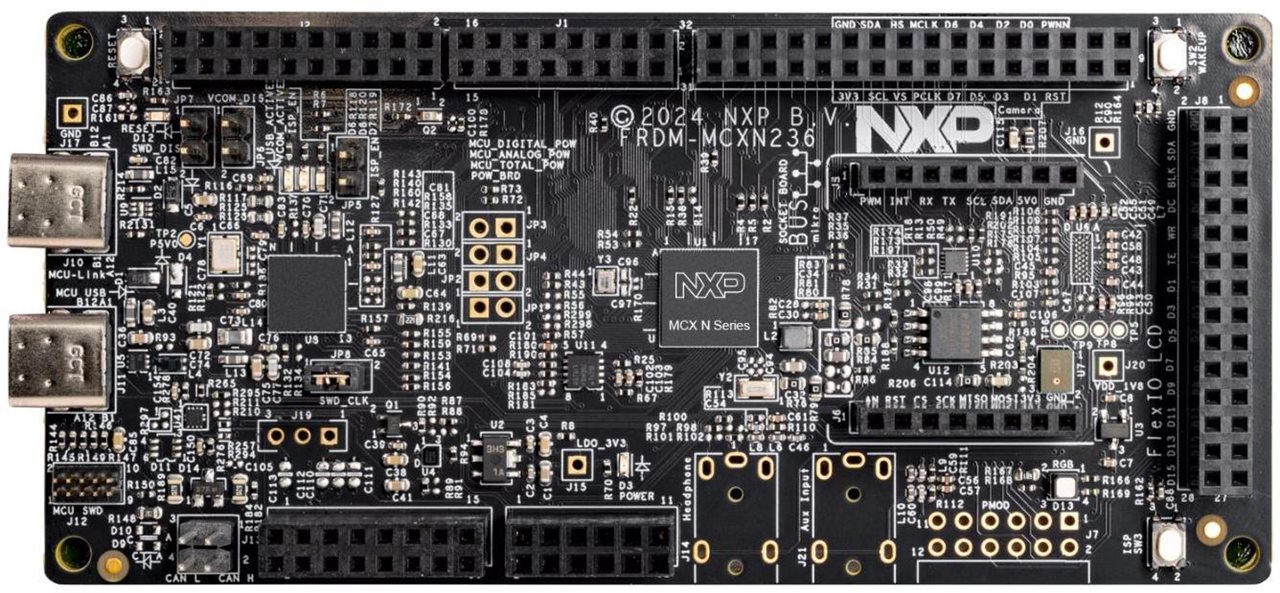
The FRDM-MCXN236 is a compact, scalable development board for rapid prototyping with Arm Cortex-M33 microcontrollers and is aimed at industrial control, IoT sensing, and edge applications. It provides standard I/O headers and onboard debugging, making it ideal for embedded firmware, sensor hubs, and actuator control systems.
The board features an NXP MCXN23x Cortex-M33 MCU with up to 1MB dual-bank flash, optional full ECC RAM, QSPI flash for extended storage, an onboard CMIS-DAP MCU-Link debugger, and SPI, I2C, UART, and Pmod/mikroBUS connectors. Additional features include an FXLS8974CFR3 3-axis accelerometer, a visible light sensor, a digital microphone, and headers compatible with Arduino boards, FlexIO, SmartDMA, and more.
BeagleBone Black Industrial

(Image credit: Newark)
The BeagleBone Black Industrial is designed for harsh environments, making it ideal for automation, control systems, and machinery integration applications. The board comes equipped with a TI Sitara AM3358 SoC with an ARM Cortex-A8 processor, 512MB of DDR3 RAM, 4GB of eMMC storage, and a microSD slot for storage expansion. The board also features an SGX 3D graphics engine, a NEON floating-point accelerator, USB, Ethernet, HDMI, and a pair of 46-pin headers.
Final thoughts
These development boards represent a wide range of architectures, performance levels, and AI acceleration capabilities, providing engineers with a myriad of options for 2025 projects. Whether the goal is low-power sensing, high-speed control, AI-accelerated vision, or modular prototyping, each board offers an innovative path toward building and testing embedded systems. As new hardware continues to reach the market, the trend toward higher performance at lower costs is pushing development platforms even further in the years to come.
Have a story tip? Message me here at element14.
Top Comments